Making Jupiters

August 21, 2009 Making Jupiters

Enlarge

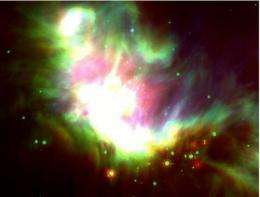
A three-color infrared image of the IC 348 Nebula. Some of the stars in this young cluster could have Jupiter-sized planets orbiting them. Credit: NASA/JPL-Caltech

IC348 is a glowing nebula of young stars, hot gas, and cold dust seen in the direction of the constellation of Perseus. It is the nearest rich cluster of young stars to earth, being only about one thousand light-years away. Its proximity has made it an important laboratory for astronomers probing the early stages of stellar evolution and star formation. At an estimated age of only two to three million years, it is also a somewhat young cluster; IC348 did not shine in the night sky of the first hominids. For comparison, our sun is about 4.5 billion years old.

Most stars less than about a million years old are still surrounded by the disks of material from which they formed. These primordial disks contain gas and dust that is also the raw material for planets. As the star ages, planets and smaller bodies form out of some of that material; the rest is soon expelled, or accreted onto the star. After about 3-7 million years, the initial disks are gone. But then a new kind of disk begins to develop as orbiting rocky bodies collide with each other to produce a dusty disk of debris that can be seen with infrared instruments.

This is the simple picture, anyway, that astronomers think is the most consistent with their observations to date. The problem is that sensitive new data from the , and other telescopes, suggest that primordial disks disappear faster, and debris disks appear sooner, around mid- or high mass stars than they do around stars like the sun or smaller. How and why this could occur is an important part of the story of how planets form in stellar systems.

The stars in IC348 have a range of masses and a median age perfect for probing the timing of disk evolution. SAO astronomers Thayne Currie and Scott Kenyon combined new Spitzer observations of IC348 with spectra taken using the 1.5m Tillinghast telescope at the Fred L. Whipple Observatory, and other archival datasets. They find clear evidence that the primordial disks around high and intermediate mass stars do disappear relatively quickly.

Their results imply that such stars have much less time to form giant gas planets -- those like Jupiter and Saturn -- than do their solar-mass counterparts. Since there is some evidence that Jupiter-like planets commonly exist around larger stars, there must be some very rapid (a few million years) and efficient ways of making them.

Astronomers have only recently begun to propose some ways that might happen. The new observations help lend some credibility to the emerging picture of giant gas around massive .

Source: Smithsonian Astrophysical Observatory


print this article email this article download pdf blog this article bookmark this article     Stumble it Digg this share on Facebook retweet share on Reddit add to delicious
Rate this story - 4.7 /5 (3 votes)

Rank Filter

Move the slider to adjust rank threshold, so that you can hide some of the comments.


Display comments: newest first

  • Adam - Aug 21, 2009
    • Rank: 5 / 5 (1)
    Any jupiters made around such young stars should be visible by their heat of formation. Might be perfect for actually spotting one with the right telescopes.
  • omatumr - Aug 22, 2009
    • Rank: 1 / 5 (2)
    TO MAKE JUPITER

    Measurements from the Galileo probe that entered Jupiter in 1995 indicate that this process made Jupiter:

    Lightweight elements like H, He, C and N from the outer layer of a supernova -- mixed with a late spike of actinide elements (Th, U, Pu) and heavy isotopes of other elements (e.g., Xe-136) from the r-process -- formed Jupiter.

    http://tinyurl.com/359q3u

    Isotope and element abundances in Jupiter are unlike those at the surface of the Sun [See: Adam Nolte and Cara Lietz (2000) "Abundances of hydrogen and helium isotopes in Jupiter", in The Origins of the Elements in the Solar System: Implications of Post 1957 Observations (O. K. Manuel, Editor) Kluwer Academic/Plenum Publishers, New York, NY, 589-643].

    Excess heat coming from Jupiter is probably generated by the late spike of actinide elements that were by rapid neutron capture, made together with excess Xe-136, in the supernova that gave birth to the solar system 5x10^9 year (Gyr) ago.

    http://tinyurl.com/2zxx4q

    See: "The origin, composition, and energy source for the Sun" [Abstract #1041, 32nd Lunar & Planetary Science Conference, Houston, TX, 12-16 March 2001] for a very brief (2-page) summary of the origin of Jupiter and the solar system.

    http://arxiv.org/...411255v1

    With kind regards,
    Oliver K. Manuel
    http://www.omatumr.com
  • yaridanjo - Aug 23, 2009
    • Rank: 1 / 5 (1)
    Sol's planets are formed with the aid our our Sun's brown dwarf companion. They are first seeded with primordial black holes. The following shows how planets about other stars can be modeled. Three examples with data verifying some of the larger planets are offered.


    http://www.yarida...sel.com/
    ASTRO-METRICS
    Of Undiscovered Planets And Intelligent Life Forms

    See also
    http://barry.warmkessel.com/

August 21, 2009 all stories

Comments: 3

4.7 /5 (3 votes)
  • Stumble this up

  • Digg this

  • share this

  • hide
  • Related Stories

  • Baby Jupiters must gain weight fast
    created Jan 05, 2009 | popularity not rated yet | comments 0
  • Planets Living on the Edge
    created Dec 17, 2008 | popularity not rated yet | comments 0
  • Probing the nurseries of miniature planetary systems
    created Nov 21, 2007 | popularity not rated yet | comments 0
  • Hubble Photographs One of the Smallest Stellar Companions Ever Seen
    created Sep 07, 2006 | popularity not rated yet | comments 0
  • Rapid-born planets present 'baby picture' of our early solar system
    created Sep 09, 2005 | popularity not rated yet | comments 0


  • hide
  • Relevant PhysicsForums posts

  • Question about 2-body gravity
    created 6 hours ago
  • life on Mars
    created 9 hours ago
  • Semi-major axis from cartesian co-ordinates
    created 22 hours ago
  • Primary Mirror grinding
    created Nov 23, 2009
  • More from Physics Forums - General Astronomy

Other News

Global study of salmon shows: 'Sustainable' food isn't so sustainable

Space & Earth / Environment

created 1hour ago | popularity not rated yet | comments 0

Popular thinking about how to improve food systems for the better often misses the point, according to the results of a three-year global study of salmon production systems. Rather than pushing for organic or land-based ...


Icebergs head from Antarctica for New Zealand (AP)

Icebergs head from Antarctica for New Zealand

Space & Earth / Earth Sciences

created 57 minutes ago | popularity not rated yet | comments 0

(AP) -- Ships in the south Pacific Ocean have been alerted that hundreds of icebergs believed to have split off Antarctic ice shelves are drifting north toward New Zealand, officials said Tuesday.


Does carbon labelling give developing countries a bad deal?

Space & Earth / Environment

created 37 minutes ago | popularity not rated yet | comments 0

Carbon labelling could unfairly disadvantage economies in the developing world, and mislead consumers, according to an interdisciplinary project carried out by the UK Research Councils' Rural Economy and Land Use Programme. ...


First black holes may have incubated in giant, starlike cocoons, says CU-Boulder study

First black holes may have incubated in giant, starlike cocoons

Space & Earth / Astronomy

created 2 hours ago | popularity 5 / 5 (5) | comments 6

(PhysOrg.com) -- The first large black holes in the universe likely formed and grew deep inside gigantic, starlike cocoons that smothered their powerful x-ray radiation and prevented surrounding gases from ...


The drying shores of the Dead Sea

Dead Sea needs world help to stay alive

Space & Earth / Environment

created 1hour ago | popularity 5 / 5 (1) | comments 0

The Dead Sea may soon shrink to a lifeless pond as Middle East political strife blocks vital measures needed to halt the decay of the world's lowest and saltiest body of water, experts say.