NASA watches as Hurricane Bill sweeps over Bermuda
August 21, 2009 NASA watches as Hurricane Bill sweeps over Bermuda

Enlarge

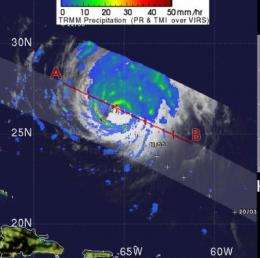
TRMM captured Hurricane Bill's heavy rainfall on August 21 at 5:22 a.m. EDT. The yellow, green and red areas indicate rainfall between .78 to 1.57 inches per hour. The red and purple areas around Bill's eye are considered moderate to heavy rainfall. Credit: NASA/SSAI, Hal Pierce

Hurricane Bill was raining on Bermuda on Friday, August 21, 2009, and NASA satellites were providing forecasters with information about Bill's rainfall, clouds and winds.

NASA and the Japanese Space Agency's Measuring Mission (TRMM) satellite flew over the center of Hurricane Bill on August 21, 2009 at 0225 UTC (August 17 at 10:25 p.m. EDT) capturing rainfall data.

TRMM rainfall images are false-colored with yellow, green and red areas, which indicate rainfall between 20 and 40 millimeters (.78 to 1.57 inches) per hour. TRMM captured Hurricane Bill's heavy rainfall on August 21 at 5:22 a.m. EDT. The yellow, green and red areas indicate rainfall between .78 to 1.57 inches per hour. The red and purple areas around Bill's eye are considered moderate to heavy rainfall.

According to the National Hurricane Center, Bill is expected to produce total rain accumulations of 1 to 3 Inches over Bermuda, with maximum amounts of 5 inches. Both a hurricane and watch are in effect for Bermuda as the rain continues.

For live radar of Bermuda, from the Bermuda Weather Service, visit: http://www.weather.bm/radarLarge.asp

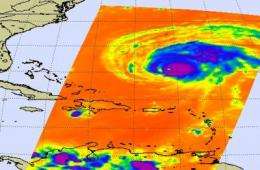
The Aqua satellite also flew over Hurricane Bill early today, Friday, August 21, and provided valuable data on his cloud top temperatures. They're important because they tell forecasters how high thunderstorms are, and the higher the thunderstorm, the more powerful it is, and Bill is pretty powerful as a Category Three Hurricane on the Saffir-Simpson Scale.
NASA watches as Hurricane Bill sweeps over Bermuda
Enlarge

This NASA AIRS infrared satellite image shows Bill's clouds (depicted in purple and blue) on August 21 at 2:11 a.m. EDT indicating high, cold powerful thunderstorms. Credit: NASA JPL, Ed Olsen

In , NASA's false-colored purple clouds are as cold as or colder than 220 Kelvin or minus 63 degrees Fahrenheit (F). The blue colored clouds are about 240 Kelvin, or minus 27F. The colder the clouds are, the higher they are, and the more powerful the thunderstorms are that make up the cyclone.

Although Bill has weakened slightly over the last 24 hours, forecasters say it could regain a little strength before winds and cooler waters start battering it and weakening it. Bill is forecast to parallel the eastern U.S. coast and affect Nova Scotia, Canada, on its curved track into the North Atlantic Ocean this weekend. As Bill approaches the Canadian Maritimes it will undergo a transition into an extra-tropical storm.

At 11 a.m. EDT, Hurricane Bill had maximum sustained winds near 115 mph. He was moving northwest near 18 mph and is expected to turn to the north-northwest later today. His center is currently near latitude 27.6 north and longitude 66.3 west or about 335 miles south-southwest of Bermuda and about 755 miles southeast of Cape Hatteras, North Carolina. Minimum central pressure is 958 millibars.

Meanwhile a warning is in effect now about large, and dangerous ocean swells for a huge area in the eastern Atlantic. Large swells associated with Bill will be impacting the coasts of Puerto Rico; Hispaniola; the Bahamas; Bermuda the entire eastern United States; and the Canadian Maritimes. The National Center warns "These swells will likely cause extremely dangerous surf and life-threatening rip currents. Please consult output from your local weather office for details."

Source: NASA/Goddard Space Flight Center


print this article email this article download pdf blog this article bookmark this article     Stumble it Digg this share on Facebook retweet share on Reddit add to delicious
Rate this story - not rated yet


August 21, 2009 all stories

Comments: 0

not rated yet
  • Stumble this up

  • Digg this

  • share this

  • hide
  • Related Stories


  • hide
  • Relevant PhysicsForums posts

  • AIRS and Atmospheric Carbon Dioxide
    created Dec 16, 2009
  • Opacity of the Earth's atmosphere
    created Dec 13, 2009
  • Effect of ranching on the environment
    created Dec 12, 2009
  • Earth's response to CO2 underestimated
    created Dec 10, 2009
  • Question about Thermohaline Circulation
    created Dec 10, 2009
  • Weather - not climate - extremes
    created Dec 10, 2009
  • More from Physics Forums - Earth

Other News

A star is born? Herschel space observatory captures the birth of stars

A star is born? Herschel space observatory captures the birth of stars

Space & Earth / Astronomy

created 7 hours ago | popularity 4.5 / 5 (4) | comments 1

(PhysOrg.com) -- The European Space Agency has released a preview of the first science results from the Herschel Space Observatory, including the UK-led SPIRE instrument. The new data which include images ...


Right-Front Wheel Rotations

Spirit Rover: Right-Front Wheel Rotations

Space & Earth / Space Exploration

created 7 hours ago | popularity 4.5 / 5 (2) | comments 0

(PhysOrg.com) -- Spirit's right-front wheel, which had stopped operating in March 2006, revolved with apparently normal motion during the first three of four driving segments on Sol 2117 (Wednesday, Dec. 16) ...


Caltech scientists discover fog on Titan

Scientists discover fog on Titan

Space & Earth / Space Exploration

created 13 hours ago | popularity 4.7 / 5 (6) | comments 2

Saturn's largest moon, Titan, looks to be the only place in the solar system—aside from our home planet, Earth—with copious quantities of liquid (largely, liquid methane and ethane) sitting on its surface. ...


Acid oceans: the 'evil twin' of climate change (AP)

Acid oceans: the 'evil twin' of climate change

Space & Earth / Environment

created 14 hours ago | popularity 4.3 / 5 (10) | comments 7

(AP) -- Far from Copenhagen's turbulent climate talks, the sea lions, harbor seals and sea otters reposing along the shoreline and kelp forests of this protected marine area stand to gain from any global ...


Computer-simulated Thunderstorms with Ice Clouds Reveal Insights for Next-generation Computer Models

Computer-simulated Thunderstorms with Ice Clouds Reveal Insights for Next-generation Computer Models

Space & Earth / Earth Sciences

created 7 hours ago | popularity 3.7 / 5 (3) | comments 0

(PhysOrg.com) -- Computer simulations of thunderstorms using data from a field campaign in Australia confirm that the "ice-phase" cloud processes in climate models contribute most to the wide discrepancy between ...