At the fungal farmer's market, only the best cyanobacteria are for sale
August 21, 2009
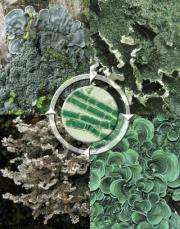
Cyanobacterial photobionts of tropical cyanolichens of the genera Acantholichen, Coccocarpia, Dictyonema, and Stereocaulon, belong to a previously unrecognized, exclusively lichenized, novel lineage with the name Rhizonema. These photobionts are shared between unrelated lichen mycobionts co-occurring in the same habitats, leading to improved strains by means of mycobiont and environmental selection, in a similar way as farmers domesticate and improve crops. Credit: Courtesy of Robert K. Lucking.
Lichens are the classic example of a symbiotic relationship. Both the fungal and photobiont components of the lichen benefit from the relationship and often are unable to survive without each other. Recent research by Dr. Robert Lücking (The Field Museum, Chicago), Dr. James Lawrey (George Mason University, Virginia) and a team of colleagues from around the world has put a new spin on this relationship.
In a paper published in the August 2009 issue of the American Journal of Botany, Lücking et al. explore the possibility of lichens as domesticators, similar to early farmers domesticating grains. By investigating the evolutionary history of a group of cyanobacteria associated with lichens, Lücking and Lawrey and their team have made some surprising conclusions.
Although lichen fungi represent more than 1000 genera, most are associated with photobionts that represent only four genera, one of them believed to be the common and widely distributed cyanobacterial genus Scytonema. However, the identity of photobionts thought to be Scytonema has never been confirmed. Lücking and his colleagues used DNA sequence data to reconstruct evolutionary relationships among free-living members of Scytonema and putative Scytonema photobionts associated with three major fungal lineages.
They discovered that these lichenized photobionts are not members of the genus Scytonema, but form a novel, previously unrecognized, entirely lichenized, lineage of cyanobacteria. The members of this novel lineage, which bears the name Rhizonema, physically appear very similar to free-living members of the genus Scytonema, and members of the two genera can be found close to each other—one lichenized, the other not. Apart from being the first discovery of a completely novel photobiont lineage in lichens using molecular phylogenetics, this find has important implications for ecosystem research because a large proportion of nitrogen-fixing cyanobacteria previously believed to occur in both lichenized and free-living forms now appear to be restricted to lichen symbioses.
Lücking et al. also found that a wide range of lichen fungi that are distantly related with each other but co-occur in the same habitats are associated with members of Rhizonema. This implies that the fungi "share" the cyanobacteria among them, as opposed to evolving in concert with the cyanobacteria, a process that would result in similar evolutionary patterns in the fungal and cyanobacterial components of the lichen.
The authors propose that photobionts are selected based on their compatibility with the mycobionts and their ability to contribute to the establishment and growth of the lichen. This results in an increase in the frequency of particular mycobiont-photobiont pairs, and likewise an increase in the frequency of particular photobionts, which then leads to an increase in the availability of these photobiont strains for other lichen associations. This process may be compared to crop domestication, where farmers develop improved crop varieties and share them with other farmers, leading to higher yields for the farmers and proliferation of the most widely-used varieties. Indeed, the North American lichenologist Trevor Goward has defined lichens as "fungi that discovered agriculture," and this study not only supports this view but adds a further dimension to it.
More information: The full article is available for no charge for 30 days following the date of this summary at http://www.amjbot. … ll/96/8/1409 .
Source: American Journal of Botany
-
UC Riverside researcher names lichen after President Barack Obama
Apr 15, 2009 |
not rated yet |
0
-
Lichen Survives In Space
Nov 10, 2005 |
not rated yet |
0
-
Lichens function as indicators of nitrogen pollution in forests
Oct 06, 2008 |
not rated yet |
0
-
Temporary infidelity may contribute to the stability of ancient relationships
Jun 01, 2009 |
not rated yet |
0
-
Long-term co-evolution stability studied
Jun 27, 2006 |
not rated yet |
0
-
Engineers build first sub-10-nm carbon nanotube transistor
Feb 01, 2012 |
4.9 / 5 (30) |
30
-
Something old, something new: Evolution and the structural divergence of duplicate genes
Jan 31, 2012 |
4.6 / 5 (7) |
1
-
The hidden nanoworld of ice crystals: Revealing the dynamic behavior of quasi-liquid layers
Jan 30, 2012 |
5 / 5 (3) |
1
-
Stock market network reveals investor clustering
Jan 27, 2012 |
3.9 / 5 (23) |
8
-
Of microchemistry and molecules: Electronic microfluidic device synthesizes biocompatible probes
Jan 26, 2012 |
5 / 5 (1) |
0
-
Pertubance in a model
1 hour ago
-
Cancer drugs and Alzheimer's, Oh my!
9 hours ago
-
Squishing cells
9 hours ago
-
Any books/articles for evolutionary stable strategy models in humans?
21 hours ago
-
Science behind the bore feeling?
Feb 09, 2012
-
Homo Sapien vs. Chimpanzee - Divergence Timeline
Feb 09, 2012
- More from Physics Forums - Biology
More news stories
An eye for the tsetse fly
(PhysOrg.com) -- Geoffrey M. Attardo was one of those little boys who made pets of the spiders outside his bedroom window, feeding them and watching as they spun intricate webs. Age has not diminished his ...
45 minutes ago |
not rated yet |
0
Cure of ADPKD by selection for spontaneous genetic repair events in Pkd1-mutated iPS cells
A research group including Kyoto University researchers demonstrates that mouse iPS cells, in which genetic correction occurs spontaneously through mitotic recombination, is selectable from the population of genetically mutated ...
40 minutes ago |
not rated yet |
0
Miami battling invasion of giant African snails
No one knows how they got there. But an invasion of African giant snails has southern Florida in a panic over potential crop damage, disease and general yuckiness surrounding the slimy gastropods.
3 hours ago |
not rated yet |
1
Protein libraries in a snap
(PhysOrg.com) -- A Rice University undergraduate will depart with not only a degree but also a possible patent for his invention of an efficient way to create protein libraries, an important component of biomolecular ...
2 hours ago |
5 / 5 (1) |
0
|
Fighting crimes against biodiversity: How to catch a killer weed
Invasive species which have the potential to destroy biodiversity and influence global change could be tracked and controlled in the same way as wanted criminals, according to new research from Queen Mary, University of London.
4 hours ago |
not rated yet |
0
A frank discussion of the power law and linking correlation to causation
(PhysOrg.com) -- Michael Stumpf a mathematics professor at Imperial College in London, and Mason Porter a lecturer at Oxford have teamed together to write and publish a perspective piece in Science regarding the in ...
Mars Science Laboratory computer issue resolved
(PhysOrg.com) -- Engineers have found the root cause of a computer reset that occurred two months ago on NASA's Mars Science Laboratory and have determined how to correct it.
Advanced power-grid model finds low-cost, low-carbon future in West
(PhysOrg.com) -- The least expensive way for the Western U.S. to reduce greenhouse gas emissions enough to help prevent the worst consequences of global warming is to replace coal with renewable and other ...
Small modular reactor design could be a 'SUPERSTAR'
(PhysOrg.com) -- Though most of today's nuclear reactors are cooled by water, we've long known that there are alternatives; in fact, the world's first nuclear-powered electricity in 1951 came from a reactor ...
Clam fields found at deep, low-temperature Mariana vents
(PhysOrg.com) -- Scientists have marveled at the unusual life forms thriving at high temperature hydrothermal vents of the deep ocean.
Seeing colors in music, tasting flavors in shapes may happen in life's early months
Famed violinist Itzhak Perlman sees a deep forest green whenever he plays a B-flat on his Stradivarius' G string. The A on the E string is red.