To save lives, an Indian doctor rethinks the toilet
August 23, 2009 by Sebastien Buffet
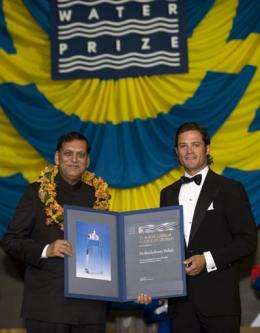
Bindeshwar Pathak (left), receives the Stockholm Water prize from Swedish Prince Carl Philip at the Town Hall in Stockholm, on August 20. Bindeshwar is the founder of the Sulabh Sanitation Movement in India.
By rethinking the humble toilet, Indian sanitation expert Bindeshwar Pathak has found a way that can save water -- and lives -- in developing countries.
For four decades, His Sulabh Sanitation Movement has equipped more than 1.2 million households with eco-friendly toilets and installed 7,500 public lavatories across India.
Yet almost three out of four Indians, or around 700 million people, still have no access to basic sanitation.
This leads to up to half a million deaths each year, Pathak, 66, told AFP at the World Water Week conference in Stockholm, where he was awarded this year's Stockholm Water Prize for his groundbreaking work.
To lower the risk to human health, Pathak developed a twin-pit, pour-flush toilet known as the Sulabh, that uses a pair of tanks to store waste matter with no smell or soil pollution, pending recycling as fertiliser.
It uses significantly less water than a standard toilet, Pathak said.
"It requires only 1.0 to 1.5 liters to flush instead of 10 liters," he said. "It saves trillions of litres of water each year."
The idea is to discourage both open-air defecation and the use of bucket toilets -- options that ramp up the risk of the spread of disease and diarrhoea.
"People have died of cholera cleaning the bucket toilets," Pathak explained.
When a Sulabh is sold to households, its price is adjusted according to a family's ability to pay. The poorest families pay 15 dollars (10 euros) whereas richer families can be asked to pay up to 1,000 dollars.
The Sulabh Sanitation Movement's campaign to raise awareness of health issues has also seen more and more Indians prepared to pay user charges for its 7,500 public toilets.
Staffed 24 hours a day, they cost one dollar a month to use them by subscription -- with an exemption for slum dwellers, women and children.
"For the whole month, you can go to the toilet, you can have a bath, you can drink water," Pathak said.
The Sulabh has been exported to Afghanistan and Bhutan, and there are also plans to ship some to 15 other countries, most of them in Africa.
"I feel very happy because what we have been doing for the last 40 years, now it feels that we are going in the right direction," Pathak told AFP.
As the winner of the Stockholm Water Prize, Pathak receives a cheque for 150,000 dollars (104,700 euros) in recognition of his work to conserve water and improve public health.
(c) 2009 AFP
-
Flushing toilet takes medical prize
Jan 19, 2007 |
not rated yet |
0
-
Human waste feeds rest stop greenhouse
Aug 31, 2005 |
not rated yet |
0
-
Latrines trounce toilets
Jun 17, 2008 |
not rated yet |
0
-
Unusual water recycling device is revealed
Dec 08, 2005 |
not rated yet |
0
-
Safe water? Lessons from Kazakhstan
Apr 29, 2008 |
not rated yet |
0
-
Engineers build first sub-10-nm carbon nanotube transistor
Feb 01, 2012 |
4.9 / 5 (31) |
30
-
Something old, something new: Evolution and the structural divergence of duplicate genes
Jan 31, 2012 |
4.6 / 5 (7) |
1
-
The hidden nanoworld of ice crystals: Revealing the dynamic behavior of quasi-liquid layers
Jan 30, 2012 |
5 / 5 (3) |
1
-
Stock market network reveals investor clustering
Jan 27, 2012 |
3.9 / 5 (23) |
8
-
Of microchemistry and molecules: Electronic microfluidic device synthesizes biocompatible probes
Jan 26, 2012 |
5 / 5 (1) |
0
-
Discrepancy between oxygen and carbon-dioxide levels
21 hours ago
-
where gems are found in the world
Feb 09, 2012
-
Wind Waves in Reservoir ~ Wind run-up and Wind set-up
Feb 08, 2012
-
Balance of oxygen in the atmosphere
Feb 01, 2012
-
The case for a methanol-based economy
Jan 30, 2012
-
Weather in a rotating cylinder
Jan 25, 2012
- More from Physics Forums - Earth
More news stories
NASA sees wide-eyed cyclone Jasmine
Cyclone Jasmine's eye has opened wider on NASA satellite imagery, as it moves through the Southern Pacific Ocean.
Space & Earth / Earth Sciences
1 hour ago |
not rated yet |
0
NASA sees Giovanna reach cyclone strength, threaten Madagascar
Tropical Storm 12S built up steam and became a cyclone on February 10, 2012 as NASA's Terra satellite passed overhead. Residents of east-central Madagascar should prepare for this cyclone to make landfall ...
Space & Earth / Earth Sciences
1 hour ago |
not rated yet |
0
Humans may have helped the decline of African rainforests 3000 years ago
(PhysOrg.com) -- Large areas of rainforests in Central Africa mysteriously disappeared over three thousand years ago, to be replaced by savannas. The prevailing theory has been that the cause was a change ...
Could Venus be shifting gear?
(PhysOrg.com) -- ESAs Venus Express spacecraft has discovered that our cloud-covered neighbour spins a little slower than previously measured. Peering through the dense atmosphere in the infrared, the ...
Space & Earth / Space Exploration
9 hours ago |
5 / 5 (7) |
7
|
Mars Science Laboratory computer issue resolved
(PhysOrg.com) -- Engineers have found the root cause of a computer reset that occurred two months ago on NASA's Mars Science Laboratory and have determined how to correct it.
Space & Earth / Space Exploration
10 hours ago |
4.7 / 5 (6) |
3
|
Google users warned of threat to smartphone wallets
Users of Google smartphone wallets were being warned on Friday that there is a way to crack pass codes intended to thwart thieves from going on illicit shopping sprees.
Anonymous knocks CIA website offline (Update)
The website of the Central Intelligence Agency was inaccessible on Friday after the hacker group Anonymous claimed to have knocked it offline.
Complex wiring of the nervous system may rely on a just a handful of genes and proteins
Researchers at the Salk Institute have discovered a startling feature of early brain development that helps to explain how complex neuron wiring patterns are programmed using just a handful of critical genes. ...
Putting the squeeze on planets outside our solar system
(PhysOrg.com) -- Using high-powered lasers, scientists at Lawrence Livermore National Laboratory and collaborators discovered that molten magnesium silicate undergoes a phase change in the liquid state, abruptly ...
The power of estrogen -- male snakes attract other males
A new study has shown that boosting the estrogen levels of male garter snakes causes them to secrete the same pheromones that females use to attract suitors, and turned the males into just about the sexiest ...
New error-correcting codes guarantee the fastest possible rate of data transmission
Error-correcting codes are one of the triumphs of the digital age. Theyre a way of encoding information so that it can be transmitted across a communication channel such as an optical fiber o ...
Aug 23, 2009
Rank: 3.4 / 5 (5)
Toilets are the dumbest designs ever for something to pee and poop in.
Just imagine, if something from another world that had a major lack of water showed up and saw that we poop into fresh water, we would look like major A-holes.
( I cant help but to look at everything from a sci-fi stand point, sorry )
Aug 23, 2009
Rank: 2 / 5 (3)
Aug 23, 2009
Rank: 4 / 5 (4)
Technologies like this are investments in the future even if you don't believe in global warming.
Aug 23, 2009
Rank: 5 / 5 (3)
Aug 23, 2009
Rank: not rated yet
Aug 23, 2009
Rank: 4 / 5 (6)
Aug 23, 2009
Rank: 4 / 5 (4)
'Idiocracy'
Aug 23, 2009
Rank: 5 / 5 (2)
Aug 23, 2009
Rank: 3 / 5 (2)
Aug 23, 2009
Rank: 3.7 / 5 (3)
Aug 24, 2009
Rank: 3 / 5 (2)
Because people are too dumb to use separate sources properly and will end up infecting themselves and their children with substandard water-born diseases.
Aug 24, 2009
Rank: not rated yet
Aug 25, 2009
Rank: not rated yet
Of course we can easily solve this problem by throwing lots of energy at it through desalinization. Saudi Arabia actually uses this method to provide much of it's freshwater today.
Aug 25, 2009
Rank: 5 / 5 (1)
Aug 30, 2009
Rank: not rated yet
I think the first issue that needs to be addressed is sanitation. Once people are pooping where they should be, then you can worry about using less water to flush it. After all, they are not pooping in the streets due to a lack of flushing water are they!! Hello!
Don't get me wrong, water conservation is a good thing but it has very little to do with the where and why of pooping practices in third world countries!
BTW, how many toilets would that $150,000 buy for India?
Aug 30, 2009
Rank: 5 / 5 (1)