Diamond mining is not forever, SAfrica learns
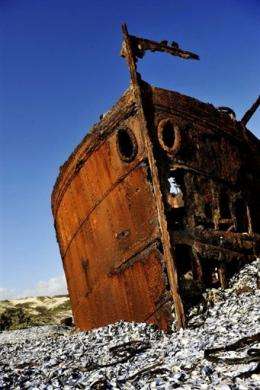
August 23, 2009 by Fran Blandy A ship wreck lays on the beach on one of the De Beers restoration sites on the Northern Cape coastline

Enlarge

A ship wreck lays on the beach on one of the De Beers restoration sites on the Northern Cape coastline on the outskirt of the diamonds giant De Beers owned mining town of Kleinzee, SAfrica. Isolated under strict security for 80 years of mining, towering mine dumps reach hundreds of metres into the air along the coast, the site of one of the most ambitious mining restoration projects to date.

The glittering diamonds are almost gone and as the lustre fades on South Africa's Diamond Coast, desperate ghost towns are left clinging to the last signs of life.

The heyday of diamond mining may be over, but the restoration of a once-pristine landscape along the country's west coast should turn this wasteland of scarred earth into a tourist paradise.

Isolated under strict security for 80 years of mining, towering mine dumps reach hundreds of metres into the air along the coast, the site of one of the most ambitious mining restoration projects to date.

It's hard to believe it by looking at the area now. The sole customer in a supermarket on a recent day in one of the mining towns, Kleinzee, said the industry has left it looking as if a "nuclear bomb was dropped on it."

Since 2007 the world's leading diamond company De Beers has drastically cut operations at its Namaqualand mines as the precious gem runs out, reducing staff from about 3,000 to 250.

Globally, known diamond reserves are expected to run out in 30 years.

Kleinzee, located about 600 kilometres (370 miles) north of Cape Town in the country's biggest and most sparsely populated province of Northern Cape, is entirely owned by the diamond giant.

Schools, recreation centres and houses stand mostly empty.

Its mine has already shut down and residents wait desperately for officials to proclaim an end to its life as a privately owned mining town so individuals can buy homes themselves and try to breathe life back into business.

"All my friends lost their jobs. This is a mining town, what must they do here?" said local supermarket owner Ann Engelbrecht, whose sales have dropped 60 percent with only a trickle of tourists and locals sustaining her.

She took over the Spar in 2007 after working for De Beers since 1984, and says she has already had two heart attacks from the stress, making opening hours ever later and shutting down completely over weekends.

"It is just not worth it anymore. Business is so bad but I really believe if the town is proclaimed it will get better."

De Beers, grappling with how to leave the town, is partnering with conservationists to reinvigorate the area through tourism, fish farming and other industries.

The project highlights increasing concerns about the environmental footprint left by mining and the responsibility of companies to mitigate it.

Gert Klopper, De Beers Namaqualand spokesman, says the company hopes the project will improve the image of the diamond industry, long blighted by conflict and violence.

"I think it's the first time anywhere in the world that it (restoration) has taken place on such a large scale," he tells AFP of the 463 million rand (56 million dollar, 40 million euro) project.

De Beers owns some 10 percent of South Africa's 2,500-kilometre coastline, much of which has been extensively mined.

Conservation experts are now busy filling gaping holes and transplanting sensitive plant species to restore the vast plains to their former glory.

"The succulent Karoo is one of only two arid hotspots in the world with more than 4,500 plant species. The whole of Europe doesn't have the same number of plant species," says environmental officer Werner Nel.

Klopper notes that while some 10,000 hectares (25,000 acres) have been mined, a total of 90,000 hectares were restricted from the public for decades, meaning "huge tracts of land have been pristinely preserved."

Thick and varied vegetation which comes alive with wildflowers in spring stretches for miles to sandy white dunes and idyllic beaches ideal for surfing.

With the rest of South Africa's coast overdeveloped, it is hoped a new tourist attraction will be created along with hundreds of jobs in the most isolated corner of the country.

Sea water pumps designed for mining are now helping fill the pits, which are being turned into oyster and abalone farms.

Already exposed bedrock is being eyed for nearly 100 wind turbines along the wind-blown coastline -- to create much needed renewable energy in the power-strapped country.

Other plans are underway to create land art, a marina, seawater greenhouses and hiking trails, and even to turn one massive pit into a concert venue.

"It will take 10, 20, 30 years to get to the point that you can't see happened here," says Andre Meyer of the Nurture, Restore, Innovate project which is restoring the land for De Beers.

(c) 2009 AFP


print this article email this article download pdf blog this article bookmark this article     Stumble it Digg this share on Facebook retweet share on Reddit add to delicious
Rate this story - 4.2 /5 (6 votes)

Rank Filter

Move the slider to adjust rank threshold, so that you can hide some of the comments.


Display comments: newest first

  • Yes - Aug 23, 2009
    • Rank: not rated yet
    This is done by the same De Beers.
    hmm....................
    .......................
    I think I prefer a synthetic diamond though if I would need one.
    hmm....................
    .......................
    hmm.... I think I don't need one.
  • vika_Tae - Aug 23, 2009
    • Rank: not rated yet
    Well, with 30 years left of natural diamond deposits, we have three decades to scale synthetic diamond production up to handle recreating larger pieces. Sounds doable, and if we can scale to any size synthetic diamond, they will prove far more useful than the natural ones anyway.
  • sender - Aug 24, 2009
    • Rank: 5 / 5 (1)
    Carbon vapor deposition provides purer cleaner optronics grade diamonds, natural diamonds are now literally worth less.
  • vika_Tae - Aug 24, 2009
    • Rank: not rated yet
    Perhaps, but I was thinking of scale. Our current diamond creation processes cannot create sheets of diamond, or slabs, for example. When I wrote the above post, I was thinking about using the structural capabilities of diamond, as a building material.

August 23, 2009 all stories

Comments: 4

4.2 /5 (6 votes)
  • Stumble this up

  • Digg this

  • share this

  • hide
  • Related Stories

  • Study finds that damaged land can restore itself
    created Apr 01, 2008 | popularity not rated yet | comments 0
  • Uranium mining prospect worries neighbors
    created Nov 17, 2006 | popularity not rated yet | comments 0
  • Under Andean ice, a golden prize
    created May 13, 2009 | popularity not rated yet | comments 0
  • Interior halting uranium mining at Grand Canyon
    created Jul 21, 2009 | popularity not rated yet | comments 0
  • U.S. OKs uranium search near Grand Canyon
    created Feb 07, 2008 | popularity not rated yet | comments 0


  • hide
  • Relevant PhysicsForums posts

Other News

Message gone viral? Blame it on altruistic, yet image-conscious Internet  'e-mavens'

Message gone viral? Blame it on altruistic, yet image-conscious Internet 'e-mavens'

Other Sciences / Economics

created 3 hours ago | popularity 2 / 5 (1) | comments 0

(PhysOrg.com) -- Why do some online ad campaigns go viral while other online marketing messages gather "cyber-dust" on the information superhighway? The key may lie in the motivation of Internet users to email ...


Study: Race, class and gender shape religion's effect on American voters

Other Sciences / Social Sciences

created 22 hours ago | popularity not rated yet | comments 0

(PhysOrg.com) -- How Americans vote is strongly linked to their religious identities, but it is not an independent influence that transcends race, socio-economic class and gender, reports a new Cornell study.


Researcher: Faint writing seen on Shroud of Turin (AP)

Researcher: Faint writing seen on Shroud of Turin (Update)

Other Sciences / Archaeology & Fossils

created Nov 20, 2009 | popularity 2.4 / 5 (30) | comments 40

(AP) -- A Vatican researcher has rekindled the age-old debate over the Shroud of Turin, saying that faint writing on the linen proves it was the burial cloth of Jesus. Experts say the historian may be reading ...


Explained: The Discrete Fourier Transform

Explained: The Discrete Fourier Transform

Other Sciences / Mathematics

created Nov 25, 2009 | popularity 4.2 / 5 (25) | comments 8

(PhysOrg.com) -- In 1811, Joseph Fourier, the 43-year-old prefect of the French district of Isčre, entered a competition in heat research sponsored by the French Academy of Sciences. The paper he submitted ...


Climate change could boost incidence of civil war in Africa

Other Sciences / Social Sciences

created Nov 23, 2009 | popularity 2.4 / 5 (16) | comments 9

Climate change could increase the likelihood of civil war in sub-Saharan Africa by over 50 percent within the next two decades, according to a new study led by a team of researchers at University of California, Berkeley, ...