How diarrheal bacteria cause some colon cancers revealed in mouse studies
August 23, 2009
How diarrheal bacteria cause some colon cancers revealed in mouse studies

Enlarge

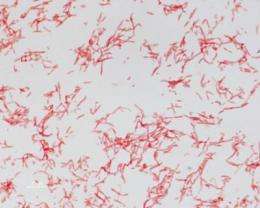
This is a gram stain of Enterotoxigenic B. fragilis (ETBF) under oil immersion. 100x. Credit: Courtesy of Shaoguang Wu

Johns Hopkins scientists say they have figured out how bacteria that cause diarrhea may also be the culprit in some colon cancers. The investigators say that strains of the common Bacteroides fragilis (ETBF) dupe immune system cells into permitting runaway colon tissue inflammation, a precursor for malignant growth.

"This could be the H. pylori of colon cancer," says Johns Hopkins infectious disease specialist, Cynthia Sears, M.D., referring to the bacteria long known to cause and suspected of causing the majority of stomach cancers. Her studies suggest that ETBF uses tissue inflammation to cause colon cancer in a similar way that H. pylori causes stomach tumors.

A so-called enterotoxigenic bacterium, the germ is widely known to cause diarrhea in children and adults in the developing and developed world, and a previous study in Turkey has linked it to colon cancer.

The bacteria, which colonize in the gut, cause no symptoms in some individuals, but others develop diarrhea and colon inflammation, which has been linked to cancer growth. Unlike the case with H. pylori, it is unknown whether standard antibiotics can eradicate the microbe, experts say.

To track the link between ETBF and colon cancer, the Johns Hopkins researchers conducted a series of tests in mice bred to carry mutations in a colon cancer-causing gene called APC.

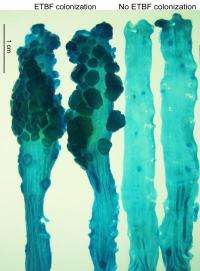
Their results, published in the August 23 issue of , show that mice infected with ETBF developed diarrhea which resolved quickly, but within a week, developed inflammation and small tumors in the colon. One month later, the colons were pockmarked with tumors.

Mice infected with a non-toxin producing strain of the bacteria were free of diarrhea, inflammation and tumors.

Next, Sears and the Johns Hopkins team evaluated the bacteria's effect on immune responses that may contribute to cancer development.
How diarrheal bacteria cause some colon cancers revealed in mouse studies
Enlarge

These are tumors in the colons of multiple intestinal neoplasia (Min) mice colonized with enterotoxigenic Bacteroides fragilis (ETBF) for 3 months compared to Min mice not colonized with ETBF. The colons are stained with methylene blue. Credit: courtesy of Dr. Shaoguang Wu

In ETBF-infected mice, they found high levels of a protein called pStat3, which, in its normal role, acts as a signal to trigger inflammation. One of those signals activates an immune cell called T-helper 17 (Th17). Th17 cells produce molecules that have been implicated in fostering inflammation of tissues.

Th17 activity in the gut of germ-bearing mice was 100 times greater than normal, according to the investigators, and when they blocked the effects of Th17, they were able to reverse inflammation and tumor growth.

Drew Pardoll, M.D., Ph.D., an immunologist and cancer researcher at Johns Hopkins, speculates that in humans, infection with ETBF "produces a low-level inflammation that persists for a long time."

"If what we are seeing in mice holds true in humans, the chronic inflammation damages genetic material in the colon cells, allowing them to grow uncontrollably and develop into tumors earlier and more progressively than if they were not infected with ETBF," Pardoll says.

Sears first witnessed the impact of diarrheal pathogens two decades ago in a refugee camp in Thailand where children, especially, were vulnerable to infection where water sanitation is poor. Most diarrheal disease is short-lived but can be very severe, Sears says, and it is common worldwide. The ETBF microbe is found in the gut of up to 20 to 35 percent of children and adults and, according to the Turkish study, in as many as 40 percent of colon cancer patients.

Sears and Pardoll believe that ETBF may collude with other types of normal bacteria in the gut to promote cancer. The microbe itself is difficult to culture from stool specimens, according to the investigators, so they are working on blood tests to detect antibodies to the pathogen's toxin, which may show whether an individual has been exposed to it and perhaps determine who may be at risk for .

The investigators also envision vaccines and drug therapies that neutralize the pathogen's toxin and its ability to inflame tissues.

Source: Johns Hopkins Medical Institutions


Rank 5 /5 (2 votes)
Related Stories
Relevant PhysicsForums posts
  • Is Everyday Technology Killing Us?
    createdFeb 08, 2012
  • Exercise and weight loss
    createdFeb 08, 2012
  • Why do we have head aches? Our brains can't feel anything.
    createdFeb 07, 2012
  • "The end of diseases" by David Agus, interview from Daily Show with Jon Stewart
    createdFeb 04, 2012
  • Oncolytic adenovirus
    createdFeb 04, 2012
  • Nutrition label stuffs and diets
    createdFeb 02, 2012
  • More from Physics Forums - Medical Sciences

More news stories

New ability to regrow blood vessels holds promise for treatment of heart disease

(Medical Xpress) -- University of Texas at Austin researchers have demonstrated a new and more effective method for regrowing blood vessels in the heart and limbs — a research advancement that could have ...

Medicine & Health / Research

created 57 minutes ago | popularity 5 / 5 (3) | comments 0 | with audio podcast

Motivation to exercise affects behavior

(Medical Xpress) -- For many people, the motivation to exercise fluctuates from week to week, and these fluctuations predict whether they will be physically active, according to researchers at Penn State. In an effort to ...

Medicine & Health / Health

created 47 minutes ago | popularity not rated yet | comments 0 | with audio podcast

'It's not nutritious until it's eaten'

As part of her "Let's Move! Initiative," First Lady Michelle Obama unveiled a new web resource highlighting new changes in the Chefs Move to Schools, during a CMST gathering in Dallas, TX today. CMTS advocates ...

Medicine & Health / Health

created 34 minutes ago | popularity not rated yet | comments 0

New tumor suppressor gene identified

A recent study published in Clinical Cancer Research suggests that the protein hVps37A suppresses tumor growth in ovarian cancer. The work, which was funded by the Austrian Science Fund FWF, shows, for th ...

Medicine & Health / Cancer

created 1 hour ago | popularity 4.7 / 5 (3) | comments 0

Social psychologist: Lust makes you smarter and evidence that seven deadly sins are good for you

(Medical Xpress) -- Good news for lovers on Valentine’s Day - the seven deadly sins, including Lust, are good for you. University of Melbourne social psychologist Dr Simon Laham uses modern research to make a compelling ...

Medicine & Health / Psychology & Psychiatry

created 3 hours ago | popularity 4.5 / 5 (2) | comments 0


Fast photon control brings quantum photonic technologies closer

(PhysOrg.com) -- Using photons instead of electrons to transmit information could lead to faster and more secure ways to communicate, among other advantages. Now a team of physicists has taken another step toward realizing ...

Planck mission steps closer to the cosmic blueprint

(PhysOrg.com) -- ESA's Planck mission has revealed that our Galaxy contains previously undiscovered islands of cold gas and a mysterious haze of microwaves. These results give scientists new treasure to mine ...

A lost world? How zooarchaeology can inform biodiversity conservation

A new study of tropical forests will provide a 50,000-year perspective on how animal biodiversity has changed, explored through an archaeological investigation of animal bones.

Myths and shame keep many from seeking bankruptcy protection

(PhysOrg.com) -- Two interesting facts that may counter modern ideas about bankruptcy: The overwhelming majority of U.S. filings belong to individuals rather than corporations or entities, and most of these ...

Big Society could threaten biodiversity conservation

A study of the Moray Firth Seal Management Plan (MFSMP), in north-east Scotland, identified four key conditions for long-term success, three of which pointed to the importance of direct government involvement.

Independent group inspects Apple supplier

(AP) -- An independent group, the Fair Labor Association, has started auditing Apple Inc.'s Chinese supplier Foxconn after a request by Apple.