Lightning’s Mirror Image, Only Much Bigger (w/ Video)
August 23, 2009 Lightning's mirror image... only much bigger

Enlarge

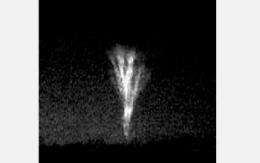
Trees form a horizon from which a gigantic jet emerges; the thunderstorm is 200 miles away. Credit: Steven Cummer

(PhysOrg.com) -- With a very lucky shot, scientists have captured a one-second image and the electrical fingerprint of huge lightning that flowed 40 miles upward from the top of a storm.

These rarely seen, highly charged meteorological events are known as gigantic jets, and they flash up to the lower levels of space, or ionosphere.

While they don't occur every time there is lightning, they are substantially larger than their downward striking cousins.

"Despite poor viewing conditions as a result of a full moon and a hazy , we were able to clearly capture the gigantic jet," said study leader Steven Cummer, an electrical and computer engineer at Duke University in North Carolina.

A paper reporting Cummer's results appears online today in the journal Nature Geoscience.

Images of gigantic jets have only been recorded on five occasions since 2001. The Duke University team caught a one-second view and measurements that are now giving scientists a much clearer understanding of these rare events.

"This confirmation of visible electric discharges extending from the top of a storm to the edge of the ionosphere provides an important new window on processes in Earth's global electrical circuit," said Brad Smull, program director in NSF's Division of Atmospheric Sciences, which funded the research.
Lightning's mirror image... only much bigger
Enlarge

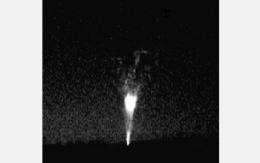
A gigantic jet, coming from a thunderstorm in N.C. on May 9, 2009, as it expands. Credit: Steve Cummer

"Our measurements show that gigantic jets are capable of transferring a substantial to the lower ionosphere," Cummer said.

"They are essentially upward lightning from thunderclouds that deliver charge just like conventional cloud-to-ground lightning. What struck us was the size of this event."

It appears from the measurements that the amount of electricity discharged by conventional lightning and gigantic jets is comparable, Cummer said.

But the gigantic jets travel farther and faster than conventional lightning because thinner air between the clouds and ionosphere provides less resistance.

Whereas a conventional lightning bolt follows a six-inch channel and travels about 4.5 miles down to earth, the gigantic jet recorded by the scientists contained multiple channels and traveled about 40 miles upward.
Lightning's mirror image... only much bigger
Enlarge

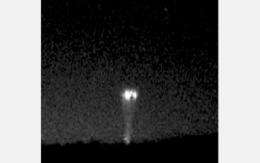
The gigantic jet, pictured as it begins to form in the May 9, 2009 thunderstorm. Credit: Steve Cummer

"Given that reservoirs of electric charge in thunderstorms are the sources for both and gigantic jets, and that both events involve contact between these reservoirs and a very large conducting surface, it is not surprising that their charge transfers are comparable," Cummer said.

Scientists don't know what conditions or what types of storms are conducive to gigantic jet formation.

It has been difficult in the past to obtain images of gigantic jets because they occur so quickly that cameras have to be trained on them at the precise moment they occur.

Cummer caught the gigantic jet almost by accident.

The equipment had been set to capture another phenomenon known as sprites, which were first photographed in 1989.

Sprites are electrical discharges that occur above storm clouds and are colored red or blue, with jellyfish-like tendrils hanging down.

Cummer maintains a low-light video camera trained to the sky and programmed to start recording when specific meteorological conditions occur.

At the same time, other equipment constantly measures radio emissions in the same sector to capture electrical events. A special GPS system ensures that the readings from all the equipment are synchronized.

Cummer is planning to install a low-light, high-speed camera to capture gigantic jet images in color, which could provide additional information about chemical processes and temperatures inside the phenomenon.

Source: National Science Foundation (news : web)


Rate this story - 4.5 /5 (17 votes)

Rank Filter

Move the slider to adjust rank threshold, so that you can hide some of the comments.


Display comments: newest first

  • Mandan - Aug 23, 2009
    • Rank: not rated yet
    Electrifying news.
  • Truth - Aug 23, 2009
    • Rank: not rated yet
    But what attracts the lightning upwards?
  • CaptBarbados - Aug 23, 2009
    • Rank: 5 / 5 (1)
    Sprites!
  • CaptBarbados - Aug 23, 2009
    • Rank: 5 / 5 (1)
    Lightning Sprites:

    wiki: lightning sprites
  • E_L_Earnhardt - Aug 23, 2009
    • Rank: not rated yet
    No, PROTONS, but only a portion are cought in orbits. Generally "OZONE" is the major result of these. Call them "Sprites" if you wish. ELECTRONS power everything!
  • barakn - Aug 23, 2009
    • Rank: 1 / 5 (3)
    Truth - the ionosphere does.
  • sender - Aug 24, 2009
    • Rank: not rated yet
    Laser induced lightnings will fuel Tesla's ionospheric wireless energy systems.
  • KCD - Aug 24, 2009
    • Rank: not rated yet
    yup, those are sprites. they are the opposite "strike" to a lightning. they are mostly seen during thunder storms but were rarely taken by scientists.
  • SmartK8 - Aug 24, 2009
    • Rank: not rated yet
    Truth - The common lightning goes in both directions,(also it goes multiple times) from the skies to the ground, and vice versa. The color (yeah, they're colorful) of the sprite depends on the height, in which the spray appears above the clouds.

August 23, 2009 all stories

Comments: 9

4.5 /5 (17 votes)

  • hide
  • Related Stories

  • Uncovering the mechanisms of lightning varieties
    created Mar 26, 2008 | popularity not rated yet | comments 0
  • Scientists Seek Sprite Light Source
    created Jun 07, 2005 | popularity not rated yet | comments 0
  • Clearest Video of Lightning-Generated 'Sprites' High Above Thunderstorms Captured
    created Feb 17, 2006 | popularity not rated yet | comments 0
  • Gamma rays from thunderstorms?
    created May 03, 2005 | popularity not rated yet | comments 0
  • A space station view on giant lightning
    created Oct 03, 2005 | popularity not rated yet | comments 0


  • hide
  • Relevant PhysicsForums posts

  • Carbon Dioxide emissions question
    created Feb 08, 2010
  • Photosynthesis vs. carbonization
    created Feb 07, 2010
  • Sheep's footprints
    created Feb 05, 2010
  • How did Victorians estimate the ages of fossils?
    created Feb 03, 2010
  • How can we defeat pollution as individuals?
    created Jan 29, 2010
  • Formation of lava fields on Lanzarote
    created Jan 27, 2010
  • More from Physics Forums - Earth

Other News

Rho Ophiuchus cloud

Professor: We have a 'moral obligation' to seed universe with life

Space & Earth / Astronomy

created 19 hours ago | popularity 3.2 / 5 (23) | comments 48 | with audio podcast report

(PhysOrg.com) -- Eventually, the day will come when life on Earth ends. Whether that’s tomorrow or five billion years from now, whether by nuclear war, climate change, or the Sun burning up its fuel, the last ...


Climate 'Tipping Points' May Arrive Without Warning, Says Top Forecaster

Space & Earth / Environment

created 7 hours ago | popularity 3.7 / 5 (6) | comments 5 | with audio podcast

(PhysOrg.com) -- A new University of California, Davis, study by a top ecological forecaster says it is harder than experts thought to predict when sudden shifts in Earth's natural systems will occur -- a worrisome finding ...


A new 3-D map of the interstellar gas within 300 parsecs from the sun

A new 3D map of the interstellar gas within 300 parsecs from the Sun

Space & Earth / Astronomy

created 10 hours ago | popularity 5 / 5 (4) | comments 0 | with audio podcast

(PhysOrg.com) -- Astronomy & Astrophysics is publishing new 3D maps of the interstellar gas in the local area around our Sun. A French-American team of astronomers presents new absorption measurements toward ...


38 percent of world's surface in danger of desertification

38 percent of world's surface in danger of desertification

Space & Earth / Environment

created 4 hours ago | popularity 2.3 / 5 (3) | comments 4

A team of Spanish researchers has measured the degradation of the planet's soil using the Life Cycle Assessment (LCA), a scientific methodology that analyses the environmental impact of human activities, and ...


Russian Soyuz TMA-17 rocket blasts off to the International Space Station

Russia wants to charge more for rides to space: report

Space & Earth / Space Exploration

created 21 hours ago | popularity 5 / 5 (3) | comments 5

Russia, which is set to hold a monopoly on flights to the international space station (ISS), wants to charge more for rides on its Soyuz rocket, the space agency head said Tuesday.