Research finds higher acidity in Alaska waters
August 24, 2009 By DAN JOLING , Associated Press Writer
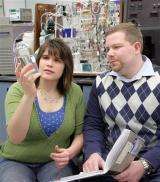
This Feb. 6, 2009 photo provided by the University of Alaska, Fairbanks, School of Fisheries and Ocean Sciences shows Jeremy Mathis right and Kristen Shake, one of his students studying ocean acidification, testing seawater samples in Jeremy's lab on the UAF campus in Fairbanks, Alaska. Alaska's marine waters are turning acidic from absorption of greenhouse gases faster than tropical waters, according to findings by Mathis. (AP Photo/University of Alaska, Fairbanks, School of Fisheries and Ocean Sciences)
(AP) -- Erosion threatens to topple coastal Alaskan villages. Melting ice threatens polar bears. Now, a marine scientist says the state's marine waters are turning acidic from absorbing greenhouse gases faster than tropical waters, potentially endangering Alaska's $4.6 billion fishing industry.
The same things that make Alaska's marine waters among the most productive in the world - cold, shallow depths and abundant marine life - make them the most vulnerable to acidification, said Jeremy Mathis, a chemical oceanographer at the University of Alaska Fairbanks.
"Ecosystems in Alaska are going to take a hit from ocean acidification," he said. "Right now, we don't know how they are going to respond."
Alaska has already seen more than its share of global warming effects: shrinking glaciers, coastal erosion, the march north of destructive forest beetles formerly held in check by cold winters, melting Arctic Ocean ice that also threatens walrus and other marine mammals.
Ocean acidification, the lowering of basicity and the increase in acidity of marine waters, is tied to increased carbon dioxide levels in the atmosphere.
Oceans absorb 22 million tons of carbon dioxide from human activities per day, removing 30 percent emitted to the atmosphere each year and mitigating the harmful impact of greenhouse gas, according to the Intergovernmental Oceanographic Commission.
When carbon dioxide dissolves in sea water, it forms carbonic acid. That decreases the amount of calcium carbonate, used by marine creatures to construct shells or skeletons.
Mathis last spring collected water in the Gulf of Alaska and found samples to be more acidic than expected - and higher than in tropical waters. The results matched his findings in the Chukchi and Bering seas off Alaska's west and northwest coast. Cold water absorbs and holds more gas than warm water, Mathis said.
His research in the Gulf of Alaska uncovered multiple sites where concentrations of shell-building minerals were so low, that shellfish, including crab, and other organisms would be unable to build strong shells.
"We're not saying that crab shells are going to start dissolving, but these organisms have adapted their physiology to a certain range of acidity," Mathis said. "Early results have shown that when some species of crabs and fish are exposed to more acidic water, certain stress hormones increase and their metabolism slows down.
"If they are spending energy responding to acidity changes, then that energy is diverted away from growth, foraging and reproduction."
Acidification could affect the tiny pteropod, also known as a sea butterfly or swimming sea snail. It is at the base of the food chain and makes up nearly half of the diet of pink salmon. A 10 percent decrease in pteropods could mean a 20 percent decrease in an adult salmon's body weight.
"This is a case where we see ocean acidification having an indirect effect on a commercially viable species by reducing its food supply," Mathis said.
The shallow waters of Alaska's broad continental shelves also retain more carbon dioxide because there is less mixing from deeper ocean waters.
Another contributor is the rich biological life of Alaska waters, from tiny plankton to humpback whales. All use oxygen and emit CO2. Mathis and other scientists call it the "biological pump." Phytoplankton, like other plant life, absorbs CO2 and gives off oxygen, but when it dies and sinks in the shallow Alaska waters, decomposes and adds carbon to the water column.
Mathis has been warning fisheries managers around the state of ocean acidification. He has been hearing back of salmon returns with fewer, smaller fish reaching streams.
"We can't correlate that yet to ocean acidification or any climate process," he said. "We cannot make those connections yet but there's indications in the ecosystem that the ecosystems are stressed."
He said there should be a twofold course of action: increasing studies and observation of the effects of ocean acidification, and reducing carbon emissions.
A future study will look at the physiological impact of acidification on one of Alaska's money fish, pollock. A graduate student will rear pollock from hatch and study them in the larval and juvenile stages under different acidified conditions, looking for decreases in body mass, increases in stress hormones and other physiological indicators.
Pollock is the largest U.S. fishery by volume. Annual catches average 2.5 billion pounds and provide raw material for fish sticks and fast food fish sandwiches. Ocean acidification could be a blow to commercial fishing, which accounts for 50 percent of U.S. seafood production.
The Center for Biological Diversity, citing Mathis' findings, renewed its call for Alaska to declare its waters impaired under the Clean Water Act. The state last year rejected the group's first request for the declaration.
©2009 The Associated Press. All rights reserved. This material may not be published, broadcast, rewritten or redistributed.
-
New findings show increased ocean acidification in Alaska waters
Aug 13, 2009 |
not rated yet |
0
-
Ocean acidification threatens cold-water coral ecosystems
Apr 03, 2006 |
not rated yet |
0
-
First buoy to monitor ocean acidification launched
Jun 12, 2007 |
not rated yet |
0
-
Ocean acidification could have broad effects on marine ecosystems
Dec 17, 2008 |
not rated yet |
0
-
New Study Finds Increasing Acidification of Pacific Ocean’s Continental Shelf
May 22, 2008 |
not rated yet |
0
-
Engineers build first sub-10-nm carbon nanotube transistor
Feb 01, 2012 |
4.9 / 5 (31) |
30
-
Something old, something new: Evolution and the structural divergence of duplicate genes
Jan 31, 2012 |
4.6 / 5 (7) |
1
-
The hidden nanoworld of ice crystals: Revealing the dynamic behavior of quasi-liquid layers
Jan 30, 2012 |
5 / 5 (3) |
1
-
Stock market network reveals investor clustering
Jan 27, 2012 |
3.9 / 5 (23) |
8
-
Of microchemistry and molecules: Electronic microfluidic device synthesizes biocompatible probes
Jan 26, 2012 |
5 / 5 (1) |
0
-
Do some geologists actually act a lot like Randy Marsh?
Feb 11, 2012
-
Discrepancy between oxygen and carbon-dioxide levels
Feb 09, 2012
-
where gems are found in the world
Feb 09, 2012
-
Wind Waves in Reservoir ~ Wind run-up and Wind set-up
Feb 08, 2012
-
Balance of oxygen in the atmosphere
Feb 01, 2012
-
The case for a methanol-based economy
Jan 30, 2012
- More from Physics Forums - Earth
More news stories
Latin America mining boom clashes with conservation
Latin America is experiencing a mining boom as prices rise fuelled by a hike in global demand, but the region is also being hit by a wave of violent protests, strikes and rallies by environmentalists.
6 hours ago |
not rated yet |
0
Political leaders play key role in how worried Americans are by climate change: study
More than extreme weather events and the work of scientists, it is national political leaders who influence how much Americans worry about the threat of climate change, new research finds.
Feb 06, 2012 |
5 / 5 (6) |
73
NASA budget will axe Mars deal with Europe: scientists
US President Barack Obama's budget proposal to be submitted next week for 2013 will cut NASA's budget by 20 percent and eliminate a major partnership with Europe on Mars exploration, scientists said Thursday.
Space & Earth / Space Exploration
Feb 10, 2012 |
5 / 5 (3) |
55
Humans may have helped the decline of African rainforests 3000 years ago
(PhysOrg.com) -- Large areas of rainforests in Central Africa mysteriously disappeared over three thousand years ago, to be replaced by savannas. The prevailing theory has been that the cause was a change ...
Study shows global glaciers, ice caps, shedding billions of tons of mass annually
Earth's glaciers and ice caps outside of the regions of Greenland and Antarctica are shedding roughly 150 billion tons of ice annually, according to a new study led by the University of Colorado Boulder.
Space & Earth / Earth Sciences
Feb 08, 2012 |
4.4 / 5 (9) |
14
|
Injured boomers beware: Know when to see doctor
(AP) -- It happened to nurse Jane Byron years after an in-line skating fall, business owner Haralee Weintraub while doing "men's" push-ups, and avid cyclist Gene Wilberg while lifting a heavy box.
Google might launch Drive for cloud storage soon
(PhysOrg.com) -- Google's next big move, according to the Wall Street Journal, is a cloud storage service called Drive. Hardly first to the plate, Google is simply catching up to introducing its cloud reposi ...
Love a click away in Indonesia's Twitter Republic
He was a geeky kid from Yogyakarta, she a glamorous city girl in Jakarta. In a country with one of the world's most vibrant social networking scenes they fell in love on Twitter.
Europeans protest controversial Internet pact
Tens of thousands of people marched in protests in more than a dozen European cities Saturday against a controversial anti-online piracy pact that critics say could curtail Internet freedom.
Walney offshore wind farm is world's biggest (for now)
(PhysOrg.com) -- The Walney wind farm on the Irish Sea--characterized by high tides, waves and windy weather--officially opened this week. The farm is treated in the press as a very big deal as the Walney ...
Navy to begin tests on electromagnetic railgun prototype launcher
The Office of Naval Research (ONR)'s Electromagnetic (EM) Railgun program will take an important step forward in the coming weeks when the first industry railgun prototype launcher is tested at a facility ...