New robots mimic fish's swimming (w/ Video)
August 24, 2009 by Anne Trafton New robots mimic fish's swimming

Enlarge

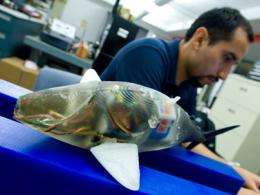
Pablo Valdivia Y Alvarado, a research affiliate in the Department of Mechanical Engineering, works in his lab on a robotic fish he created with Professor Kamal Youcef-Toumi. The robot is designed to more easily maneuver into areas where traditional underwater autonomous vehicles cannot go. Photo / Patrick Gillooly/MIT News Office

(PhysOrg.com) -- Borrowing from Mother Nature, a team of MIT researchers has built a school of swimming robo-fish that slip through the water just as gracefully as the real thing, if not quite as fast.

Mechanical engineers Kamal Youcef-Toumi and Pablo Valdivia Y Alvarado have designed the sleek robotic fish to more easily maneuver into areas where traditional underwater autonomous vehicles can’t go. Fleets of the new robots could be used to inspect submerged structures such as boats and oil and gas pipes; patrol ports, lakes and rivers; and help detect environmental pollutants.

“Given the (robotic) fish’s robustness, it would be ideal as a long-term sensing and exploration unit. Several of these could be deployed, and even if only a small percentage make it back there wouldn't be a terrible capital loss due to their low cost,” says Valdivia Y Alvarado, a recent MIT PhD recipient in mechanical engineering.

You need Flash installed to watch this ideo

Robotic fish are not new: In 1994, MIT ocean engineers demonstrated Robotuna, a four-foot-long robotic fish. But while Robotuna had 2,843 parts controlled by six motors, the new robotic fish, each less than a foot long, are powered by a single motor and are made of fewer than 10 individual components, including a flexible, compliant body that houses all components and protects them from the environment. The motor, placed in the fish’s midsection, initiates a wave that travels along the fish’s flexible body, propelling it forward.

The robofish bodies are continuous (i.e., not divided into different segments), flexible and made from soft polymers. This makes them more maneuverable and better able to mimic the swimming motion of real fish, which propel themselves by contracting muscles on either side of their bodies, generating a wave that travels from head to tail.

“Most swimming techniques can be copied by exploiting natural vibrations of soft structures,” says Valdivia Y Alvarado.

New robots mimic fish's swimming
Enlarge

Professor Kamal Youcef-Toumi holds two robotic fishes he designed with recent PhD student Pablo Valdivia. The sleek robots can more easily maneuver into areas where traditional underwater autonomous vehicles can't go. Photo / Patrick Gillooly/MIT News Office

As part of his doctoral thesis, Valdivia Y Alvarado created a model to calculate the optimal material properties distributions along the ’s body to create a fish with the desired speed and swimming motion. The model, which the researchers initially proposed in the journal Dynamic Systems Measurements and Control (ASME), also takes into account the robot’s mass and volume. A more detailed model is described in Valdivia Y Alvarado’s thesis and will soon be published along with new applications by the group.

Other researchers, including a team at the University of Essex, have developed new generations of robotic fish using traditional assembly of rigid components to replicate the motions of fish, but the MIT team is the only one using controlled vibrations of flexible bodies to mimic biological locomotion.

“With these polymers, you can specify stiffness in different sections, rather than building a robot with discrete sections,” says Youcef-Toumi. “This philosophy can be used for more than just fish” — for example, in robotic prosthetic limbs.

Mimicking fish

With motors in their bellies and power cords trailing as they swim, the robo-fish might not be mistaken for the real thing, but they do a pretty good fish impersonation.

The team’s first prototypes, about five inches long, mimic the carangiform swimming technique used by bass and trout. Most of the movement takes place in the tail end of the body. Fish that use this type of motion are generally fast swimmers, with moderate maneuverability.

Later versions of the robo-fish, about eight inches long, swim like tuna, which are adapted for even higher swimming speeds and long distances. In tuna, motion is concentrated in the tail and the peduncle region (where the tail attaches to the body), and the amplitude of body motions in this region is greater than in carangiform fish.

Real fish are exquisitely adapted to moving through their watery environment, and can swim as fast as 10 times their body length per second. So far, the MIT researchers have gotten their prototypes close to one body length per second — much slower than their natural counterparts but faster than earlier generations of robotic fish.

The new robo-fish are also more durable than older models — with their seamless bodies, there is no chance of water leaking into the robots and damaging them. Several four-year-old prototypes are still functioning after countless runs through the testing tank, which is filled with tap water.

Current prototypes require 2.5 to 5 watts of power, depending on the robot’s size. That electricity now comes from an external source, but in the future the researchers hope to power the robots with a small internal battery.

Later this fall, the researchers plan to expand their research to more complex locomotion and test some new prototype robotic salamanders and manta rays.

“The were a proof of concept application, but we are hoping to apply this idea to other forms of locomotion, so the methodology will be useful for mobile robotics research — land, air and underwater — as well,” said Valdivia Y Alvarado.

Provided by Massachusetts Institute of Technology (news : web)


Rate this story - 4.5 /5 (2 votes)

Rank Filter

Move the slider to adjust rank threshold, so that you can hide some of the comments.


Display comments: newest first

  • moj85 - Aug 24, 2009
    • Rank: not rated yet
    no video no proof.
  • pookawiz - Aug 24, 2009
    • Rank: not rated yet
    They sell these things as toys at Wal-Mart. They've been selling them for some time now.
  • Ant - Aug 25, 2009
    • Rank: not rated yet
    this is not new it was demonstrated by others at a third party lecture at staffordshire university 2 years ago
  • Shaffer - Aug 25, 2009
    • Rank: not rated yet
    I could make these with Jello, some scrap aluminum, 2 solenoids, a 555 timer, and a 9 volt battery. How much money was wasted here?
  • BioFish - Aug 25, 2009
    • Rank: not rated yet
    As someone who has made more than a few swimming fish, I agree with the toy comments (to some extent) and with the jello comment (if modified, and only for very short term stuff) but not the solenoids, nor the 9 volt (for fish robots, figure 1 watt/kilogram for cruising and >100 W/kg for speed). It does take some finesse, talent, and a fair bit of knowledge about fluids and axial mechanics to make a decent fish robot. The Author, Trafton, has much of it correct, but 10 body lengths per second is nothing - many fish are capable of much more, and some can swimming multiples of that (indeed, some artificial fishes have exceeded 15 BL/sec). As for mantas (and making stuff for air swimming), go look at US patent 6,250,585 as an example, or check out US6,179,683 for an example of internally powered robofishes. What we really ought to have is less "we did it first" articles and more "prize for the fastest fish" competitions.

    artificial swimming and flying fish (and other organisms) have a much longer and richer history than MIT would have one believe. There are dozens of teams building swimming and flying robots worldwide.

August 24, 2009 all stories

Comments: 5

4.5 /5 (2 votes)

  • hide
  • Related Stories

  • Fish-shaped robot for underwater research
    created Dec 16, 2004 | popularity not rated yet | comments 0
  • Robotic fish in action at London Aquarium
    created Oct 06, 2005 | popularity not rated yet | comments 0
  • Engineers building robotic fin for submarines
    created Jul 30, 2007 | popularity not rated yet | comments 0
  • Fish robot as an alternative marine propulsion system of the future (w/Video)
    created Jun 09, 2009 | popularity not rated yet | comments 0
  • How to Grow a Bigger Brain
    created Mar 06, 2006 | popularity not rated yet | comments 0


  • hide
  • Relevant PhysicsForums posts

  • how to welding thin SS foil (0.002")?
    created Feb 08, 2010
  • Civil Engineering is hazardous to your career prospects
    created Feb 06, 2010
  • hot water circulator, kitchen faucet, ? mixing
    created Feb 06, 2010
  • Static or dynamic pressures in duct
    created Feb 06, 2010
  • Nuclear Engineering in Australia??
    created Feb 06, 2010
  • Building Gravitational Wave Experiment
    created Feb 05, 2010
  • More from Physics Forums - General Engineering

Other News

Student Builds Spider Robot From Spare Parts

Student Builds Spider Robot From Spare Parts (w/ Video)

Electronics / Robotics

created 1hour ago | popularity 5 / 5 (3) | comments 1

Picture a spider-like robot that teaches itself to walk, can adapt when damaged and watches its maker as he moves around the room. That might sound terrifying.


US technology titans IBM and Intel have rolled out powerful new computer chips designed for business networks

Intel, IBM roll out new computer network chips

Electronics / Hardware

created 12 hours ago | popularity 5 / 5 (4) | comments 1

US technology titans IBM and Intel have rolled out powerful new computer chips designed for businesses continually demanding more from networks and data centers.


Millimeter-scale, energy-harvesting sensor system developed

Millimeter-scale, energy-harvesting sensor system developed

Electronics / Hardware

created Feb 08, 2010 | popularity 4.8 / 5 (12) | comments 5 | with audio podcast

(PhysOrg.com) -- A 9-cubic millimeter solar-powered sensor system developed at the University of Michigan is the smallest that can harvest energy from its surroundings to operate nearly perpetually.


Intel Itanium 9300 Processor Raises Bar for Scalable, Resilient Mission-Critical Computing

Electronics / Hardware

created 23 hours ago | popularity not rated yet | comments 0

Intel Corporation today introduced the Itanium processor 9300 series, previously codenamed "Tukwila," which delivers more than double the performance of its predecessor, boosts scalability and adds reliability features to ...


Robonaut 2: NASA, GM Create Cutting Edge Robotic Technology

Robonaut 2: NASA, GM Create Cutting Edge Robotic Technology

Electronics / Robotics

created Feb 04, 2010 | popularity 4.5 / 5 (13) | comments 8 | with audio podcast

(PhysOrg.com) -- Robonaut is evolving. NASA and General Motors are working together to accelerate development of the next generation of robots and related technologies for use in the automotive and aerospace ...