Scientists discover new species of crustacean on Lanzarote
August 24, 2009
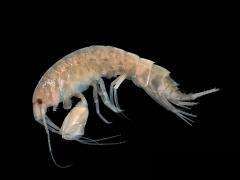
Crustaceans -- Abludomelita obtusata. Image: Wikimedia Commons. By Hans Hillewaert Lycaon.
They gracefully swim through the complete darkness of submarine caves, constantly on the lookout for prey. Instead of eyes, predatory crustaceans of the class Remipedia rely on long antennae which search the lightless void in all directions. Like some type of science fiction monster, their head is equipped with powerful prehensile limbs and poisonous fangs.
Accordingly, the translations of their Latin names sound menacing. There is the "Secret Club Bearer" (Cryptocorynetes) or the "Beautiful Hairy Sea Monster" (Kaloketos pilosus). The names of some genera were inspired by Japanese movie monsters, for example, the "Swimming Mothra" (Pleomothra), the "Strong Godzilla" (Godzillius robustus) or the "Gnome Godzilla" (Godzilliognomus).
During a cave diving expedition to explore the Tunnel de la Atlantida, the world's longest submarine lava tube on Lanzarote in the Canary Islands, an international team of scientists and cave divers have discovered a previously unknown species of crustacean, belonging to the remipede genus Speleonectes, and two new species of annelid worms of the class Polychaeta.
The team consisted of scientists from Texas A&M University and Pennsylvania State University in the U.S., the University of La Laguna in Spain, and the University of Veterinary Medicine Hannover and University of Hamburg, both in Germany. The extensive results of the Atlantida Diving Expedition will be presented in a special issue of the Springer journal Marine Biodiversity, comprising seven articles, to be published in September 2009.
The newly discovered species of Remipedia was named Speleonectes atlantida, after the cave system it inhabits. It is morphologically very similar to Speleonectes ondinae, a remipede that has been known from the same lava tube since 1985. Based on DNA comparisons, the group of Prof. Stefan Koenemann from the Institute for Animal Ecology and Cell Biology of TiHo Hannover conclusively proved that the lava tunnel harbors a second remipede species. The divergence of the two species may have occurred after the formation of the six-kilometer lava tube during an eruption of the Monte Corona volcano some 20,000 years ago.
Remipedia are among the most remarkable biological discoveries of the last 30 years. The first specimens of this crustacean group were discovered in 1979 during dives in a marine cave system on Grand Bahama in the Bahamas archipelago. Since then, 22 species of Remipedia have been discovered. The main distribution area of the cave-limited group extends from the Yucatan Peninsula in Mexico, through the northeastern Caribbean. However, two geographically isolated species inhabit caves in Western Australia and Lanzarote.
The occurrence of these disjunct species has continues to give rise to speculation about the evolutionary origins and history of Remipedia. Since it is assumed that the relatively small (largest specimens are up to four centimeters long) and eyeless cave-dwellers could not cross an entire ocean by actively swimming, there must be other reasons for their disjunct global distribution. It has therefore been suggested that Remipedia are a very ancient crustacean group, which was already widespread in the oceans of the Mesozoic, over 200 million years ago. For these reasons, remipedes are often considered as a primeval group of crustaceans.
According to this evolutionary scenario, the newly discovered species Speleonectes atlantida and the previously known species Speleonectes ondina, both occurring in the undersea lava tube on Lanzarote, would represent ancient relicts that became isolated from the main Caribbean group during the formation of the Atlantic Ocean.
More information: Koenenmann S et al (2009). A new, disjunct species of Speleonectes (Remipedia, Crustacea) from the Canary Islands. Marine Biodiversity. DOI 10.1007/s12526-009-0021-8
Source: Springer
-
Briefs: New invertebrate species found in Israel
May 30, 2006 |
not rated yet |
0
-
Researchers chirping over discovery of new cricket genus
May 06, 2006 |
not rated yet |
0
-
Unique Underground Ecosystem Revealed by Hebrew University Researchers Uncovers Eight Previously Unknown Species
May 31, 2006 |
not rated yet |
0
-
Gray bats may be making a comeback
Jan 30, 2006 |
not rated yet |
0
-
Group: Don't rebury Hawaiian artifacts
Mar 02, 2006 |
not rated yet |
0
-
Engineers build first sub-10-nm carbon nanotube transistor
Feb 01, 2012 |
4.9 / 5 (31) |
30
-
Something old, something new: Evolution and the structural divergence of duplicate genes
Jan 31, 2012 |
4.6 / 5 (7) |
1
-
The hidden nanoworld of ice crystals: Revealing the dynamic behavior of quasi-liquid layers
Jan 30, 2012 |
5 / 5 (3) |
1
-
Stock market network reveals investor clustering
Jan 27, 2012 |
3.9 / 5 (23) |
8
-
Of microchemistry and molecules: Electronic microfluidic device synthesizes biocompatible probes
Jan 26, 2012 |
5 / 5 (1) |
0
-
Mitosis
2 hours ago
-
Stem cell question.
4 hours ago
-
Protease cleavage
10 hours ago
-
Pertubance in a model
17 hours ago
-
Cancer drugs and Alzheimer's, Oh my!
Feb 09, 2012
-
Squishing cells
Feb 09, 2012
- More from Physics Forums - Biology
More news stories
The power of estrogen -- male snakes attract other males
A new study has shown that boosting the estrogen levels of male garter snakes causes them to secrete the same pheromones that females use to attract suitors, and turned the males into just about the sexiest ...
15 hours ago |
4.8 / 5 (6) |
1
|
Grass to gas: Researchers' genome map speeds biofuel development
Researchers at the University of Georgia have taken a major step in the ongoing effort to find sources of cleaner, renewable energy by mapping the genomes of two originator cells of Miscanthus x giganteus, a large perenn ...
12 hours ago |
3.8 / 5 (5) |
0
|
Experts reveal how plants don't get sunburn
(PhysOrg.com) -- Experts at the University of Glasgow have discovered how plants survive the harmful rays of the sun.
15 hours ago |
4.8 / 5 (5) |
0
|
Miami battling invasion of giant African snails
No one knows how they got there. But an invasion of African giant snails has southern Florida in a panic over potential crop damage, disease and general yuckiness surrounding the slimy gastropods.
19 hours ago |
4 / 5 (1) |
4
Protein libraries in a snap
(PhysOrg.com) -- A Rice University undergraduate will depart with not only a degree but also a possible patent for his invention of an efficient way to create protein libraries, an important component of biomolecular ...
18 hours ago |
4.8 / 5 (4) |
1
|
Google users warned of threat to smartphone wallets
Users of Google smartphone wallets were being warned on Friday that there is a way to crack pass codes intended to thwart thieves from going on illicit shopping sprees.
Anonymous knocks CIA website offline (Update)
The website of the Central Intelligence Agency was inaccessible on Friday after the hacker group Anonymous claimed to have knocked it offline.
New error-correcting codes guarantee the fastest possible rate of data transmission
Error-correcting codes are one of the triumphs of the digital age. Theyre a way of encoding information so that it can be transmitted across a communication channel such as an optical fiber o ...
Humans may have helped the decline of African rainforests 3000 years ago
(PhysOrg.com) -- Large areas of rainforests in Central Africa mysteriously disappeared over three thousand years ago, to be replaced by savannas. The prevailing theory has been that the cause was a change ...
New power source discovered
(PhysOrg.com) -- Researchers at the Massachusetts Institute of Technology (MIT) and RMIT University have made a breakthrough in energy storage and power generation.
Complex wiring of the nervous system may rely on a just a handful of genes and proteins
Researchers at the Salk Institute have discovered a startling feature of early brain development that helps to explain how complex neuron wiring patterns are programmed using just a handful of critical genes. ...