What she sees in you -- facial attractiveness explained
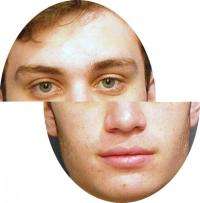
(PhysOrg.com) -- When it comes to potential mates, women may be as complicated as men claim they are, according to psychologists.
"We have found that women evaluate facial attractiveness on two levels -- a sexual level, based on specific facial features like the jawbone, cheekbone and lips, and a nonsexual level based on overall aesthetics," said Robert G. Franklin, graduate student in psychology working with Reginald Adams, assistant professor of psychology and neurology, Penn State. "At the most basic sexual level, attractiveness represents a quality that should increase reproductive potential, like fertility or health."
On the nonsexual side, attractiveness can be perceived on the whole, where brains judge beauty based on the sum of the parts they see.
"But up until now, this (dual-process) concept had not been tested," Franklin explained. The researchers report the findings of their tests in the current issue of the Journal of Experimental Social Psychology.
To study how women use these methods of determining facial attractiveness, the psychologists showed fifty heterosexual female college students a variety of male and female faces. They asked the participants to rate what they saw as both hypothetical dates and hypothetical lab partners on a scale of one to seven. The first question was designed to invoke a sexual basis of determining attractiveness, while the second was geared to an aesthetic one. This part of the experiment served as a baseline for next phase.
The psychologists then presented the same faces to another set of fifty heterosexual female students. Some of these faces, however, were split horizontally, with the upper and lower halves shifted in opposite directions. The scientists asked these participants to rate the overall attractiveness of the split and whole faces on the same scale.
By dividing the faces in half and disrupting the test subjects' total facial processing, the researchers believed that women would rely more on specific facial features to determine attractiveness. They thought that this sexual route would come into play particularly when the participants saw faces that were suited as hypothetical dates rather than lab partners. The study showed exactly that.
"The whole face ratings of the second group correlated better with the nonsexual 'lab partner' ratings of the first group." Franklin said. With the faces intact, the participants could evaluate them on an overall, nonsexual level.
"The split face ratings of the second group also correlated with the nonsexual ratings of the first group when the participants were looking at female faces," he added. "The only change occurred when we showed the second group split, male faces. These ratings correlated better with the 'hypothetical date' ratings of the first group."
The bottom line is that, at a statistically significant level, splitting the faces in half made the women rely on a purely sexual strategy of processing male faces. The study verifies that these two ways of assessing facial appeal exist and can be separated for women.
"We do not know whether attractiveness is a cultural effect or just how our brains process this information," Franklin admitted. "In the future, we plan to study how cultural differences in our participants play a role in how they rate these faces. We also want to see how hormonal changes women experience at different stages in the menstrual cycle affect how they evaluate attractiveness on these two levels."
Researchers have long known that women's biological routes of sexual attraction derive from an instinctive reproductive desire, relying on estrogen and related hormones to regulate them. The overall aesthetic approach is a less reward-based function, driven by progesterone.
How this complex network of hormones interacts and is channeled through the conscious brain and the human culture that shapes it is a mystery.
"It is a complicated picture," Franklin added. "We are trying to find what features in the brain are at play, here."
Source: Pennsylvania State University (news : web)


