NASA expands high-end computing system for climate simulation
August 24, 2009
NASA expands high-end computing system for climate simulation

Enlarge

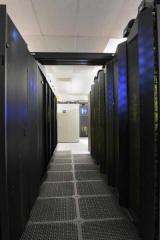
Goddard Space Flight Center recently added 4,128 processors to its Discover high-end computing system, with another 4,128 processors to follow this fall. The expanded Discover will host NASA's climate simulations for the Intergovernmental Panel on Climate Change. Credit: NASA/Pat Izzo

NASA's Goddard Space Flight Center in Greenbelt, Md., made available to scientists in August the first unit of an expanded high-end computing system that will serve as the centerpiece of a new climate simulation capability. The larger computer, part of NASA's High-End Computing Program, will be hosting the agency's modeling contributions to the Intergovernmental Panel on Climate Change (IPCC) and other national and international climate initiatives.

The expansion added 4,128 computer processors to Goddard's Discover high-end computing system. The IBM iDataPlex "scalable unit" uses Intel's newest Xeon 5500 series processors, which are based on the Nehalem architecture introduced in spring 2009.

Discover will be hosting climate simulations for the IPCC's Fifth Assessment Report by the Goddard Institute for Space Studies (GISS) in New York City and Goddard's Global Modeling and Assimilation Office (GMAO). Stimulus funds from the American Recovery and Reinvestment Act of 2009 will enable installation of another 4,128 Nehalem processors this fall, bringing Discover to 15,160 processors.

"We are the first high-end computing site in the United States to install Nehalem processors dedicated to climate research," said Phil Webster, chief of the Computational and Information Sciences and Technology Office (CISTO) at Goddard. "This new computing system represents a dramatic step forward in performance for climate simulations."

In preliminary testing of Discover's Nehalem processors, NASA climate simulations performed up to twice as fast per processor compared to other nationally recognized high-end computing systems. Moreover, the new computational capabilities allow NASA climate scientists to run high-resolution simulations that reproduce atmospheric features not previously seen in their models.

"Nehalem architecture is especially well-suited to climate studies," said Dan Duffy, CISTO lead architect. "Speed is an inherent advantage for solving complex problems, but climate models need large memory and fast access. We configured our Nehalem system to have 3 gigabytes of memory per processor, among the highest available today, and memory access is three to four times faster than Discover's previous-generation processors."

In daily forecasts for NASA satellite missions and field campaigns, the GMAO typically runs its flagship Goddard Earth Observing System Model, Version 5 (GEOS-5) at 27-kilometer resolution. Using Discover's new processors, the GMAO has been testing a special "cubed-sphere" version of GEOS-5 at resolutions as high as 3.5 kilometers.

"Once the model goes below 10-kilometer resolution, features such as well-defined hurricane eyewalls and convective cloud clusters appear for the first time," said William Putman, acting lead of the Advanced Software Technology Group in Goddard's Software Integration and Visualization Office. "At these cloud-permitting resolutions, the differences are stunning." Putman has been collaborating with GMAO modeling lead Max Suarez and others on the cubed-sphere configuration of GEOS-5.

NASA's IPCC simulations will include both longer-and-shorter-term climate projections using the latest versions of the GISS and GMAO models. GISS ModelE will perform simulations going back a full millennium and forward to 2100. Making its first IPCC contributions, the GMAO will focus on the next 30 years and perform decadal prediction simulations using GEOS-5 and atmospheric chemistry-climate simulations using the GEOS Chemistry Climate Model. With the performance of GEOS-5 on the Nehalem processors, investigations of societal relevance, such as climate impacts on weather extremes, now reach a new level of realism. The IPCC's Fifth Assessment Report is due to be published in 2014.

NASA climate simulation efforts also contribute to the U.S. Global Change Research Program, the U.S. Integrated Earth Observation System, and the U.S. Weather Research Program. Supported international programs include UNESCO's Intergovernmental Oceanographic Commission, the United Nations Environment Programme, the World Climate Research Programme, the World Meteorological Organization, and the World Weather Research Programme.

Source: NASA/Goddard Space Flight Center

Filter


Move the slider to adjust rank threshold, so that you can hide some of the comments.


Display comments: newest first

omatumr
Aug 24, 2009

Rank: 2.3 / 5 (3)
NASA'S INTEREST IN EARTH'S CLIMATE

I am delighted that NASA is showing increasing interest in Earth's climate.

Now NASA needs to frankly admit to the American taxpayers that the Sun controls Earth's climate, not CO2.

See: "EARTH'S HEAT SOURCE - THE SUN", Energy and Environment [SPECIAL ISSUE: Natural drivers of weather and climate, volume 20 (2009) pages 131-144 http://arxiv.org/pdf/0905.0704

With kind regards,
Oliver K. Manuel
http://www.omatumr.com
Rank 1 /5 (2 votes)
Related Stories
Relevant PhysicsForums posts
  • Do some geologists actually act a lot like Randy Marsh?
    createdFeb 11, 2012
  • Discrepancy between oxygen and carbon-dioxide levels
    createdFeb 09, 2012
  • where gems are found in the world
    createdFeb 09, 2012
  • Wind Waves in Reservoir ~ Wind run-up and Wind set-up
    createdFeb 08, 2012
  • Balance of oxygen in the atmosphere
    createdFeb 01, 2012
  • The case for a methanol-based economy
    createdJan 30, 2012
  • More from Physics Forums - Earth

More news stories

Salvage workers begin pumping fuel from Italian shipwreck

Salvage workers Sunday began pumping fuel from the shipwrecked Italian cruise liner Costa Concordia, a day ahead of schedule, officials said.

Space & Earth / Environment

created 5 hours ago | popularity not rated yet | comments 0

Latin America mining boom clashes with conservation

Latin America is experiencing a mining boom as prices rise fuelled by a hike in global demand, but the region is also being hit by a wave of violent protests, strikes and rallies by environmentalists.

Space & Earth / Environment

created 13 hours ago | popularity 5 / 5 (1) | comments 1

Political leaders play key role in how worried Americans are by climate change: study

More than extreme weather events and the work of scientists, it is national political leaders who influence how much Americans worry about the threat of climate change, new research finds.

Space & Earth / Environment

created Feb 06, 2012 | popularity 5 / 5 (6) | comments 73

NASA budget will axe Mars deal with Europe: scientists

US President Barack Obama's budget proposal to be submitted next week for 2013 will cut NASA's budget by 20 percent and eliminate a major partnership with Europe on Mars exploration, scientists said Thursday.

Space & Earth / Space Exploration

created Feb 10, 2012 | popularity 5 / 5 (3) | comments 58

Humans may have helped the decline of African rainforests 3000 years ago

(PhysOrg.com) -- Large areas of rainforests in Central Africa mysteriously disappeared over three thousand years ago, to be replaced by savannas. The prevailing theory has been that the cause was a change ...

Space & Earth / Environment

created Feb 10, 2012 | popularity 4.1 / 5 (14) | comments 21 | with audio podcast report


Scientists discover molecular secrets of 2,000-year-old Chinese herbal remedy

For roughly two thousand years, Chinese herbalists have treated Malaria using a root extract, commonly known as Chang Shan, from a type of hydrangea that grows in Tibet and Nepal. More recent studies suggest that halofuginone, ...

Overeating may double risk of memory loss

New research suggests that consuming between 2,100 and 6,000 calories per day may double the risk of memory loss, or mild cognitive impairment (MCI), among people age 70 and older. The study was released today and will be ...

New method to examine batteries -- MRI from the inside

There is an ever-increasing need for advanced batteries for portable electronics, such as phones, cameras, and music players, but also to power electric vehicles and to facilitate the distribution and storage of energy derived ...

A mitosis mystery solved: How chromosomes align perfectly in a dividing cell

Although the process of mitotic cell division has been studied intensely for more than 50 years, Whitehead Institute researchers have only now solved the mystery of how cells correctly align their chromosomes during symmetric ...

Lab study raises questions over nano-particle impact

Tests involving chickens have raised questions about the impact on health from engineered nano-particles, the ultra-fine grains commonly used in drugs and processed foods, scientists said on Sunday.

Starve a virus, feed a cure? Findings show how some cells protect themselves against HIV

A protein that protects some of our immune cells from the most common and virulent form of HIV works by starving the virus of the molecular building blocks that it needs to replicate, according to research published online ...