Satellite imagery shows Typhoon Vamco has a huge 45-mile wide eye
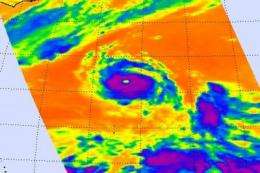
August 24, 2009 Satellite imagery shows Typhoon Vamco has a huge 45-mile wide eye

Enlarge

Aqua's Atmospheric Infrared Sounder (AIRS) instrument captured Vamco's frigid cloud temperatures at the same time. The image revealed Vamco's huge eye 45 miles in diameter, and indicated Vamco's high thunderstorm cloud temperatures were colder than minus 63 Fahrenheit. Credit: NASA/JPL, Ed Olsen

Typhoon Vamco is being as stubborn in its quest to live in the Pacific Ocean as Bill is in the Atlantic Ocean this week, and NASA satellite data confirmed that the large storm has a huge eye, about 45 miles in diameter!

NASA's Aqua satellite flew over Vamco early today, Monday, August 24, and infrared imagery from Aqua's Atmospheric Infrared Sounder (AIRS) instrument clearly showed Vamco's 45-mile in diameter eye. Around the huge eye, AIRS showed Vamco's cold high thunderstorm cloud temperatures were colder than minus 63 Fahrenheit. That's an indication that the is still strong, and it is still a category one typhoon.

Also on NASA's Aqua satellite, the Moderate Imaging Spectroradiometer (MODIS) instrument captured a stunning look at Typhoon Vamco's clouds at 0255 UTC (August 23 at 10:55 p.m. EDT).

On August 24, Vamco was 990 miles northwest of Wake Island, near 32.1 north and 155.0 east. It was moving north near 12 mph and had sustained winds near 85 knots (97 mph) creating 25 foot-high waves in the open ocean. Typhoon Vamco is maintaining strength and will start to weaken later as upper-level winds start to batter the storm.

Vamco is currently in the Northern West and will begin changing to an extra-tropical storm tomorrow while moving into the North Central Pacific Ocean. The extreme west Aleutian Islands will see Vamco as a non-tropical low by Wednesday.

The Aleutian Islands are a chain of 300 small volcanic islands in the Northern Pacific Ocean that extend about 1,200 miles west from the Alaska Peninsula toward the Kamchatka Peninsula. They are the westernmost part of the United States.

Source: /Goddard Space Flight Center


print this article email this article download pdf blog this article bookmark this article     Stumble it Digg this share on Facebook retweet share on Reddit add to delicious
Rate this story - 3.7 /5 (3 votes)


August 24, 2009 all stories

Comments: 0

3.7 /5 (3 votes)
  • Stumble this up

  • Digg this

  • share this

  • hide
  • Related Stories


  • hide
  • Relevant PhysicsForums posts

  • Climate Science Update
    created 5 hours ago
  • The IPCC and the term "most"
    created Nov 23, 2009
  • Is global warming a fact?
    created Nov 23, 2009
  • Random variability of wind patterns
    created Nov 23, 2009
  • More from Physics Forums - Earth

Other News

Fermi Telescope Peers Deep into Microquasar

Fermi Telescope Peers Deep into Microquasar (w/ Video)

Space & Earth / Astronomy

created 2 hours ago | popularity 5 / 5 (1) | comments 0

(PhysOrg.com) -- NASA's Fermi Gamma-ray Space Telescope has made the first unambiguous detection of high-energy gamma-rays from an enigmatic binary system known as Cygnus X-3. The system pairs a hot, massive ...


The Energy Sources of Ultraluminous Galaxies

The Energy Sources of Ultraluminous Galaxies

Space & Earth / Astronomy

created 3 hours ago | popularity 5 / 5 (1) | comments 0

(PhysOrg.com) -- Ultraluminous infrared galaxies ((ULIRGs) are galaxies whose luminosity exceeds that of a trillion suns; for comparison, the Milky Way galaxy has a typical (and much more modest) luminosity ...


Space shuttle Atlantis, 7 astronauts back on Earth (AP)

Space shuttle Atlantis, 7 astronauts back on Earth

Space & Earth / Space Exploration

created 3 hours ago | popularity not rated yet | comments 0

(AP) -- Space shuttle Atlantis and its seven astronauts returned to Earth with a smooth touchdown Friday to end an 11-day flight that resupplied the International Space Station.


Herschel takes a peek at the ingredients of the galaxies

Herschel takes a peek at the ingredients of the galaxies

Space & Earth / Astronomy

created 1hour ago | popularity not rated yet | comments 0

(PhysOrg.com) -- The European Space Agency has today released spectacular new observations from the Herschel Space Observatory, including the UK-led SPIRE instrument. Spectrometers on board all three Hershel ...


China is set to launch its second moon orbiter next October, state media have reported

China to launch second lunar probe: state media

Space & Earth / Space Exploration

created 8 hours ago | popularity 5 / 5 (3) | comments 0

China will launch its second moon orbiter next October, state media reported Friday, as it powers ahead with a space programme that has sparked concerns abroad.