Research pinpoints conditions favorable for freak waves
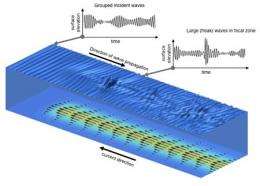
(PhysOrg.com) -- Stories of ships mysteriously sent to watery graves by sudden, giant waves have long puzzled scientists and sailors. New research by Assistant Professor of Geosciences Tim Janssen suggests that changes in water depth and currents, which are common in coastal areas, may significantly increase the likelihood of these extreme waves.
Janssen's wave model simulations show that the bending and interaction of waves by shoals and currents could increase the likelihood of a freak wave by as much as 10 times. Although scientists cannot predict the occurrence of individual extreme waves, Janssen’s findings help pinpoint conditions and locations favorable for giant waves.
Extreme waves, also known as "freak" or "rogue" waves, measure roughly three times the size of the average wave height of a given sea state. Recorded monster waves have exceeded 60 feet -- the approximate size of a six-story building. Janssen's research suggests that in areas where wave energy is focused, the probability of freak waves is much greater than previously believed.
Wave focal zones are particularly common in coastal areas where water depth variations and strong currents can result in dramatic focusing of wave energy. Such effects are particularly well known around river mouths and coastal inlets, restricting accessibility for shipping due to large, breaking waves near the inlet, or resulting in erosion issues at nearby beaches. Extreme examples of wave interaction over coastal topography include the Mavericks off the northern California coast and such world-class surf spots as Cortez Banks in California. The identification of freak wave hot spots is also important for shipping and navigation in coastal areas, and the design of offshore structures.
"In a normal wave field, on average, roughly three waves in every 10,000 are extreme waves," Janssen said. "In a focal zone, this number could increase to about three in every 1,000 waves. In a focal zone, the average wave height is already increased due to the focusing of energy so that an extreme wave in such a high energy area can potentially be very energetic and dangerous."
Janssen's wave simulations estimated the evolution of waves in open oceans, waves interacting with an opposing current, and waves traveling over a topographical feature such as a reef. The simulations show that freely developing waves maintain normal statistical properties with a small likelihood of extremes. But when the waves are focused by variations in water depth or currents, the rapid increase in energy drives wave interactions that enhance the likelihood of extreme waves.
"We found that if the focusing is sufficiently strong and abrupt, wave interactions create conditions favorable to extreme waves," Janssen said. "When we gradually increase the focal strength, initially wave interactions are weak and statistics remain normal. However, when increasing the focal strength beyond a certain threshold, suddenly wave interactions are enhanced and freak waves are much more likely than normal. It appears that wherever waves undergo a rapid transformation, freak waves can be much more likely than we would otherwise expect."
The paper is co-authored by T.H.C. Herbers of the Naval Postgraduate School in Monterey, Calif. "Nonlinear wave statistics in a focal zone," was published in the August issue of the Journal of Physical Oceanography, a journal of the American Meteorological Society.
Provided by San Francisco State University (news : web)


.jpg)


