SKorea rocket takes off, satellite launch fails
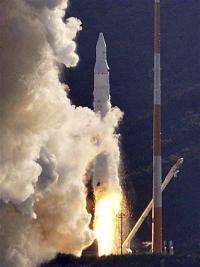
(AP) -- South Korea's first rocket launch Tuesday failed to push a satellite into its orbit but the flawed mission may still anger rival North Korea, coming just months the communist nation's own launch drew international condemnation.
The failure dealt a blow to Seoul's quest to become a regional space power. It comes against the complex backdrop of relations on the Korean peninsula - and recent signs that months of heightened tension over the North's nuclear program may be easing.
Also Tuesday, a South Korean newspaper reported that North Korea has invited top envoys of President Barack Obama for the first nuclear negotiations between the two countries under his presidency, but Washington quickly said it has no plans to send the envoys to Pyongyang.
The North gave no immediate reaction to the rocket launch but has said it will watch to see if the U.S. and regional powers refer the matter to the U.N. Security Council - which in June approved sanctions on the North over its recent nuclear and missile tests.
The two-stage Naro rocket, whose first stage was designed by Russia, was South Korea's first launch of a rocket from its own territory. It lifted off Tuesday from South Korea's space center on Oenaro Island, about 290 miles (465 kilometers) south of Seoul.
The rocket was carrying a domestically built satellite aimed at observing the atmosphere and oceans. A South Korean official said they could not trace the satellite in orbit after it separated from the rocket.
"We could not locate our satellite. It seems that communications with the satellite scheduled on Wednesday are unlikely to happen," Science Ministry official Yum Ki-soo told The Associated Press late Tuesday.
He said more details could be available on Wednesday as South Korean and Russian scientists were analyzing data to try to determine the cause of the failure.
Russia's Interfax-AVN news agency, citing an unidentified Russian space industry source, said the satellite never reached orbit and problems occurred in the South Korean-built second stage of the rocket.
In Moscow, an official at the Russian space agency, Roscosmos, declined to comment on the report that the satellite did not enter any orbit or say anything about what happened to it.
In joint statements, Roscosmos and the state-controlled Khrunichev company, which made the rocket's first stage, said that the first stage operated as planned.
South Korean President Lee Myung-bak called the launch a "half success."
"We must further strive to realize the dream of becoming a space power," Lee said, according to his office. Among Asian countries, China has conducted a manned space flight, and Japan and India have also sent rockets carrying satellites into space.
The liftoff came after a warning from North Korea that it would be "watching closely" for the international response to Seoul's launch after its own launch in April - suspected as a disguised test of long-range missile technology - drew a rebuke from the United Nations.
The North, unlike the South, is banned from ballistic missile activity by Security Council resolutions as part of international efforts to eliminate its nuclear and long-range missile programs.
South Korean officials said it is inappropriate to compare their launch with the North's because Seoul's is for peaceful purposes and was carried out with transparency.
"As I look at the case, our government, as a member of international treaties on nonproliferation, has been engaging in its space development program with a responsible attitude. We've been doing this openly," Defense Ministry spokesman Won Tae-jae told reporters.
Last week, U.S. State Department spokesman Ian Kelly supported Seoul, saying South Korea has developed its program in a very open and transparent way.
The North sees the contrasting international reactions over the launches as discriminatory. It says its April rocket launch fired a satellite into space, although experts say no such satellite has been detected in orbit.
Kim Tae-woo, a senior analyst of the Korea Institute for Defense Analyses, said that despite the North's stance, Tuesday's launch is unlikely to have major implications on inter-Korean relations.
In recent weeks, the North has become markedly more conciliatory, both toward the United States and to South Korea.
Earlier this month, it freed two American journalists following a trip to Pyongyang by former President Bill Clinton. It has also freed a South Korean detainee, agreed to lift restrictions on border crossings with the South and resume suspended inter-Korean projects in industry and tourism.
On Wednesday, Red Cross officials of both Koreas are set to hold three days of talks on resuming reunions of families separated during the Korean War over five decades ago.
In its latest diplomatic sweetener toward Washington, Pyongyang has reportedly invited U.S. envoys for talks on its nuclear program.
North Korea recently offered the invitation to Stephen Bosworth, special envoy to North Korea, and chief nuclear negotiator Sung Kim, Seoul's JoongAng Ilbo daily reported.
But in Washington, State Department spokesman Ian Kelly said Tuesday that neither Bosworth nor Sung Kim has plans to go to North Korea.
Pyongyang has long sought direct negotiations with Washington about its nuclear program and other issues. The U.S. has said it is willing to talk bilaterally to Pyongyang, but only within the framework of six-party talks involving the two Koreas, the U.S., China, Russia and Japan, which North Korea withdrew from in April.
--
Associated Press writers Jae-soon Chang and Hyung-jin Kim in Seoul, Jin-man Lee in Goheung, South Korea, Steve Gutterman in Moscow and Matthew Lee in Washington contributed to this report.
©2009 The Associated Press. All rights reserved. This material may not be published, broadcast, rewritten or redistributed.


