Star-birth myth 'busted' (w/ Podcast)
August 25, 2009
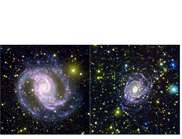
False-colour images of two galaxies, NGC 1566 (left) and NGC 6902 (right), showing their different proportions of very massive stars. Regions with massive O stars show up as white or pink, while less massive B stars appear in blue. NGC 1566 is much richer in O stars than is NGC 6902. The images combine observations of UV emission by NASA's Galaxy Evolution Explorer spacecraft and H-alpha observations made with the Cerro Tololo Inter-American Observatory (CTIO) telescope in Chile. NGC 1566 is 68 million light years away in the southern constellation of Dorado. NGC 6902 is about 33 million light years away in the constellation Sagittarius. Photo by: NASA/JPL-Caltech/JHU
(PhysOrg.com) -- An international team of researchers has debunked one of astronomy's long held beliefs about how stars are formed, using a set of galaxies found with CSIRO’s Parkes radio telescope.
When a cloud of interstellar gas collapses to form stars, the stars range from massive to minute.
Since the 1950s astronomers have thought that in a family of new-born stars the ratio of massive stars to lighter ones was always pretty much the same — for instance, that for every star 20 times more massive than the Sun or larger, you’d get 500 stars the mass of the Sun or less.
“This was a really useful idea. Unfortunately it seems not to be true,” said team research leader Dr Gerhardt Meurer of Johns Hopkins University in Baltimore.
FLV player
Working with a set of galaxies found with CSIRO’s Parkes radio telescope, an international team of researchers has debunked one of astronomers’ most cherished ideas about how stars are formed. (5:32)
The different numbers of stars of different masses at birth is called the ‘initial mass function’ (IMF).Most of the light we see from galaxies comes from the highest mass stars, while the total mass in stars is dominated by the lower mass stars.
By measuring the amount of light from a population of stars, and making some corrections for the stars’ ages, astronomers can use the IMF to estimate the total mass of that population of stars.
Results for different galaxies can be compared only if the IMF is the same everywhere, but Dr Meurer’s team has shown that this ratio of high-mass to low-mass newborn stars differs between galaxies.
For instance, small 'dwarf' galaxies form many more low-mass stars than expected.
To arrive at this finding, Dr Meurer’s team used galaxies from the HIPASS Survey (HI Parkes All Sky Survey) done with CSIRO’s Parkes radio telescope.
“All of these galaxies were detected with the Parkes telescope because they contain substantial amounts of neutral hydrogen gas, the raw material for forming stars, and this emits radio waves,” said CSIRO’s Dr Baerbel Koribalski, a member of Dr Meurer’s team.
Selecting galaxies on the basis of their neutral hydrogen gave a sample of galaxies of many different shapes and sizes, unbiased by their star formation history.
The astronomers measured two tracers of star formation, ultraviolet and H-alpha emissions, in 103 galaxies using NASA’s GALEX satellite and the 1.5-m CTIO optical telescope in Chile.
H-alpha emission traces the presence of very massive stars called O stars, which are born with masses more than 20 times that of the Sun.
The UV emission, traces both O stars and the less massive B stars — overall, stars more than three times the mass of the Sun.
Meurer’s team found that this ratio, of H-alpha to UV emission, varied from galaxy to galaxy, implying that the IMF also did, at least at its upper end.
Their work confirms tentative suggestions made first by Veronique Buat and collaborators in France in 1987, and then a more substantial study last year by Eric Hoversteen and Karl Glazebrook working out of Johns Hopkins and Swinburne Universities that suggested the same result.
“This is complicated work, and we’ve necessarily had to take into account many factors that affect the ratio of H-alpha to UV emission, such as the fact that B stars live much longer than O stars,” Dr Meurer said.
Dr Meurer’s team suggests the IMF seems to be sensitive to the physical conditions of the star-forming region, particularly gas pressure.
For instance, massive stars are most likely to form in high-pressure environments such as tightly bound star clusters.
The team’s results allow a better understanding of other recently observed phenomena that have been puzzling astronomers, such as variation of the ratio of H-alpha to ultraviolet light as a function of radius within some galaxies. This now makes sense as the stellar mix varying as the pressure drops with radius (just like the pressure varies with altitude on the Earth).
Importantly, the team also found that essentially all galaxies rich in neutral hydrogen seem to form stars.
“That means surveys for neutral hydrogen with radio telescopes will find star-forming galaxies of all kinds,” Dr Meurer said.
The Australian SKA Pathfinder, the next-generation radio telescope now being developed by CSIRO, will find neutral hydrogen gas in half a million galaxies, allowing a comprehensive examination of star-formation in the nearby universe.
Provided by CSIRO (news : web)


I think the interesting part (not discussed in the article) is how this affects the estimations of the amount of dark matter in the universe.
I was thinking as I was reading the article the same thing - if the ratio of massive to lighter stars isn't always the same, that might affect our calculations of the total mass of the universe, which (I hope) would finally answer the "dark matter" questions and theories (which I was recently discussing in another Physorg thread as probably being a "we need a formula" issue).
http://www.physor...408.html
DozerIAm - Aug 12, 2009
Dark Matter is a hypothetical concept to paper over the butts of physicists who's gravitation formulae come shy for what the mass of the universe should be. So rather than chasing possibly non-existent matter, why aren't we making better formulae to predict the behavior of gravitation?
You have a great imagination that has nothing to do with reality.
Clouds of gas do not collapse to form stars. Stars form on the gravitational wells of pre-existing objects.
Like the neutron star at the core of the Sun http://tinyurl.com/2et3mc
See: "Isotopes tell origin and operation of the Sun," AIP Conference Proceedings, volume 822 (2006) pages 206-225
http://arxiv.org/.../0510001
With kind regards,
Oliver K. Manuel
http://www.omatumr.com
Actually all the evidence is against you on this.
Are you ever going to settle on which is Iron or Neutron? You are so certain you are right yet keep switching back and forth between them.
Another sign that you simply don't have clue. Or rather you simply can't understand what the clues say.
Ethelred
Sorry for the new signature. But It Needed Killun.
From QubitTamer's fake profile
Qubitwit gets the rest of August in my signature for aiming his idiocy at me. Again.
Actually it was hit as always.
Actually he does. But then he can't accept that his ideas are crap. I understand that but they are still crap.
You do know that he is retired don't you? Note that we have at least two retired scientists that have gone down the crank road here. I am not sure about another but I think that he too has gone that way. However if he hasn't it will be way cool. The guy from South Africa.
On a number of sites he would be banned for this. However business has nothing to do with it. What business is it of yours?
I have been using computers since 1979. Its what I do. That and photography and for that I need more money. Its hard to take photos at night in any case. Not impossible just hard.
I once sat at glacier point taking a series of moonlit shots of increasing length. Nowadays I could add the shots together and get better results. In between I was reading by the light of my motorcyle's parking light. Nowadays I would be using a laptop while waiting.
And yes you stay in my sig till the end of the month.
And this almost as silly as claiming there is a Neutron Star in the core of the Sun.
Now that would be a waste of time. Easier to get blood out of a turnip than to get energy from the lowest energy points in the Universe.
Ethelred
Sorry for the new signature. But It Needed Killun.
From QubitTamer's fake profile
Qubitwit gets the rest of August in my signature for aiming his idiocy at me. Again.
Know thyself
I am having fun. You are trolling me and losing. More fun.
You are on your second week of obsessing about me. So it is pretty clear just who is owned.
I believe the phrase 'get a life' applies to you. But don't bother if you don't want too.
And thank you for being so predictable. Typical of trolls on every site.
I consider myself progressive. Far better than being a Right Wing Green and Scaly Troll with delusions of grandeur.
It tells me I have better eye than you. Did I mention that I worked in photo labs for 18 years. Thank you for giving me an excuse to mention it.
Begging will still not avail you. You stay in my sig till the end of the month. Obsess all you want. Prove my point for me.
Oh and the right to way to slit your wrists is along the arm and not across. Running around the block might help but the guy that did finally called the a hospital and survived.
Ethelred
Sorry for the new signature. But It Needed Killun.
From QubitTamer's fake profile
Qubitwit gets the rest of August in my signature for aiming his idiocy at me. Again.
Translation from troll speak:
I am tired of self-inflicted harm so I will go away for awhile.
Translation from troll speak:
That way I can pretend that I am Doing Something Important while the heat of my flameout dies down.
Translation from troll speak:
I think that everyone is just like me.
Translation from troll speak:
If too many people cheer my absence I will wait longer for it to get cooler.
Even this abject surrender won't get you out of my sig till the end of August.
-----------------^===
QubitTroll's Arm ===
-----------------~===
Ethelred
Sorry for the new signature. But It Needed Killun.
From QubitTamer's fake profile
Qubitwit gets the rest of August in my signature for aiming his idiocy at me. Again.