Deadly heat waves are becoming more frequent in California

August 25, 2009
This photos shows a setting sun. Credit: Corbis
From mid July to early August 2006, a heat wave swept through the southwestern United States. Temperature records were broken at many locations and unusually high humidity levels for this typically arid region led to the deaths of more than 600 people, 25,000 cattle and 70,000 poultry in California alone.
An analysis of this extreme episode carried out by researchers at Scripps Institution of Oceanography, UC San Diego, put this heat wave in the context of six decades of observed heat waves. Their results suggest that such regional extremes are becoming more and more likely as climate change trends continue.
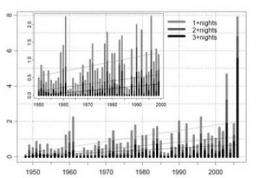
An index of regional summertime heat wave activity that reflects intensity, duration and spatial extent of heat waves over California and Nevada. The index is computed using nighttime (minimum) temperatures for local durations of at least one, two and three consecutive days/nights. Credit: Scripps Institution of Oceanography, UC San Diego
The team, led by climate scientist Alexander Gershunov, examined meteorological conditions that lead to this and other recorded heat waves, when temperatures rose into the hottest one percent of historical summertime daily and nightly temperatures recorded in California and Nevada since 1948. The scientists found that heat waves in the region often fall into either of two types: the typical "daytime" events characterized by dry daytime heat and rejuvenating nighttime cooling, or the less typical "nighttime" heat waves characterized additionally by high humidity and hot muggy days and nights. Since the early 1990s, nighttime heat wave events in California, which historically had been less common, have become more prevalent, increasing in both frequency and intensity. The pinnacle of nighttime heat waves occurred in a 17-day episode during July 2006 when a persistent warm pattern was aggravated by unusually humid conditions, associated with warm ocean waters off Baja California, Mexico."Water vapor is the main greenhouse gas. During the night in humid environments, air doesn't cool nearly as much as it does in dry conditions," said Gershunov. "Elevated humidity also causes heat waves to last longer. Hotter nights pre-condition hotter days and the cycle feeds on itself until the winds change. The weather pattern that traditionally causes heat waves in California is tending to bring with it more humidity, changing the character of heat waves from the dry daytime heat and cool nights typical for this region, to the muggy heat around the clock that locals are simply not accustomed to."
A preliminary version of the study, co-authored by Scripps climate researchers Dan Cayan and Sam Iacobellis, appeared July 27 in the online edition of the American Meteorological Society's Journal of Climate.
The 2006 event caused a wide variety of systemic impacts. One percent of the state's dairy cows succumbed, milk production was reduced by 10 percent, agriculture took a heavy toll and energy and water delivery infrastructure was stressed almost to the breaking point. Electrical blackouts were avoided, but only barely through a series of heroic measures by California's electrical power managers. Additionally, the heat wave impacted emergency and social service networks as well as natural ecosystems.
The 2006 pattern of extreme muggy heat is actually part of a trend of increasing nighttime heat wave activity observed over the last six decades. This trend has accelerated since the 1980s and has become especially prevalent in this decade. The nighttime heat waves of 2001, 2003 and 2006 were each unprecedented on record when they occurred. The source of the moisture that propelled the heat wave was an area of the eastern Pacific Ocean where a strong increase in sea surface temperatures has been observed and linked to global-scale trends of human-induced warming of the upper oceans.
Humidity is the key ingredient forming muggy nighttime heat waves. That same humidity usually provides some daytime relief by stoking afternoon cloud formation. The authors note that in the 2006 event, however, and to a lesser degree in the next largest 2003 event, the convection that usually triggers afternoon cooling was stifled.
"This conspicuous relative absence of convection in the presence of so much moisture led to intense daytime warming which in turn promoted more intense and extensive nighttime heat, without any observed precedent," the researchers wrote.
While mechanisms driving this regional anomaly are still under investigation, the researchers concluded that the trend towards more frequent and larger-scale muggy heat waves should be expected to continue in the region as climate change evolves over the next decades.
-
Researchers Find Evidence of Warming Climate In Ohio
Oct 08, 2007 |
not rated yet |
0
-
Heat Waves of the 21st Century: More Intense, More Frequent and Longer Lasting
Aug 12, 2004 |
not rated yet |
0
-
Long heat waves boost hospital admissions
Aug 09, 2007 |
not rated yet |
0
-
California heat wave may be global warming
Jul 25, 2006 |
not rated yet |
0
-
Projected California warming promises cycle of more heat waves, energy use for next century
Jul 10, 2008 |
not rated yet |
0
-
Engineers build first sub-10-nm carbon nanotube transistor
Feb 01, 2012 |
4.9 / 5 (32) |
30
-
Something old, something new: Evolution and the structural divergence of duplicate genes
Jan 31, 2012 |
4.6 / 5 (7) |
1
-
The hidden nanoworld of ice crystals: Revealing the dynamic behavior of quasi-liquid layers
Jan 30, 2012 |
5 / 5 (4) |
1
-
Stock market network reveals investor clustering
Jan 27, 2012 |
3.9 / 5 (23) |
8
-
Of microchemistry and molecules: Electronic microfluidic device synthesizes biocompatible probes
Jan 26, 2012 |
5 / 5 (2) |
0
-
Do some geologists actually act a lot like Randy Marsh?
Feb 11, 2012
-
Discrepancy between oxygen and carbon-dioxide levels
Feb 09, 2012
-
where gems are found in the world
Feb 09, 2012
-
Wind Waves in Reservoir ~ Wind run-up and Wind set-up
Feb 08, 2012
-
Balance of oxygen in the atmosphere
Feb 01, 2012
-
The case for a methanol-based economy
Jan 30, 2012
- More from Physics Forums - Earth
More news stories
Salvage workers begin pumping fuel from Italian shipwreck
Salvage workers Sunday began pumping fuel from the shipwrecked Italian cruise liner Costa Concordia, a day ahead of schedule, officials said.
1 hour ago |
not rated yet |
0
Latin America mining boom clashes with conservation
Latin America is experiencing a mining boom as prices rise fuelled by a hike in global demand, but the region is also being hit by a wave of violent protests, strikes and rallies by environmentalists.
9 hours ago |
5 / 5 (1) |
1
Political leaders play key role in how worried Americans are by climate change: study
More than extreme weather events and the work of scientists, it is national political leaders who influence how much Americans worry about the threat of climate change, new research finds.
Feb 06, 2012 |
5 / 5 (6) |
73
NASA budget will axe Mars deal with Europe: scientists
US President Barack Obama's budget proposal to be submitted next week for 2013 will cut NASA's budget by 20 percent and eliminate a major partnership with Europe on Mars exploration, scientists said Thursday.
Space & Earth / Space Exploration
Feb 10, 2012 |
5 / 5 (3) |
55
Humans may have helped the decline of African rainforests 3000 years ago
(PhysOrg.com) -- Large areas of rainforests in Central Africa mysteriously disappeared over three thousand years ago, to be replaced by savannas. The prevailing theory has been that the cause was a change ...
Lab study raises questions over nano-particle impact
Tests involving chickens have raised questions about the impact on health from engineered nano-particles, the ultra-fine grains commonly used in drugs and processed foods, scientists said on Sunday.
Iran blocks email, restricts net access: reports
Iran has further restricted access to the Internet and blocked popular email services for the past few days, in a move a top lawmaker said could "cost the regime dearly," media reports said on Sunday.
Scientists discover molecular secrets of 2,000-year-old Chinese herbal remedy
For roughly two thousand years, Chinese herbalists have treated Malaria using a root extract, commonly known as Chang Shan, from a type of hydrangea that grows in Tibet and Nepal. More recent studies suggest that halofuginone, ...
New method to examine batteries -- MRI from the inside
There is an ever-increasing need for advanced batteries for portable electronics, such as phones, cameras, and music players, but also to power electric vehicles and to facilitate the distribution and storage of energy derived ...
A mitosis mystery solved: How chromosomes align perfectly in a dividing cell
Although the process of mitotic cell division has been studied intensely for more than 50 years, Whitehead Institute researchers have only now solved the mystery of how cells correctly align their chromosomes during symmetric ...
Starve a virus, feed a cure? Findings show how some cells protect themselves against HIV
A protein that protects some of our immune cells from the most common and virulent form of HIV works by starving the virus of the molecular building blocks that it needs to replicate, according to research published online ...

Aug 25, 2009
Rank: 1 / 5 (2)
Aug 25, 2009
Rank: 5 / 5 (1)
Sep 01, 2009
Rank: not rated yet