Apple in hot water in France over 'exploding iPhones'
August 26, 2009 by Katell Abiven
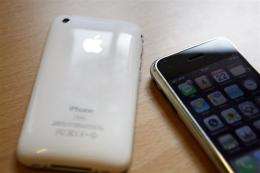
The Apple iPhone seen here in June 2009. Half a dozen new cases of "exploding iPhones" emerged in France on Wednesday, as Apple faced an official inquiry and calls to come clean over possible risks linked to its wildly popular smartphone.
Half a dozen new cases of "exploding iPhones" emerged in France on Wednesday, as Apple faced an official inquiry and calls to come clean over possible risks linked to its wildly popular smartphone.
An 80-year-old pensioner from the Paris suburbs said Wednesday his iPhone screen cracked up in his hands, a day after a supermarket watchman claimed he was hurt in the eye when his screen suddenly shattered this week.
Eight French consumers have now come forward saying their iPhone screens exploded or cracked without explanation, according to an AFP tally, including a first case in mid-August in which a teenager suffered an eye injury.
Apple is accused of trying to hush up 15 cases of iPod music players heating up and bursting into flames in the United States and in one similar British case, all apparently due to overheated lithium ion batteries.
None of the incidents has caused a serious injury but Apple was forced to defend the safety of its flagship smartphone before the European Union this month, insisting the exploding screen cases were "isolated incidents."
The US technology giant, which has sold 26 million iPhones and 200 million iPods to date, said it been informed of the French cases, but would not comment until it had examined the damaged phones.
"We are aware of these reports and we are waiting to receive the iPhones from the customers. Until we have the full details, we don't have anything further to add," Alan Hely, head of communications at Apple Europe, told AFP.
But France's official competition, consumer affairs and fraud watchdog, the DGCCRF, has launched an investigation to find out whether the Apple smartphone could pose a threat to consumers.
"An investigation is under way. We have been alerted to the problem and we are looking into it closely," a spokesman said Tuesday.
France's consumer rights group, UFC-Que Choisir, also called on Apple to come clean about possible faults with its iPod and iPhone devices.
"We want to know if this is an isolated incident as they claim, or a real problem involving the iPhone -- in which case, what are they planning by way of compensation and to prevent it happening again?" said a spokesman.
In the British case Apple came under fire for allegedly asking the young girl's family to sign a confidentiality agreement -- slammed as a "gagging order" -- before it would agree to refund her.
In the latest French incident, Rolland Caufman, a pensioner from the Paris suburb of Noisy-le-Sec, says his iPhone screen broke up on July 21, the week after he bought it.
"I went out shopping, with my iPhone in my left pocket, when I suddenly felt it heat up and start vibrating -- even though I never use the vibrate setting.
"I took it out of my pocket and held it to my ear -- and saw the screen crack up like a car windscreen," he told AFP.
Caufman says Apple initially refused to believe him, before finally sending him a free replacement.
On Tuesday, 26-year-old security guard Yassine Bouhadi, claimed he was hit in the eye with a glass shard when the screen of his iPhone cracked up. He said he would seek a full refund and file suit for damages.
French mobile phone operator Orange said it had been contacted by two customers with shattered iPhone screens, out of 1.2 million iPhones sold.
The European Commission has asked all 27 EU nations to keep it informed of any problems, under the community's rapid alert system for dangerous consumer products, known as RAPEX.
Commission spokeswoman Helen Kearns said "Apple has been very cooperative," stressing that RAPEX alerts were issued every week -- sometimes leading to mass product recalls, but at other times with no consequence.
"We're not there yet. We just need to monitor closely now and see if these are isolated incidents," she told AFP.
"We'll be vigilant and if necessary we'll take further actions. But we need to examine the situation better."
(c) 2009 AFP
-
Frenchman hurt in new 'exploding iPhone' incident
Aug 25, 2009 |
not rated yet |
0
-
Exploding iPhones 'isolated incidents', Apple assures
Aug 18, 2009 |
not rated yet |
0
-
Exploding iPhone incident follows iPod reports
Aug 13, 2009 |
not rated yet |
0
-
Apple to unveil next-generation iPhone software
Mar 12, 2009 |
not rated yet |
0
-
Taiwan firm accuses Apple of patent infringement
Apr 09, 2009 |
not rated yet |
0
-
Engineers build first sub-10-nm carbon nanotube transistor
Feb 01, 2012 |
4.9 / 5 (33) |
30
-
Something old, something new: Evolution and the structural divergence of duplicate genes
Jan 31, 2012 |
4.6 / 5 (7) |
1
-
The hidden nanoworld of ice crystals: Revealing the dynamic behavior of quasi-liquid layers
Jan 30, 2012 |
5 / 5 (4) |
1
-
Stock market network reveals investor clustering
Jan 27, 2012 |
3.9 / 5 (23) |
8
-
Of microchemistry and molecules: Electronic microfluidic device synthesizes biocompatible probes
Jan 26, 2012 |
5 / 5 (2) |
0
-
How to tilt a object
3 hours ago
-
How to calculate total compressibility in liquid porous solid system
9 hours ago
-
Need help reading 3-D
Feb 11, 2012
-
A way to send and receive wireless data
Feb 11, 2012
-
Calling function with no input argument
Feb 10, 2012
-
Force free body diagram problem on gym equipment
Feb 10, 2012
- More from Physics Forums - General Engineering
More news stories
Japan scientist makes 'Avatar' robot
A Japanese-developed robot that mimics the movements of its human controller is bringing the Hollywood blockbuster "Avatar" one step closer to reality.
Feb 10, 2012 |
5 / 5 (9) |
12
Intel packs performance and reliability into its latest SSD 520 series
Intel Corporation announced today its fastest, most robust client/consumer solid-state drive (SSD) to date, the Intel Solid-State Drive 520 Series (Intel SSD 520), a 6 gigabit-per-second (gbps) SATA III SSD ...
Feb 07, 2012 |
5 / 5 (1) |
4
Google rumored to have built Heads-Up-Display glasses prototype
(PhysOrg.com) -- 9to5Google is reporting that they have received a tip from someone they believe to be a reliable source saying that Google is working on a Heads-Up-Display (HUD) pair of eye-glasses. The per ...
New Kindle Touch is an impressive e-reader
When it comes to reading digital books, tablets are all the rage. But there's a lot to like about simple e-readers, which over the past year have become both a lot cheaper and a lot less clunky.
Electronics / Consumer & Gadgets
Feb 09, 2012 |
5 / 5 (4) |
1
Apple to debut 'iPad 3' in March: report
Apple will unveil a new version of its market-ruling iPad table computer in March, according to a report in Dow Jones-owned technology blog All Things D.
Electronics / Consumer & Gadgets
Feb 09, 2012 |
1.9 / 5 (21) |
0
Scientists discover molecular secrets of 2,000-year-old Chinese herbal remedy
For roughly two thousand years, Chinese herbalists have treated Malaria using a root extract, commonly known as Chang Shan, from a type of hydrangea that grows in Tibet and Nepal. More recent studies suggest that halofuginone, ...
New method to examine batteries -- MRI from the inside
There is an ever-increasing need for advanced batteries for portable electronics, such as phones, cameras, and music players, but also to power electric vehicles and to facilitate the distribution and storage of energy derived ...
Google might launch Drive for cloud storage soon
(PhysOrg.com) -- Google's next big move, according to the Wall Street Journal, is a cloud storage service called Drive. Hardly first to the plate, Google is simply catching up to introducing its cloud reposi ...
A mitosis mystery solved: How chromosomes align perfectly in a dividing cell
Although the process of mitotic cell division has been studied intensely for more than 50 years, Whitehead Institute researchers have only now solved the mystery of how cells correctly align their chromosomes during symmetric ...
Lab study raises questions over nano-particle impact
Tests involving chickens have raised questions about the impact on health from engineered nano-particles, the ultra-fine grains commonly used in drugs and processed foods, scientists said on Sunday.
Starve a virus, feed a cure? Findings show how some cells protect themselves against HIV
A protein that protects some of our immune cells from the most common and virulent form of HIV works by starving the virus of the molecular building blocks that it needs to replicate, according to research published online ...
Aug 26, 2009
Rank: not rated yet