Found: The planet that shouldn't exist (w/ Video)
August 26, 2009
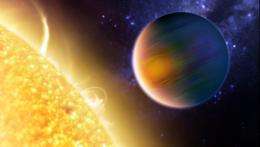
An artist's impression of a transiting exoplanet: Credit NASA/Hubble
(PhysOrg.com) -- The 'most unlikely' discovery of a new planet which could spiral into its star within the next 500,000 years, has been made by Scottish astronomers.
The find, by an international team including the University of St Andrews, is so bizarre that odds on catching it at this late stage in its life were 1000-1.
The 'huge new planet', found orbiting a star 1000 light years away, was discovered by the UK's WASP project, of which St Andrews is a founding member.
Newly-christened WASP-18b, the planet is so massive and so close to its host star that it is almost certain to spiral inwards to its destruction during the lifetime of the star.
Researchers from St Andrews are currently calculating the rate at which tidal interactions between star and planet will eventually cause the planet's orbit to decay completely.
St Andrews' physicist, Professor Andrew Collier Cameron said, "This is another bizarre WASP planet discovery. The situation is analogous to the way tidal friction is gradually causing the earth's spin to slow down, and the Moon to spiral away from the earth.
"In this case, however, the spin of the star is slower than the orbit of the planet - so the star should be spinning up, and the planet spiralling in."
WASP-18b is ten times the mass of Jupiter and orbits its star in less than one Earth-day. The new planet belongs to a now-common class of extrasolar planets known as 'hot Jupiters' - massive planets thought to have formed far from their host stars that migrated inwards over time.
The discovery, led by Keele University's Coel Hellier, suggests that WASP-18's parent star is about a billion years old - making the likelihood of observing WASP-18b about one in a thousand.
If the planet's remaining life is as short as predicted, its orbital decay should be measurable within a decade.
Professor Cameron continued, "We don't yet know how long the planet will survive, because we don't understand fully how tides operate on the Sun and other stars. It could be half a million years, or half a billion. But if it's spiralling in quickly, we should be able to see measurable changes in the orbit within ten years."
Provided by University of St Andrews
-
Planet hunters announce three new finds
Oct 31, 2007 |
not rated yet |
0
-
Huge new planet tells of game of planetary billiards
Aug 12, 2009 |
not rated yet |
0
-
Nature is 'always more crazy than we are'
Nov 16, 2005 |
not rated yet |
0
-
Missing planets attest to destructive power of stars' tides
Apr 27, 2009 |
not rated yet |
0
-
Scientists discover new planet orbiting dangerously close to giant star
Nov 18, 2008 |
not rated yet |
0
-
Engineers build first sub-10-nm carbon nanotube transistor
Feb 01, 2012 |
4.9 / 5 (30) |
30
-
Something old, something new: Evolution and the structural divergence of duplicate genes
Jan 31, 2012 |
4.6 / 5 (7) |
1
-
The hidden nanoworld of ice crystals: Revealing the dynamic behavior of quasi-liquid layers
Jan 30, 2012 |
5 / 5 (3) |
1
-
Stock market network reveals investor clustering
Jan 27, 2012 |
3.9 / 5 (23) |
8
-
Of microchemistry and molecules: Electronic microfluidic device synthesizes biocompatible probes
Jan 26, 2012 |
5 / 5 (1) |
0
-
Titan's lack of impact craters
23 hours ago
-
Real pictures of black hole eating a star?
Feb 08, 2012
-
Hypothetical way to travel faster than light, but not technically exceed lightspeed
Feb 06, 2012
-
How do scientists monitor the Sun's activity?
Feb 05, 2012
-
Search patterns in observational studies
Feb 05, 2012
-
Derivation of Pogson's law
Feb 03, 2012
- More from Physics Forums - General Astronomy
More news stories
Sandy streets over the Atlantic
Thick dust from the Sahara blowing over the ocean off the western coast of Africa encounters the islands of Cape Verde, forming a wake of swirling vortex streets visible by satellite.
Space & Earth / Earth Sciences
48 minutes ago |
not rated yet |
0
Domestic consumption main contributor to Africa's growing e-waste
West Africa faces a rising tide of e-waste generated by domestic consumption of new and used electrical and electronic equipment, according to a new United Nations report. Domestic consumption makes up the majority (up to ...
20 minutes ago |
not rated yet |
0
Could Venus be shifting gear?
(PhysOrg.com) -- ESAs Venus Express spacecraft has discovered that our cloud-covered neighbour spins a little slower than previously measured. Peering through the dense atmosphere in the infrared, the ...
Space & Earth / Space Exploration
1 hour ago |
5 / 5 (3) |
2
|
Humans may have helped the decline of African rainforests 3000 years ago
(PhysOrg.com) -- Large areas of rainforests in Central Africa mysteriously disappeared over three thousand years ago, to be replaced by savannas. The prevailing theory has been that the cause was a change ...
Clam fields found at deep, low-temperature Mariana vents
(PhysOrg.com) -- Scientists have marveled at the unusual life forms thriving at high temperature hydrothermal vents of the deep ocean.
Space & Earth / Earth Sciences
1 hour ago |
not rated yet |
0
|
The power of estrogen -- male snakes attract other males
A new study has shown that boosting the estrogen levels of male garter snakes causes them to secrete the same pheromones that females use to attract suitors, and turned the males into just about the sexiest ...
Experts reveal how plants don't get sunburn
(PhysOrg.com) -- Experts at the University of Glasgow have discovered how plants survive the harmful rays of the sun.
Team isolates nerve cells involved in storing long term memory and gene proteins associated with them
(Medical Xpress) -- A research team in Taiwan has succeeded in isolating two nerve cells in fruit fly brains that are believed to be the major players in allowing for the formation of long term memories. Furthermore, ...
Fool's gold may prove an unlikely alternative to overexploited catalytic materials
Catalytic materials, which lower the energy barriers for chemical reactions, are used in everything from the commercial production of chemicals to catalytic converters in car engines. However, with current catalytic materials ...
SLAC, Stanford team focuses on high-energy electrons to treat cancer
Accelerator physicists at SLAC and cancer specialists from Stanford are working on a new technology that could dramatically reduce the time needed for cancer radiation treatments. The team ran an initial experiment ...
News of plaque-clearing drug tops week of major advances against Alzheimer's disease
In the last eight days, scientists have delivered a powerful one-two punch in the fight to defeat Alzheimer's disease. At the same time, the White House and members of Congress are proposing increases in Alzheimer's research ...
Aug 26, 2009
Rank: 5 / 5 (1)
Aug 27, 2009
Rank: 3 / 5 (1)
Aug 27, 2009
Rank: 2 / 5 (4)
Professor Cameron makes an intriguing comment:
The study of solar tides may be the way to resolve if the internal structure of the Sun is very heterogeneously layered, as we suggested*, or homogeneous as the Standard Solar Model suggests.
* http://arxiv.org/.../0609509
With kind regards,
Oliver K. Manuel
http://www.omatumr.com
Aug 27, 2009
Rank: 4 / 5 (1)
Interesting idea, but I doubt the radiation pressure could do the trick. If you had a general luminosity of the star, masses of the bodies involved, and radii you could do a quick check to see.
I'm more interested how the planet got to where it is, perhaps this system is a failed binary system? Or maybe it is just an extreme case of another hot-Jupiter.
Either way, so much cool stuff out there to find, I am glad we have more instruments dedicated to finding extrasolar planets.
Aug 27, 2009
Rank: 2 / 5 (1)
A huge planet very close to it's star.
Not interested.
We want planets similar to Earth, so they might have life.
Aug 27, 2009
Rank: not rated yet
But I agree JohnDoe, I'm not interested either (about hot jupiters) it's going to take perfecting their detection before we can find smaller, more rocky, and more outlying planets. Remember they're doing this by looking at the way the extra-solar sun wobbles, or by picking up what little light flickers as the planet passes by. Give it time, there is life out there.
I'm sort of upset with the title of this article. Did anyone else thing they were trying to say that they confirmed the extra-plant theory of our solar system? That's what made me read the article. (But I suppose if they called it "another hot-jupiter planet found" not too many people would read it.)
Aug 27, 2009
Rank: 4 / 5 (1)
("if it's spiralling in quickly, we should be able to see measurable changes in the orbit within ten years.")
Aug 27, 2009
Rank: not rated yet
Now, a new planet is found to be spiraling around its home sun.
The reason for spiraling is to be found as well. Whatever the reason might be, it can give us a clue to the fate of Earth millions to billions of years from now.
Aug 27, 2009
Rank: 2 / 5 (4)
Because the Moon was ejected from the Earth and Earth was ejected from the Sun: http://tinyurl.com/359q3u
The question is this: Does the presence of a Jupiter-like planet close to the remnant star mean that rocky, dense, Earth-like planets have already been eaten?
With kind regards,
Oliver K. Manuel
http://www.omatumr.com
Aug 27, 2009
Rank: 4 / 5 (1)
I think that helioseismology (the measurement of Sunquakes/sound waves on the Sun) would be more useful, since the mechanics of sound/pressure wave propagation are well known, and observations have been done already.
Aug 28, 2009
Rank: not rated yet
Aug 28, 2009
Rank: 5 / 5 (2)
Aug 28, 2009
Rank: not rated yet
Aug 31, 2009
Rank: not rated yet
Mathematical Breakthrough
It is now mathematical proven that the decelerating force that affected the Pioneer probes and the accelerating force that had caused many Fly-by anomalies:
1.) Both affect the Earth (and the planets) as well, - and with full force.
2.) Automatically equalize each other (when affecting the planets).
3.) This explains the cause of the WASP-18b mystery and all the probes anomalies as well.
http://www.scienc...aly.html
Aug 31, 2009
Rank: not rated yet
Sep 01, 2009
Rank: not rated yet
You must read the whole chapter, and follw all links, then you will see the two new unknown forces equalize each other. Its the excactly smae that happens with WASP-18b. We will certianly find more such planet, also these will be stable in their orbit, (not approaching the Star)- Yes we have to wait and see to be sure. Just remember, BIG surprise / chock to science is coming.
Sep 02, 2009
Rank: not rated yet
However, you seem to take Y-1 (Y=1/sqrt(1-(v/c)^2)) to be an deceleration; however, Y is dimensionless it cannot, by itself, be any dimensionful quantity (e.g. velocity, acceleration, etc.). The acceleration of an object is slightly different (from the classical formula) in relativity, and does involve a factor of Y when one converts between frames. The lorentz invariant quantity analogous to acceleration is the 4-vector ((1/c)dE/dt,Ax*Y,Ay*Y,Az*Y) where E=Ymc^2 and Ax,Ay,Az are the accelerations in the x,y, and z directions, respectively, in the frame in which one is calculating the dynamics. (the vector is invariant in that its magnitude remains the same before and after a lorentz transformation/boost)
On the site, it is actually demonstrated that the "space wind" and "resistance" do not cancel; which is attributed to outside factors which are assumed to make the orbit stable (in order for the planet to exist long enough that the observation of the planet at this point in its existence not be of extremely low probability).
Sep 03, 2009
Rank: not rated yet
Sep 03, 2009
Rank: not rated yet
Y express bacically resistance against motion, and must hence express negative velocity.
But yes normally we use the transformation factor "dimensionless" to find KE or M incrase. Anyway its a process taking place 1.) resistance increase = (negative velocity) = 2.) KE increase = 3.) Mass increase. If you think the negative velocity (per s.) is wrong, what would you say is the correct one ?. I think you will agree the right one is (Y-1) right ?
The "space-wind" doesn't equalize 100 % with each "resistance" right. - But it is also explained that the inner planets contributes to sets space into circulation and hence also transfer KE to the outer planets, exactly like the "space-wind" following the suns does.
Sep 03, 2009
Rank: not rated yet
Suppose we set up an ideal situation in which there are two point masses, with one much more mass than the other. In this system, neither body is spinning, so there is no contribution due to "space-wind" (or anything else, there is only space and the two objects), but there is a deceleration due to "resistance". This deceleration implies that there are no stable orbits, any bound orbit will eventually decay to one with a smaller semi-major axis (asymptotically approaching the central object). At the very least, this theory would seem to violate energy conservation unless the energy goes into space itself (then the question becomes, what happens to it there?).
Sep 04, 2009
Rank: not rated yet
It should be 2 (discovered ) big planets in orbit around the motherstar WASP-18. ....
The thing is: that the rotation velocity of the Star is very important for the strenght of the "space-wind" (centrifugal-force).
If WASP-18b was in orbit (the same distance) around our Sun, it would die much faster (few million years) because our sun rotates 6 times slower, than the mother star WASP-18
This mean you can use the equation RMm/Q/r^2 to forecast a lot, - e.g; that it MUST be possible to find more very closee orbiting planets around other FAST rotating stars as well, but you will NOT find such not around the SLOW rotating stars.
And you can forescast that the exoplanets must follow the same pattern as showed to the site (science27.com)
Also the two forces in these cases must equalize each othe. I will research this now and update the site later...(PS..If this is not perfect english, I hope you can live with it)..