Rats' mental 'instant replay' drives next moves
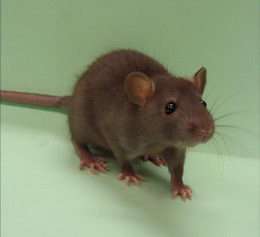
(PhysOrg.com) -- Researchers at MIT’s Picower Institute for Learning and Memory have found that rats use a mental instant replay of their actions to help them decide what to do next, shedding new light on how animals and humans learn and remember.
The work will appear in the Aug. 27 issue of the journal Neuron.
“By understanding how thoughts and memories are structured, we can gain insight into how they might be disrupted in diseases and disorders of memory and thought such as Alzheimer's and schizophrenia,” said study author Matthew A. Wilson, the Sherman Fairchild Professor of Neuroscience at the Picower Institute. “This understanding may lead to new methods of diagnosis and treatment.”
Wilson’s laboratory explores how rats form and recall memories by recording — with an unprecedented level of accuracy — the activity of single neurons in the hippocampus while the animal is performing tasks, pausing between actions and sleeping. The hippocampus is the seahorse-shaped brain region researchers believe to be critical for learning and memory.
Wilson’s previous work has shown that after the animals run a maze, their brains “replay” during sleep the sequence of events they experienced while awake. Researchers believe this process is key to sleep-reinforced memory consolidation in both animals and humans.
The latest study shows that these sequences also occur when the animals are awake and may help them decide what to do next.
Not-so-instant replay
When a rat moves through a maze, certain neurons called “place cells,” which respond to the animal’s physical environment, fire in patterns and sequences unique to different locations. By looking at the patterns of firing cells, researchers can tell which part of the maze the animal is running.
While the rat is awake but standing still in the maze, its neurons fire in the same pattern of activity that occurred while it was running. The mental replay of sequences of the animals’ experience occurs in both forward and reverse time order.
“This may be the rat equivalent of ‘thinking,’” Wilson said. “This thinking process looks very much like the reactivation of memory that we see during non-REM dream states, consisting of bursts of time-compressed memory sequences lasting a fraction of a second.
“So, thinking and dreaming may share the same memory reactivation mechanisms,” he said.
Memory’s building blocks
“This study brings together concepts related to thought, memory and dreams that all potentially arise from a unified mechanism rooted in the hippocampus,” said co-author Fabian Kloosterman, senior postdoctoral associate.
The team’s results show that long experiences, which in reality could have taken tens of seconds or minutes, are replayed in only a fraction of a second. To do this, the brain links together smaller pieces to construct the memory of the long experience.
The researchers speculated that this strategy could help different areas of the brain share information — and deal with multiple memories that may share content — in a flexible and efficient way. “These results suggest that extended replay is composed of chains of shorter subsequences, which may reflect a strategy for the storage and flexible expression of memories of prolonged experience,” Wilson said.
Moreover, by comparing the content of the replay with the rat's physical location on the track and his actual behavior immediately before and after the replay event the researchers could tell the rat was not just thinking about his most recent experience but also about other options, such as: "What if I turned around and went back the way I came?" or "How would I get here if my starting point is at a distant location?"
This suggests that the same brain mechanisms come into play to remember the past and consider future actions, reinforcing recent work by neuroscientists outside of MIT who determined that in humans, cognitive processes related to episodic recall and evaluation of future events overlap to a high degree.
Memory formation and future planning are among the cognitive functions ravaged by diseases such as Alzheimer's disease, schizophrenia and psychosis.
“A better understanding of how we use memories, not only to learn from past experiences but also to explore our future options, can give us insights into how the system fails under these disease conditions,” Kloosterman said.
The MIT researchers plan to further explore the link between awake replay and cognition in animals engaged in more cognitively demanding tasks such as those involving multiple choices, where the rat has to make a decision ("do I go left or right?") based on a prior learned rule.
In addition to Wilson, the study was led jointly by Kloosterman and MIT brain and cognitive sciences graduate student Thomas J. Davidson.
Provided by Massachusetts Institute of Technology (news : web)


