Safer, Denser Acetylene Storage in an Organic Framework
August 26, 2009 Safer, denser acetylene storage in an organic framework

Enlarge

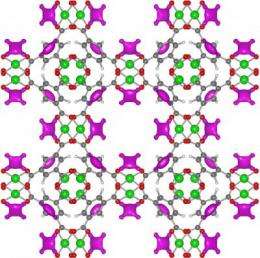
This closeup image of the HKUST-1 metal-organic framework (MOF), recently obtained by NIST scientists, reveals that copper atoms (green) are exposed to the open air within the MOF's lattice-like structure. The exposed copper allows the MOF to safely store acetylene (magenta) up to 100 times more densely than current methods. Credit: Liu, NIST

(PhysOrg.com) -- The century-old challenge of transporting acetylene may have been solved in principle by a team of scientists working at the National Institute of Standards and Technology. A NIST research team has figured out why a recently discovered material can safely store at low pressure up to 100 times as much of the volatile chemical as can be done with conventional methods.

The team has probed the atomic-level workings of a metal-organic framework (MOF), a lattice-like structure made of and benzene, that soaks up acetylene like a sponge. Using tools at the NIST Center for Neutron Research (NCNR), the scientists have shown that exposed copper atoms within the lattice give the MOF its talent at storing acetylene. The findings, according to NCNR physicist Yun Liu, could be of use to the chemical industry in the future.

“This discovery could provide substantial savings in acetylene transportation costs,” says Liu, a member of the research team, which also included scientists from the University of Texas at San Antonio.

Acetylene, widely used in decades past for welding and illumination, is now also valuable as a starting point for synthesizing a range of chemicals used in plastics and explosives. In the United States alone, several hundred thousand tons of acetylene are produced every year, but its volatility renders it difficult to transport: It becomes dangerously explosive at about 30 psi (207 kilopascal), only about twice normal . To safely store acetylene, storage cylinders have to be filled with both and liquid solvents such as .

The research team used neutron powder diffraction and computer calculations at the NCNR to investigate an MOF called HKUST-1, which has a sponge-like interior in which copper atoms are exposed to the air. The analysis showed that the acetylene attaches to the exposed copper by virtue of weak electrical charges, allowing the MOF to store 201 cubic centimeters of acetylene per gram of lattice at ambient pressure—comparable to the amount of similar chemicals that can be contained within a high pressure storage cylinder.

Liu says the fundamental discovery could also help scientists better understand MOFs, which could be used to store other materials. “More than a thousand of these metal—organic frameworks have been created so far,” he says. “We hope our technique will turn out to be a good way to check such materials’ properties in advance.”

More information: S. Xiang, W. Zhou, J.M. Gallegos, Y. Liu, and B. Chen. Exceptionally High Acetylene Uptake in a Microporous Metal - Organic Framework With Open Metal Sites. Journal of the American Chemical Society, Aug. 11, 2009, DOI 10.1021/ja904782h .

Source: National Institute of Standards and Technology (news : web)


print this article email this article download pdf blog this article bookmark this article     Stumble it Digg this share on Facebook retweet share on Reddit add to delicious
Rate this story - 4.4 /5 (5 votes)

Rank Filter

Move the slider to adjust rank threshold, so that you can hide some of the comments.


Display comments: newest first

  • Nik_2213 - Aug 26, 2009
    • Rank: not rated yet
    Is this sufficiently energy-dense for rocketry ?
  • sender - Aug 27, 2009
    • Rank: not rated yet
    Using two types of MOF's with varying electromechanical properties and cycling acetylene or another compound between them could offer new supercapacitor battery potential.
  • theken101 - Sep 04, 2009
    • Rank: not rated yet
    Might make an interesting bomb, with electric-arc ignition. Something the military might look into...

August 26, 2009 all stories

Comments: 3

4.4 /5 (5 votes)
  • Stumble this up

  • Digg this

  • share this

  • hide
  • Related Stories

  • More Solid than Solid: A Potential Hydrogen-Storage Compound
    created Apr 02, 2008 | popularity not rated yet | comments 0
  • New research could lead to practical uses for metal-organic frameworks
    created Sep 25, 2008 | popularity not rated yet | comments 0
  • Zinc-based nano-cages store hydrogen
    created Dec 02, 2005 | popularity not rated yet | comments 0
  • New methane storage technology exceeds DOE goals
    created Jan 21, 2008 | popularity not rated yet | comments 0
  • New nanoporous material has highest surface area yet
    created Mar 09, 2009 | popularity not rated yet | comments 0


  • hide
  • Relevant PhysicsForums posts

  • a question in Lewis structure???
    created 40 minutes ago
  • Paint Technology
    created 16 hours ago
  • About pH, Metallic electrodes
    created Nov 24, 2009
  • Goddard
    created Nov 21, 2009
  • More from Physics Forums - Chemistry

Other News

Study shows flavanol antioxidant content of US chocolate and cocoa-containing products

Chemistry / Other

created 8 minutes ago | popularity not rated yet | comments 0

A recent study confirms that the antioxidants and other plant-based nutrients in chocolate and cocoa products are highly associated with the amount of non-fat cocoa-derived ingredients in the product. The study expands on ...


A sticky solution for identifying effective probiotics

Chemistry / Biochemistry

created 19 hours ago | popularity 5 / 5 (1) | comments 0

Scientists have crystallised a protein that may help gut bacteria bind to the gastrointestinal tract. The protein could be used by probiotic producers to identify strains that are likely to be of real benefit to people.


Sandia CR5

Machine Converts CO2 into Gasoline, Diesel, and Jet Fuel

Chemistry / Biochemistry

created Nov 23, 2009 | popularity 4.6 / 5 (30) | comments 19

(PhysOrg.com) -- Researchers at Sandia National Laboratories have built a machine that uses the sun's energy to convert carbon dioxide waste from power plants into transportation fuels such as gasoline, diesel, ...


New hydrogen-storage method discovered

New hydrogen-storage method discovered

Chemistry / Materials Science

created Nov 22, 2009 | popularity 4.3 / 5 (41) | comments 15

Scientists at the Carnegie Institution have found for the first time that high pressure can be used to make a unique hydrogen-storage material. The discovery paves the way for an entirely new way to approach ...


New on-off 'switch' triggers and reverses paralysis in animals with a beam of light

New on-off 'switch' triggers and reverses paralysis in animals with a beam of light (w/ Video)

Chemistry / Biochemistry

created Nov 18, 2009 | popularity 4.8 / 5 (5) | comments 4

In an advance with overtones of Star Trek phasers and other sci-fi ray guns, scientists in Canada are reporting development of an internal on-off "switch" that paralyzes animals when exposed to a beam of ultraviolet ...