Extinct Mammal Used its 'Sweet Spot' to Club Rivals
August 27, 2009 by Lin Edwards Extinct Mammal Used its 'Sweet Spot' to Club Rivals

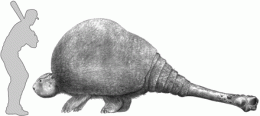
Artistic reconstruction of Doedicurus clavicaudatus, with a human for scale. The distal rigid caudal sheath and the mobile free rings are shown. Adapted from Ubilla et al. (2008) (fig. 13.3, with permission of Perea, D. ed. 2008).

(PhysOrg.com) -- Scientists in Uruguay studying extinct mammals called glyptodonts have discovered they used a "sweet spot" in their tails, just like baseball players use the center of percussion (CP), or sweet spot, in their bats to hit the ball with maximum power and minimum chance of injury.

Glyptodonts lived in the late Eocene to the early Holocene, spreading northwards from South America, and becoming extinct some 8-11,000 years ago. They were heavily armored giants resembling armadillos, and they were equipped with a lethal tail with a spiked club at the end.

The new research, published in the , studied several species of glyptodonts. Leader of the team, Dr R. Ernesto Blanco, said the research was inspired by earlier studies of sports equipment such as golf clubs and baseball bats, which calculated the position of the center of percussion (CP) or sweet spot on the sports tool. As any baseball hitter will tell you, you get the best results if you hit the ball at the bat's sweet spot since this delivers maximum power, but produces the least amount of force in the athlete's wrist and arm, reducing the chance of injury.

Blanco and his colleagues Washington W. Jones, and Andres Rinderknecht, decided to use the same methods as the sports studies to determine the location of the sweet spot on the tails of the glyptodonts. They studied fossilized remains of glyptodonts in the collections of three South American museums, and found that in many species of glyptodonts, such as Doedicurus clavicaudatus, the ball of bony plates at the end of the tail was located at the center of percussion.

The plates were fused, turning the tail into a rigid weapon that concentrated the force onto the sweet spot in the tail's club, which is believed to have been covered in large horny spikes. The scientists likened the flexible part of the glyptodont's tail to a tennis player's arm, and the rigid club at the end of the tail to the tennis racket, with the sweet spot under the largest spikes.

Having the sweet spot in the position of the largest spikes meant the glyptodont tail clubs must have been extremely effective weapons capable of inflicting damaging blows, but with minimal risk of injuring the vertebrae in the tail. Despite their huge size glyptodonts were pretty nimble creatures able to turn 180 degrees while standing on their hind legs and swinging their tails laterally at speeds of up to 49 feet per second.

The scientists believe the glyptodonts used their tails primarily against other glyptodonts in ritualized combats over territory and sexual mates. Possessing a spiked tail club was also undoubtedly useful for fighting off predators, such as South America's 650 pound terror birds, saber-toothed cats, and other giants, but the scientists' results suggest the tails were better suited to more stationary situations than fighting off fast predators.

More information: The sweet spot of a biological hammer: the centre of percussion of glyptodont (Mammalia: Xenarthra) tail clubs; Proc. R. Soc. B published online before print August 26, 2009, doi:10.1098/rspb.2009.1144

© 2009 PhysOrg.com


print this article email this article download pdf blog this article bookmark this article     Stumble it Digg this share on Facebook retweet share on Reddit add to delicious
Rate this story - 4.3 /5 (4 votes)

Rank Filter

Move the slider to adjust rank threshold, so that you can hide some of the comments.


Display comments: newest first

  • otto1923 - Aug 27, 2009
    • Rank: 5 / 5 (1)
    Glyptodonts- we can rebuild them... We have the technology. And to give them something to fight, bring back the Terror Birds. Shrieking, wailing banshees in the Night.
  • gmurphy - Aug 27, 2009
    • Rank: not rated yet
    right on man!
  • enantiomer2000 - Aug 28, 2009
    • Rank: not rated yet
    right on brother. i dont go anywhere without my mutated anthrax... for duck huntin'.

August 27, 2009 all stories

Comments: 3

4.3 /5 (4 votes)
  • Stumble this up

  • Digg this

  • share this

  • hide
  • Related Stories

  • Primitive early relative of armadillos helps rewrite evolutionary family tree
    created Dec 12, 2007 | popularity not rated yet | comments 0
  • More flight than fancy?
    created Apr 05, 2007 | popularity not rated yet | comments 0
  • Mercury's 'tail' is longer than thought
    created Feb 27, 2008 | popularity not rated yet | comments 0
  • To maximize biofuel potential, researchers look for sorghum's 'sweet spot'
    created Sep 12, 2007 | popularity not rated yet | comments 0
  • Long, sexy tails not a drag on male birds
    created Mar 12, 2009 | popularity not rated yet | comments 0


  • hide
  • Relevant PhysicsForums posts

  • Selenocysteine in pH=7
    created 10 hours ago
  • What is the formula for calculating the speed of thought?
    created 15 hours ago
  • What does word "absorption" mean in the intestine?
    created 15 hours ago
  • What is transpulmonary pressure?
    created Nov 24, 2009
  • More from Physics Forums - Biology

Other News

First-ever blueprint of a minimal cell is more complex than expected

First-ever blueprint of a minimal cell is more complex than expected

Biology / Cell & Microbiology

created 7 hours ago | popularity 5 / 5 (10) | comments 0

What are the bare essentials of life, the indispensable ingredients required to produce a cell that can survive on its own? Can we describe the molecular anatomy of a cell, and understand how an entire organism ...


The six elephants in Sierra Leone were shot and "crudely butchered"

S.Leone elephants 'wiped out' by poachers: official

Biology / Ecology

created 9 hours ago | popularity 5 / 5 (4) | comments 5

Poachers "wiped out" the entire elephant herd in Sierra Leone's only wildlife park, wildlife managers said Thursday after police said they had arrested a gang of 10 poachers.


Ecological speciation by sexual selection on good genes: Is speciation adaptive?

Biology / Ecology

created 8 hours ago | popularity 5 / 5 (1) | comments 0

Darwin suggested that the action of natural selection can produce new species, but 150 years after the publication of his famous book, 'On the Origin of Species', debate still continues on the mechanisms of speciation. New ...


Knockouts in human cells point to pathogenic targets

Knockouts in human cells point to pathogenic targets

Biology / Cell & Microbiology

created 11 hours ago | popularity not rated yet | comments 0

(PhysOrg.com) -- Whitehead researchers have developed a new approach for genetics in human cells and used this technique to identify specific genes and proteins required for pathogens.


Whiteflies sabotage alarm system of plant in distress

Whiteflies sabotage alarm system of plant in distress

Biology / Plants & Animals

created 12 hours ago | popularity 5 / 5 (1) | comments 0

(PhysOrg.com) -- When spider mites attack a bean plant, the plant responds by producing odours which attract predatory mites. These predatory mites then exterminate the spider mite population, thus acting ...