Scientists improve delivery of cancer-fighting molecules
August 27, 2009 U-Iowa improves delivery of cancer-fighting molecules

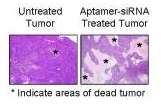
A mouse tumor treated with an aptamer-siRNA combination (right) shows many dead areas (indicated by the asterisks), whereas an untreated tumor (left) is still largely intact. Delivering siRNA successfully to specific cells has been challenging. UI researchers modified siRNA so that it could be injected into the bloodstream and impact only targeted cells. Credit: University of Iowa

Small interfering RNA (siRNA), a type of genetic material, can block potentially harmful activity in cells, such as tumor cell growth. But delivering siRNA successfully to specific cells without adversely affecting other cells has been challenging.

University of Iowa researchers have modified siRNA so that it can be injected into the bloodstream and impact targeted cells while producing fewer side effects. The findings, which were based on animal models of prostate , also could make it easier to create large amounts of targeted therapeutic siRNAs for treating cancer and other diseases. The study results appeared online Aug. 23 in the journal .

"Our goal was to make siRNA deliverable through the bloodstream and make it more specific to the genes that are over expressed in cancer," said the study's senior author Paloma Giangrande, Ph.D., assistant professor of internal medicine and a member of Holden Comprehensive Cancer Center.

In previous research completed at Duke University, Giangrande's team showed that a compound called an aptamer can be combined with siRNA to target certain genes. When the combined molecule is directly injected into tumors in animal models, it triggers the processes that stop tumor growth. However, directly injecting the combination into tumors in humans is difficult.

In the new study, the researchers trimmed the size of a prostate cancer-specific aptamer and modified the siRNA to increase its activity. Upon injection into the bloodstream, the combination triggered tumor regression without affecting normal tissues.

Making the aptamer-siRNA combination smaller makes it easier to produce large amounts of it synthetically, Giangrande said.

The team also addressed the problem that large amounts of siRNA are needed since most of it gets excreted by the kidneys before having an effect. To keep siRNA in the body longer and thereby use less of it, the team modified it using a process called PEGlyation.

"If you want to use siRNA effectively for clinical use, especially for cancer treatment, you need to deliver it through an injection into the , reduce the amount of side effects and be able to improve its cost-effectiveness. Our findings may help make these things possible," Giangrande said.

Although the current study focused on prostate cancer, the findings could apply to other cancers and diseases. Giangrande said the next step is to test the optimized aptamer-siRNA compound in a larger .

Source: University of Iowa (news : web)


print this article email this article download pdf blog this article bookmark this article     Stumble it Digg this share on Facebook retweet share on Reddit add to delicious
Rate this story - not rated yet


August 27, 2009 all stories

Comments: 0

not rated yet
  • Stumble this up

  • Digg this

  • share this

  • hide
  • Related Stories


  • hide
  • Relevant PhysicsForums posts

  • What is transpulmonary pressure?
    created Nov 24, 2009
  • Is there a gay gene?
    created Nov 23, 2009
  • Super quick question about Starling forces?
    created Nov 22, 2009
  • Questions about diffusion
    created Nov 22, 2009
  • More from Physics Forums - Biology

Other News

Variable Temperatures Leave Insects wtih a Frosty Reception

Biology / Plants & Animals

created 4 hours ago | popularity not rated yet | comments 0

(PhysOrg.com) -- For the first time, scientists at The University of Western Ontario have shown that insects exposed to repeated periods of cold will trade reproduction for immediate survival.


When camouflage is a plant's best protection

Rare woodland plant uses 'cryptic coloration' to hide from predators

Biology / Plants & Animals

created 7 hours ago | popularity 4.3 / 5 (3) | comments 0

It is well known that some animal species use camouflage to hide from predators. Individuals that are able to blend in to their surroundings and avoid being eaten are able to survive longer, reproduce, and ...


Cells defend themselves from viruses, bacteria with armor of protein errors

Biology / Cell & Microbiology

created 8 hours ago | popularity 5 / 5 (5) | comments 0

When cells are confronted with an invading virus or bacteria or exposed to an irritating chemical, they protect themselves by going off their DNA recipe and inserting the wrong amino acid into new proteins to defend them ...


'Safety valve' protects photosynthesis from too much light

Biology / Cell & Microbiology

created 8 hours ago | popularity 5 / 5 (2) | comments 0

Photosynthetic organisms need to cope with a wide range of light intensities, which can change over timescales of seconds to minutes. Too much light can damage the photosynthetic machinery and cause cell death. Scientists ...


Researchers discover biological basis of 'bacterial immune system'

Biology / Cell & Microbiology

created 9 hours ago | popularity 4.5 / 5 (2) | comments 0

Bacteria don't have easy lives. In addition to mammalian immune systems that besiege the bugs, they have natural enemies called bacteriophages, viruses that kill half the bacteria on Earth every two days.