Researchers pinpoint neural nanoblockers in carbon nanotubes
August 27, 2009 Researchers pinpoint neural nanoblockers in carbon nanotubes

Enlarge

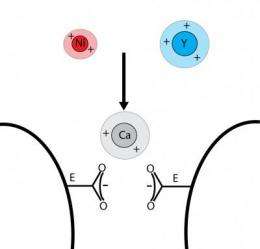
Metal catalysts -- nickel and particularly yttrium -- used to create carbon nanotubes can block a key signaling pathway in neurons. Experiments show the metal particles tend to plug cellular pores normally reserved for calcium ions. Credit: Lorin Jakubek / Brown University

Carbon nanotubes hold many exciting possibilities, some of them in the realm of the human nervous system. Recent research has shown that carbon nanotubes may help regrow nerve tissue or ferry drugs used to repair damaged neurons associated with disorders such as epilepsy, Parkinson's disease and perhaps even paralysis.

Yet some studies have shown that carbon nanotubes appear to interfere with a critical signaling transaction in neurons, throwing doubt on the tubes' value in treating neurological disorders. No one knew why the tubes were causing a problem.

Now a team of Brown University researchers has found that it's not the tubes that are to blame. Writing in the journal Biomaterials, the scientists report that the metal catalysts used to form the tubes are the culprits, and that minute amounts of one metal — yttrium — could impede neuronal activity. The findings mean that carbon nanotubes without metal catalysts may be able to treat human neurological disorders, although other possible biological effects still need to be studied.

"We can purify the nanotubes by removing the metals," said Lorin Jakubek, a Ph.D. candidate in biomedical engineering and lead author of the paper, "so, it's a problem we can fix."

Jakubek took single-walled carbon nanotubes to the laboratory of Diane Lipscombe, a Brown neuroscientist. The researchers zeroed in on ion channels located at the end of neurons' axons. These channels are gateways of sorts, driven by changes in the voltage across neurons' membranes. When an electrical signal, known as an action potential, is triggered in neurons, these ion channels "open," each designed to take in a certain ion. One such passes only calcium, a protein that is critical for transmitter release and thus for neurons to communicate with each other.

In experiments using cloned calcium ion channels in embryonic , the scientists discovered that nickel and yttrium, two metal catalysts used to form the single-walled carbon nanotubes, were interfering with the ion channel's ability to absorb the calcium.

Because its ionic radius is nearly identical to calcium's, yttrium in particular "gets stuck and prevents calcium from entering and passing through. It's an ion pore blocker," said Lipscombe, who specializes in neuronal ion channels and is a corresponding author on the paper.

The experiments showed that yttrium in trace amounts — less than 1 microgram per milliliter of water — may disrupt normal calcium signaling in and other electrically active cells, an amount far lower than what had been thought to be safe levels. With nickel, the amount needed to impede calcium signaling was 300 times higher.

"Yttrium is so potent that ... a very low nanotube dose" would be needed to affect , said Robert Hurt, professor of engineering and a corresponding author on the paper.

Jakubek said she was surprised that the metals turned out to be the cause. "Based on the literature, I thought it would be the nanotubes themselves," she said.

Source: Brown University (news : web)


print this article email this article download pdf blog this article bookmark this article     Stumble it Digg this share on Facebook retweet share on Reddit add to delicious
Rate this story - 5 /5 (2 votes)

Rank Filter

Move the slider to adjust rank threshold, so that you can hide some of the comments.


Display comments: newest first

  • Birthmark - Aug 27, 2009
    • Rank: not rated yet
    Very interesting, a couple more years of research and this will hit it big. Great potential!
  • eliecerjorfoas - Sep 16, 2009
    • Rank: not rated yet
    Calcium is not a protein!

August 27, 2009 all stories

Comments: 2

5 /5 (2 votes)
  • Stumble this up

  • Digg this

  • share this

  • hide
  • Related Stories

  • Neuroscientists explain inner workings of critical pain pathway
    created Feb 15, 2007 | popularity not rated yet | comments 0
  • Water inside single-walled carbon nanotubes
    created Jun 25, 2008 | popularity not rated yet | comments 0
  • Possible link between different forms of epilepsy found
    created Jun 16, 2008 | popularity not rated yet | comments 0
  • New 'smart' materials for the brain
    created Dec 21, 2008 | popularity not rated yet | comments 0
  • Neurotransmitter current not flowing through ion channels
    created Aug 29, 2007 | popularity not rated yet | comments 0


  • hide
  • Relevant PhysicsForums posts

Other News

Nanotech in Space: Experiment To Weather the Trials of Orbit

Nanotech in Space: Experiment To Weather the Trials of Orbit

Nanotechnology / Nanomaterials

created 4 hours ago | popularity 4 / 5 (2) | comments 0

Novel nanomaterials developed at Rensselaer were sent into orbit on Nov. 16 aboard Space Shuttle Atlantis.


Nanoparticles used in common household items caused genetic damage in mice

Nanotechnology / Bio & Medicine

created Nov 16, 2009 | popularity 4.8 / 5 (24) | comments 11

Titanium dioxide (TiO2) nanoparticles, found in everything from cosmetics to sunscreen to paint to vitamins, caused systemic genetic damage in mice, according to a comprehensive study conducted by researchers at UCLA's Jonsson ...


Peptides control crystal growth with 'switches, throttles and brakes'

Peptides control crystal growth with 'switches, throttles and brakes'

Nanotechnology / Bio & Medicine

created Nov 23, 2009 | popularity 5 / 5 (3) | comments 0

(PhysOrg.com) -- By producing some of the highest resolution images of peptides attaching to mineral surfaces, scientists have a deeper understanding how biomolecules manipulate the growth crystals. This research ...


Water droplets direct self-assembly process in thin-film materials

Nanotechnology / Nanomaterials

created Nov 23, 2009 | popularity 5 / 5 (4) | comments 2

You can think of it as origami - very high-tech origami. Researchers at the University of Illinois have developed a technique for fabricating three-dimensional, single-crystalline silicon structures from thin films by coupling ...


Nanotube defects equal better energy and storage systems

Nanotube defects equal better energy and storage systems

Nanotechnology / Nanomaterials

created Nov 19, 2009 | popularity 4.4 / 5 (10) | comments 2

(PhysOrg.com) -- Most people would like to be able to charge their cell phones and other personal electronics quickly and not too often. A recent discovery made by UC San Diego engineers could lead to carbon ...