Study: Small fluctuations in solar activity, large influence on the climate
August 27, 2009 Earth and the Sun

Enlarge

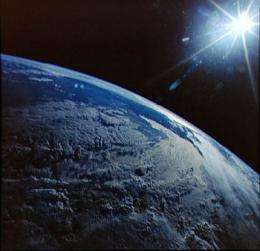
Earth and the Sun, as viewed by the Space Shuttle Discovery. (Image courtesy NASA.)

(PhysOrg.com) -- Subtle connections between the 11-year solar cycle, the stratosphere, and the tropical Pacific Ocean work in sync to generate periodic weather patterns that affect much of the globe, according to research appearing this week in the journal Science. The study can help scientists get an edge on eventually predicting the intensity of certain climate phenomena, such as the Indian monsoon and tropical Pacific rainfall, years in advance.

An international team of scientists led by the National Center for Atmospheric Research (NCAR) used more than a century of weather observations and three powerful computer models to tackle one of the more difficult questions in meteorology: if the total energy that reaches Earth from the Sun varies by only 0.1 percent across the approximately 11-year solar cycle, how can such a small variation drive major changes in weather patterns on Earth?

The answer, according to the new study, has to do with the Sun's impact on two seemingly unrelated regions. Chemicals in the stratosphere and sea surface temperatures in the respond during in a way that amplifies the Sun's influence on some aspects of air movement. This can intensify winds and , change sea surface temperatures and cloud cover over certain tropical and subtropical regions, and ultimately influence global weather.

"The Sun, the stratosphere, and the oceans are connected in ways that can influence events such as rainfall in North America," says NCAR scientist Gerald Meehl, the lead author. "Understanding the role of the solar cycle can provide added insight as scientists work toward predicting regional weather patterns for the next couple of decades."

The study was funded by the National Science Foundation, NCAR's sponsor, and by the Department of Energy. It builds on several recent papers by Meehl and colleagues exploring the link between the peaks in the solar cycle and events on Earth that resemble some aspects of La Nina events, but are distinct from them. The larger amplitude La Nina and El Nino patterns are associated with changes in surface pressure that together are known as the Southern Oscillation.

The connection between peaks in solar energy and cooler water in the equatorial Pacific was first discovered by Harry Van Loon of NCAR and Colorado Research Associates, who is a co-author of the new paper.

Top down and bottom up

The new contribution by Meehl and his colleagues establishes how two mechanisms that physically connect changes in solar output to fluctuations in the Earth's climate can work together to amplify the response in the tropical Pacific.

The team first confirmed a theory that the slight increase in solar energy during the peak production of sunspots is absorbed by stratospheric ozone. The energy warms the air in the stratosphere over the tropics, where sunlight is most intense, while also stimulating the production of additional ozone there that absorbs even more solar energy. Since the stratosphere warms unevenly, with the most pronounced warming occurring at lower latitudes, stratospheric winds are altered and, through a chain of interconnected processes, end up strengthening tropical precipitation.

At the same time, the increased sunlight at solar maximum causes a slight warming of ocean surface waters across the subtropical Pacific, where Sun-blocking clouds are normally scarce. That small amount of extra heat leads to more evaporation, producing additional water vapor. In turn, the moisture is carried by trade winds to the normally rainy areas of the western tropical Pacific, fueling heavier rains and reinforcing the effects of the stratospheric mechanism.

The top-down influence of the stratosphere and the bottom-up influence of the ocean work together to intensify this loop and strengthen the trade winds. As more sunshine hits drier areas, these changes reinforce each other, leading to less clouds in the subtropics, allowing even more sunlight to reach the surface, and producing a positive feedback loop that further magnifies the climate response.

These stratospheric and ocean responses during solar maximum keep the equatorial eastern Pacific even cooler and drier than usual, producing conditions similar to a La Nina event. However, the cooling of about 1-2 degrees Fahrenheit is focused farther east than in a typical La Nina, is only about half as strong, and is associated with different wind patterns in the stratosphere.

Earth's response to the solar cycle continues for a year or two following peak sunspot activity. The La Nina-like pattern triggered by the solar maximum tends to evolve into a pattern similar to El Nino as slow-moving currents replace the cool water over the eastern tropical Pacific with warmer water. The ocean response is only about half as strong as with El Nino and the lagged warmth is not as consistent as the La Nina-like pattern that occurs during peaks in the solar cycle.

Enhancing ocean cooling

Solar maximum could potentially enhance a true La Nina event or dampen a true El Nino event. The La Nina of 1988-89 occurred near the peak of solar maximum. That La Nina became unusually strong and was associated with significant changes in weather patterns, such as an unusually mild and dry winter in the southwestern United States.

The Indian monsoon, Pacific sea surface temperatures and precipitation, and other regional climate patterns are largely driven by rising and sinking air in Earth's tropics and subtropics. Therefore the new study could help scientists use solar-cycle predictions to estimate how that circulation, and the regional climate patterns related to it, might vary over the next decade or two.

Three views, one answer

To tease out the elusive mechanisms that connect the Sun and Earth, the study team needed three computer models that provided overlapping views of the climate system.

One model, which analyzed the interactions between and lower atmosphere, produced a small cooling in the equatorial Pacific during solar maximum years. The second model, which simulated the stratospheric ozone response mechanism, produced some increases in tropical precipitation but on a much smaller scale than the observed patterns.

The third model contained ocean-atmosphere interactions as well as ozone. It showed, for the first time, that the two combined to produce a response in the tropical Pacific during peak solar years that was close to actual observations.

"With the help of increased computing power and improved models, as well as observational discoveries, we are uncovering more of how the mechanisms combine to connect solar variability to our weather and climate," Meehl says.

More information: "Amplifying the Pacific climate system response to a small 11 year forcing", Science, August 28, 2009

Source: National Center for Atmospheric Research


Rate this story - 4.8 /5 (16 votes)

Rank Filter

Move the slider to adjust rank threshold, so that you can hide some of the comments.


Display comments: newest first

  • otto1923 - Aug 27, 2009
    • Rank: 3.7 / 5 (3)
    How is it, that our world is so delicately balanced that perturbations from the other planets or minor variations in the suns output can cause it to become an iceball or a runaway greenhouse? Yeah I read the Anthropomorphic Principle decades ago; it becomes more evident the more we realize how narrow a slot we really live in. The mystery will deepen if we dont discover life elsewhere in the system.
  • jonnyboy - Aug 27, 2009
    • Rank: 3.7 / 5 (6)
    Wait, I thought Global warming was due to CO2 and nothing but CO2?
  • Noumenon - Aug 27, 2009
    • Rank: 3.9 / 5 (7)
    Gee, who would have thought that the giant nuclear explosion in the sky 9-light minutes away would have anything to do with the earths varying climate.

    Yes Ottis, the balance is remarkable, which is why I can't buy into the 1.2*f per century caused by man theory. Whatever effect man is having is completely diluted by natural causes.
  • brianweymes - Aug 28, 2009
    • Rank: 1.7 / 5 (3)
    This study says nothing about the Sun causing Global Warming. It talks about precipitation and events like La Nina and El Nino.
  • otto1923 - Aug 28, 2009
    • Rank: 1 / 5 (1)
    @Nougyman
    Not only that... The earth seems to have the right percentage of dry arable land to oceans, and continents the right size to enable technology-producing competition among groups, These groups could diverge significantly yet maintain the ability to recombine through conquest. This competition continues to the point where we have the resultant technological ability to unite the world (per Kants 'state of nations (civitas gentium)', and to leave it to establish colonies elsewhere.

    The weight of these coincidences kind of evokes the idea of 'Providence' and the possibility that we have been 'cultured' by something greater and wiser than ourselves, eh?
  • defunctdiety - Aug 28, 2009
    • Rank: 4 / 5 (4)
    Interesting how any article that can even remotely be related to AGW in a positive way is done so, however when there's an article stating very prominently in it's title the significance of the sun in our climate, AGW does not even get a foot note. Funny how that works. Completely divisive and all too conspicuous, but funny.

    You know if you find the subjugation of mankind funny.
  • AlexJ - Aug 28, 2009
    • Rank: 3 / 5 (2)
    "Subtle connections between the 11-year solar cycle, the stratosphere, and the tropical Pacific Ocean work in sync to generate periodic weather patterns..."

    In other words, this is part of a cycle that has always been responsible for some short-term variability (like the El Nino Southern Oscillation, but of lower amplitude). It has nothing to do with the long-term warming trend. It affects the black line, not the red one:

    http://tamino.fil...ooth.jpg
  • lengould100 - Aug 31, 2009
    • Rank: 1 / 5 (1)
    You posters above pretending you know how to be AGW sceptics should go back to your grad-school classes, else you'll be late for the bell.
  • CWFlink - Sep 09, 2009
    • Rank: not rated yet
    Cycles in cycles... and we can't yet predict tomorrow's weather.

    One lesson of the past decade: "Experts" are mostly wrong... intelligence experts re 9/11 and Iraq WMD, military experts re length of Iraq war, political experts about who would win the elections, financial experts (!!! in spades !!!), climate experts re global whatever, diplomatic experts on why we are "hated" or "loved", medical experts on how much healthcare should cost, etc.

    The only solution is diversity of sources/consumers in a free market of ideas, products, services, etc.

    How many times do we have to learn that the centralization of power does not work?

August 27, 2009 all stories

Comments: 9

4.8 /5 (16 votes)

  • hide
  • Related Stories

  • Solar cycle linked to global climate
    created Jul 16, 2009 | popularity not rated yet | comments 0
  • La Niña: 'Little Girl' Makes Big Impression
    created Jan 11, 2008 | popularity not rated yet | comments 0
  • La Niña Persists
    created Nov 07, 2007 | popularity not rated yet | comments 0
  • Forecasters say El Nino may be developing
    created Jun 08, 2009 | popularity not rated yet | comments 0
  • Larger Pacific Climate Event Helps Current La Nina Linger
    created Apr 22, 2008 | popularity not rated yet | comments 0


  • hide
  • Relevant PhysicsForums posts

  • Carbon Dioxide emissions question
    created Feb 08, 2010
  • Photosynthesis vs. carbonization
    created Feb 07, 2010
  • Sheep's footprints
    created Feb 05, 2010
  • How did Victorians estimate the ages of fossils?
    created Feb 03, 2010
  • How can we defeat pollution as individuals?
    created Jan 29, 2010
  • Formation of lava fields on Lanzarote
    created Jan 27, 2010
  • More from Physics Forums - Earth

Other News

Space shuttle Endeavour pulls in at space station (AP)

Space shuttle Endeavour pulls in at space station

Space & Earth / Space Exploration

created 2 minutes ago | popularity not rated yet | comments 0

(AP) -- Shuttle Endeavour arrived to a warm welcome at the International Space Station early Wednesday, delivering a new room and observation deck that will come close to completing construction 200 miles ...


Rho Ophiuchus cloud

Professor: We have a 'moral obligation' to seed universe with life

Space & Earth / Astronomy

created 21 hours ago | popularity 3.1 / 5 (27) | comments 53 | with audio podcast report

(PhysOrg.com) -- Eventually, the day will come when life on Earth ends. Whether that’s tomorrow or five billion years from now, whether by nuclear war, climate change, or the Sun burning up its fuel, the last ...


Climate 'Tipping Points' May Arrive Without Warning, Says Top Forecaster

Space & Earth / Environment

created 10 hours ago | popularity 3 / 5 (8) | comments 7 | with audio podcast

(PhysOrg.com) -- A new University of California, Davis, study by a top ecological forecaster says it is harder than experts thought to predict when sudden shifts in Earth's natural systems will occur -- a worrisome finding ...


38 percent of world's surface in danger of desertification

38 percent of world's surface in danger of desertification

Space & Earth / Environment

created 6 hours ago | popularity 2.3 / 5 (3) | comments 5

A team of Spanish researchers has measured the degradation of the planet's soil using the Life Cycle Assessment (LCA), a scientific methodology that analyses the environmental impact of human activities, and ...


A new 3-D map of the interstellar gas within 300 parsecs from the sun

A new 3D map of the interstellar gas within 300 parsecs from the Sun

Space & Earth / Astronomy

created 12 hours ago | popularity 5 / 5 (5) | comments 0 | with audio podcast

(PhysOrg.com) -- Astronomy & Astrophysics is publishing new 3D maps of the interstellar gas in the local area around our Sun. A French-American team of astronomers presents new absorption measurements toward ...