Scientists Detect 'Fingerprint' of High-Temp Superconductivity Above Transition Temperature
August 27, 2009 Scientists Detect 'Fingerprint' of High-Temp Superconductivity Above Transition Temperature

Enlarge

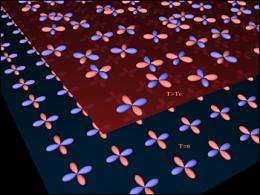
Quasiparticle interference imaging in the cuprate pseudogap state (T>Tc) reveals the spectroscopic "fingerprint" of phase incoherent d-wave superconductivity.

(PhysOrg.com) -- A team of U.S. and Japanese scientists has shown for the first time that the spectroscopic "fingerprint" of high-temperature superconductivity remains intact well above the super chilly temperatures at which these materials carry current with no resistance. This confirms that certain conditions necessary for superconductivity exist at the warmer temperatures that would make these materials practical for energy-saving applications — if scientists can figure out how to get the current flowing.

"Our measurements give the most definitive spectroscopic evidence that the material we studied is a superconductor, even above the transition temperature, but one without the coherence required for current to flow with no resistance," said physicist Seamus Davis of the Brookhaven National Laboratory and Cornell University, who led the research team. Davis was recently selected to head a DOE-funded Energy Frontier Research Center at Brookhaven that will examine the underlying nature of superconductivity in complex materials.

"The spectroscopic 'fingerprint' confirms that, at these higher temperatures, electrons are pairing up as they must in a superconductor, but for some reason they are not co-operating coherently to carry current," Davis said.

The technique and findings, described in a paper published August 28, 2009, in Science, may point the way to identifying what inhibits coherent superconductivity at higher temperatures. That knowledge, in turn, may help scientists achieve the ultimate goal of developing super-conducting materials for real-world practical devices such as zero-loss power transmission lines.

Many previous studies have hinted that the higher temperature "parent" state in copper-oxide, or cuprate, might be a "quantum phase incoherent" superconductor — a state in which exist but don't flow coherently as they do below the transition temperature. "But the methods used in these studies were indirect," Davis said. "Each of the results could be described by alternate explanations. What we were searching for was an incontrovertible signature."

Using a spectroscopic imaging scanning tunneling microscopy method developed over many years, Davis and his collaborators had previously conducted extensive studies of the superconducting state of a copper-oxide superconductor containing bismuth, strontium, and calcium (known as BSCCO). These studies identified a detailed spectroscopic signature containing all the quantum mechanical details of that superconducting state.

The new study was designed to see whether the signature changed when the material was warmed above the transition temperature, which is 37 kelvin, or -236 degrees Celsius]. This was a major challenge, however, because the method works best at very cold temperatures. As materials warm up, electrons start moving around more energetically, decreasing the resolution of the measurements.

"We had to make a series of modifications to greatly increase the signal-to-noise ratio for all measurements," Davis said. Some measurements were made over a period of up to 10 days. By averaging measurements over those long times, the scientists were better able to isolate a weak signal from the random background noise.

The results were definitive: "We found that the characteristic signature passes unchanged from the superconducting state into the parent state — up to temperatures of at least 55 K — or 1.5 times the ," Davis said. "We know of no explanation for why this fingerprint should remain other than that it represents the phase-incoherent which has been proposed to exist based on other kinds of measurements."

If the parent state is indeed an incoherent superconductor, the next step is to figure out why. "What breaks the cooperation of the electron pairs? What is the problem that is overwhelming the superconductivity?"

These are questions Davis's technique can address in a quantitative manner. For example, by varying the chemical composition, level of doping, or characteristics of the copper-oxide planes in the layered material, the scientists can measure the strength of quantum phase fluctuations affecting electron-pair cohesion.

These measurements may help scientists zero in on ways to induce coherent superconductivity at a higher range of temperatures than previously possible. And that would be an essential step to achieving real-world applications without the need for expensive cooling systems.

Source: Brookhaven National Laboratory (news : web)


print this article email this article download pdf blog this article bookmark this article     Stumble it Digg this share on Facebook retweet share on Reddit add to delicious
Rate this story - 4.9 /5 (10 votes)

Rank Filter

Move the slider to adjust rank threshold, so that you can hide some of the comments.


Display comments: newest first

  • googleplex - Aug 27, 2009
    • Rank: 2.3 / 5 (3)
    If we assume AWT is correct then can it be abandoned by applying Occam's Razor and going along with the simpler main stream physics?
    After all main stream physics appears to work (mostly) and is a simpler set of solutions than AWT.
  • Nik_2213 - Aug 27, 2009
    • Rank: not rated yet
    Interesting that sub-critical 'structure' is present so far above the transition temperature...

    Akin to the way even water behaves near 'freezing' point...
  • Alizee - Aug 27, 2009
    • Rank: 3.7 / 5 (3)
    ..can it be abandoned by applying Occam's Razor and going along with the simpler main stream physics?...
    Every theory can be replaced by combination of many simpler theories, but I'm not very sure, this is what the Occam's razor principle is about. We aren't interested just about special theories which are able to compute something - but for universal explanation of these special theories, too.
  • Alizee - Aug 27, 2009
    • Rank: 3.7 / 5 (3)
    ..sub-critical 'structure' is present so far above the transition temperature..
    In fact it's logical, because the smaller are superconductive clusters, the higher pressure exist in them, the higher temperature of superconductive transition we can expect.

    http://superstrun...evel.gif

    Overdoping increases number of conductive electrons, but because pressure in superconductive clusters decreases in such way, the temperature of superconductive transition actually decreases. Therefore for every superconductor optimal level of doping exists.
  • googleplex - Sep 01, 2009
    • Rank: 3 / 5 (2)
    ..can it be abandoned by applying Occam's Razor and going along with the simpler main stream physics?...
    Every theory can be replaced by combination of many simpler theories, but I'm not very sure, this is what the Occam's razor principle is about. We aren't interested just about special theories which are able to compute something - but for universal explanation of these special theories, too.

    So your thesis is that AWT is the simpler theory because it explains all physics better than the mainstream peer reviewed theories. However AWT is not quite finished yet so it is not so clear cut.
  • Minich - Sep 09, 2009
    • Rank: 1 / 5 (1)
    Definition of superconductivity assumes "flow with no resistance", he-he.

    It may be more correct assume, that BCS-like or Cooper-pairing-like or BEC-like theories of superconductivity ARE WRONG! :)))

    "Phase coherence" of superconducting state obviously is energetically more favorable, than nonsuperconducting state. It is SPONTANEOUS STABLE state of matter analougous to Dikke superradiance phase transition and "ordinary" ferromagnetism and He4 superfluidity (without!!!!!! so called "Cooper pairing").
    Superconducting state is favorable energetically (almost by Hamlet:) TO FLOW than NOT TO FLOW.
    And MEAN FIELD parameter for superconductivity and superfluidity was already ealier investigated by Archimedes of Syracuse, Abū Rayhān al-Bīrūnī, L. Euler in 1750-1758 and was and is NOW used for Moussbauer effect explanation.

    Good idea is the most practical tool.

    Excuse my poor English.
  • Alizee - Sep 13, 2009
    • Rank: not rated yet
    ..BCS-like or Cooper-pairing-like or BEC-like theories of superconductivity ARE WRONG!...
    This doesn't mean, older theories of low temperature superconductivity are wrong - they simply cannot be aplied to high temperature superconductivity and vice-versa.
  • Alizee - Sep 13, 2009
    • Rank: 1 / 5 (2)
    In fact, if we look to pseudogap state thoroughly, we still would see a traces of low temperature pairing in accordance to Colin Humphreys theory.
    http://superstrun...real.gif
    In Humphreys theory superconductivity occurs because these hole-pairs march collectively along the channels, like trams on pairs of tramlines running between the blocks of houses. There is one hole on each tramline, according to the model, and the pairs of holes move down the channels, hopping from oxygen to oxygen via adjacent copper sites. These structures are clearly visible on the above picture. It means, electrons aren't moving in pairs through high temperature superconductor, but in "homosexual groups", which are still paired at the more general level.

    Highest temperature superconductor achievable would contain 1D lattice of Dirac's strings of spin separated electrons aligned along whole length of superconductor.

August 27, 2009 all stories

Comments: 8

4.9 /5 (10 votes)
  • Stumble this up

  • Digg this

  • share this

  • hide
  • Related Stories

  • One Mystery of High-Tc Superconductivity Resolved
    created Nov 16, 2006 | popularity not rated yet | comments 0
  • Scientists reveal effects of quantum 'traffic jam' in high-temperature superconductors
    created Aug 27, 2008 | popularity not rated yet | comments 0
  • Disappearing Superconductivity Reappears -- in 2-D
    created Dec 01, 2008 | popularity not rated yet | comments 0
  • The pseudogap persists as material superconducts
    created Jan 27, 2009 | popularity not rated yet | comments 0
  • High-temperature superconductor 'pseudogap' imaged
    created Sep 22, 2008 | popularity not rated yet | comments 0


  • hide
  • Relevant PhysicsForums posts

  • Do you know elementary physics?
    created 1hour ago
  • Bicycles and their mad skillz
    created 1hour ago
  • Clarification of doubts on rolling motion
    created 5 hours ago
  • dropping meat on weighing scale
    created 6 hours ago
  • What is voltage drop?
    created 7 hours ago
  • waveguide
    created 8 hours ago
  • More from Physics Forums - General Physics

Other News

Aquatic creatures mix ocean water

Physics / General Physics

created 56 minutes ago | popularity not rated yet | comments 0

Understanding mixing in the ocean is of fundamental importance to modeling climate change or predicting the effects of an El Niño on our weather. Modern ocean models primarily incorporate the effects of winds and tides. However, ...


Nuclear weapons: Predicting the unthinkable

Physics / General Physics

created 4 hours ago | popularity 1 / 5 (1) | comments 0

If a nuclear weapon were detonated in a metropolitan area, how large would the affected area be? Where should first responders first go? According to physicist Fernando Grinstein, we have some initial understanding to address ...


Generating electricity from air flow

Physics / General Physics

created 4 hours ago | popularity 3.5 / 5 (4) | comments 1

A group of researchers at the City College of New York is developing a new way to generate power for planes and automobiles based on materials known as piezoelectrics, which convert the kinetic energy of motion into electricity. ...


Butterfly proboscis to sip cells

Physics / General Physics

created 1hour ago | popularity not rated yet | comments 0

A butterfly's proboscis looks like a straw -- long, slender, and used for sipping -- but it works more like a paper towel, according to Konstantin Kornev of Clemson University. He hopes to borrow the tricks of this piece ...


Restored machine to explore mysteries of Big Bang (AP)

Restored machine to explore mysteries of Big Bang

Physics / General Physics

created Nov 21, 2009 | popularity 4.5 / 5 (16) | comments 14

(AP) -- Scientists are preparing the world's largest atom smasher to explore the depths of matter after successfully restarting the $10 billion machine following more than a year of repairs.