The lost voyage: First English-led expedition to North America
August 27, 2009
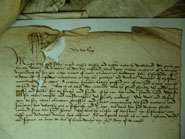
A personal letter - now in The National Archives - written by Henry VII to his Lord Chancellor on 12 March 1499 in which he writes that William Weston shall shortly ‘with God’s grace pass and sail for to search and find if he can the new found land’. Photo by Dr Evan Jones
(PhysOrg.com) -- Evidence of a previously unknown voyage to North America in 1499, led by a Bristol explorer, is to be published this week in the academic journal Historical Research.
The article by Dr Evan Jones, a historian at Bristol University, suggests that a Bristol merchant, William Weston, undertook a voyage to the ‘New Found Land’ just two years after the first voyage of Venetian explorer John Cabot who sailed from Bristol to ‘discover’ North America in 1497.
Cabot led a second, larger, expedition the following year (1498) to explore the new land, with support from King Henry VII. However, a third expedition undertaken by Weston in 1499 with the support of the King, has remained unknown until now.
The main evidence for the voyage comes from a personal letter written by the King to his Lord Chancellor on 12 March 1499. In this, Henry VII instructs his minister to suspend an injunction served against Weston in the Court of Chancery because Weston shall shortly ‘with God’s grace pass and sail for to search and find if he can the new found land’.
While this was an independent voyage, it seems that Weston was permitted to undertake it because he was one of Cabot’s chief supporters in Bristol. This meant that, although Cabot had received monopoly rights for westwards exploration from England, Weston was covered by the terms of Cabot’s royal patent.
Dr Evan Jones said “Henry VII’s letter is an exciting find because so little is known about the early English voyages of discovery. We knew that our knowledge of the first English expeditions to the New World was very incomplete. But this is beginning to show just how incomplete it is. Up till now, no one has ever even heard of William Weston. Yet this letter reveals him to be the first Englishman to lead an expedition to North America.”
Although the letter itself does not reveal what Weston achieved, research suggests that his expedition took him up into the Labrador Sea, possibly reaching as far as the Hudson Straits. “If so”, Dr Jones continued, “this can probably be counted as the first Northwest Passage expedition, commencing a centuries-long search to locate a sea-route around North America.”
Although the publication of this research is entirely new, Dr Jones is keen to stress that the letter itself was found thirty years ago, miscataloged among a bundle of Chancery files in what is now The National Archives. The archivist who found the letter, Miss Margaret Condon, passed on the information to the eminent discovery historian, Professor David Beers Quinn in 1981. He, however, failed to publish the information because he wanted to wait for another historian, Dr Alwyn Ruddock, to publish her research on the Cabot voyages first. This, however, never happened, leaving the letter unpublished at the time of Quinn’s death in 2002.
That the letter ever came to light was only the result of a bizarre twist in events. In 2005, Dr Alwyn Ruddock died, leaving instructions that all her research notes be destroyed. This was despite the fact that, during the forty years she had been researching the Cabot voyages, she had apparently made discoveries that looked set to revolutionise the field.
Following her death, Dr Jones commenced a search to discover just what Ruddock had found, his investigations being published in a earlier edition of Historical Research. Ruddock had apparently uncovered evidence that Cabot and his supporters had explored a large section of the coast of North America from 1498-1500 and, moreover, that an offshoot of his expedition established the Continent’s first Christian community in Newfoundland. It was while investigating Ruddock’s claims that Dr Jones found out about the discoveries of Margaret Condon, made decades before.
Jones and Condon have now teamed up with researchers in Canada to carry out more work on the early voyages. “When I first started investigating Ruddock’s claims’, Dr Jones said, “some people were somewhat sceptical about her claims. It was perhaps easier to think that she might have gone a bit ‘batty’ in her old age than to believe that her extraordinary claims might be true. Now though, with the bits and pieces of evidence falling into place, the hunt to relocate the material that she found, is certainly on.”
More information:
• E. T. Jones, 'Henry VII and the Bristol expeditions to North America: the Condon documents', Historical Research. This paper will be made freely available on ‘Early View’ this week.
• E. T.Jones, 'Alwyn Ruddock: John Cabot and the Discovery of America', Historical Research Vol 81, Issue 212 pages 224-254, 5 Apr 2007
-
Researcher finds El Nino may have been factor in Magellan's Pacific voyage
May 15, 2008 |
not rated yet |
0
-
The voyage to America: Fossilized human feces reveals the first immigrants
Apr 03, 2008 |
not rated yet |
0
-
Moderation in cell phone use is urged
Jul 12, 2005 |
not rated yet |
0
-
Researchers: Polynesians got to California
Jun 21, 2005 |
not rated yet |
0
-
Comet impact theory disproved
Jan 26, 2009 |
not rated yet |
0
-
Engineers build first sub-10-nm carbon nanotube transistor
Feb 01, 2012 |
4.9 / 5 (31) |
30
-
Something old, something new: Evolution and the structural divergence of duplicate genes
Jan 31, 2012 |
4.6 / 5 (7) |
1
-
The hidden nanoworld of ice crystals: Revealing the dynamic behavior of quasi-liquid layers
Jan 30, 2012 |
5 / 5 (3) |
1
-
Stock market network reveals investor clustering
Jan 27, 2012 |
3.9 / 5 (23) |
8
-
Of microchemistry and molecules: Electronic microfluidic device synthesizes biocompatible probes
Jan 26, 2012 |
5 / 5 (1) |
0
-
Bohr-Einstein debate: why did Bohr not simply say...
Feb 06, 2012
-
Best/Worst U.S. Presidents
Jan 31, 2012
- More from Physics Forums - History & Humanities
More news stories
A frank discussion of the power law and linking correlation to causation
(PhysOrg.com) -- Michael Stumpf a mathematics professor at Imperial College in London, and Mason Porter a lecturer at Oxford have teamed together to write and publish a perspective piece in Science regarding the in ...
Employers feel no love for unscrupulous practice of 'service sweethearting'
A new study led by two Florida State University marketing professors finds that some frontline service employees who are rewarded for hikes in customer loyalty and satisfaction also may engage in "service ...
Other Sciences / Economics & Business
13 hours ago |
4 / 5 (1) |
7
The question of life in the ancient world
Theres a general feeling that we dont get the Greeks ancient or modern. Many, including heads of state like Angela Merkel, visibly shake their head in exasperation, rightly or wrongly, at ...
Other Sciences / Archaeology & Fossils
19 hours ago |
1.3 / 5 (3) |
4
Sonic Cradle lands spot in TED exhibition
A Simon Fraser University graduate student project that melds music, meditation and modern technology has landed a rare spot as an exhibit at TEDActive 2012 in Palm Springs, California this month.
15 hours ago |
not rated yet |
0
Do we no longer care about the collective good?
The Transformation of Solidarity, a book co-edited by University of Queensland sociologist Dr Mara Yerkes, tackles the subject of globalisation of national economies and societies where we put a high value ...
Other Sciences / Social Sciences
Feb 06, 2012 |
3.9 / 5 (8) |
39
Anonymous knocks CIA website offline (Update)
The website of the Central Intelligence Agency was inaccessible on Friday after the hacker group Anonymous claimed to have knocked it offline.
New error-correcting codes guarantee the fastest possible rate of data transmission
Error-correcting codes are one of the triumphs of the digital age. Theyre a way of encoding information so that it can be transmitted across a communication channel such as an optical fiber o ...
Humans may have helped the decline of African rainforests 3000 years ago
(PhysOrg.com) -- Large areas of rainforests in Central Africa mysteriously disappeared over three thousand years ago, to be replaced by savannas. The prevailing theory has been that the cause was a change ...
Google users warned of threat to smartphone wallets
Users of Google smartphone wallets were being warned on Friday that there is a way to crack pass codes intended to thwart thieves from going on illicit shopping sprees.
New power source discovered
(PhysOrg.com) -- Researchers at the Massachusetts Institute of Technology (MIT) and RMIT University have made a breakthrough in energy storage and power generation.
Small modular reactor design could be a 'SUPERSTAR'
(PhysOrg.com) -- Though most of today's nuclear reactors are cooled by water, we've long known that there are alternatives; in fact, the world's first nuclear-powered electricity in 1951 came from a reactor ...
Aug 27, 2009
Rank: not rated yet
-How long before mainstream can admit to evidence, of which there is plenty, that Templars and others were here even earlier? This article shows how evidence can indeed be lost, discredited, ignored by orthodoxy until that generation has passed.
Aug 28, 2009
Rank: 1 / 5 (1)
Is there a way to have someone's degree posthumously revoked?
Aug 28, 2009
Rank: not rated yet
Isn't asking for ones lifes work to be destroyed upon death a bit batty - a kind of scorched earth policy?
Aug 28, 2009
Rank: not rated yet
Aug 28, 2009
Rank: not rated yet