Scientists find 'great Pacific Ocean garbage patch'
August 27, 2009
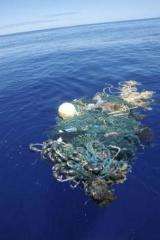
SEAPLEX researchers spotted a large net tangled with plastic in the "garbage patch." Credit: Scripps Institution of Oceanography
Scientists have just completed an unprecedented journey into the vast and little-explored "Great Pacific Ocean Garbage Patch."
On the Scripps Environmental Accumulation of Plastic Expedition (SEAPLEX), researchers got the first detailed view of plastic debris floating in a remote ocean region.
It wasn't a pretty sight.
The Scripps research vessel (R/V) New Horizon left its San Diego homeport on August 2, 2009, for the North Pacific Ocean Gyre, located some 1,000 miles off California's coast, and returned on August 21, 2009.
Scientists surveyed plastic distribution and abundance, taking samples for analysis in the lab and assessing the impacts of debris on marine life.
Before this research, little was known about the size of the "garbage patch" and the threats it poses to marine life and the gyre's biological environment.
The expedition was led by a team of Scripps Institution of Oceanography (SIO) graduate students, with support from University of California Ship Funds, the National Science Foundation (NSF) and Project Kaisei.
"SEAPLEX was an important education experience for the graduate students, and contributed to a better understanding of an important problem in the oceans," said Linda Goad, program director in NSF's Division of Ocean Sciences. "We hope that SEAPLEX will result in increased awareness of a growing issue."
After transiting for six days aboard the research vessel, the researchers reached their first intensive sampling site on August 9th.
Team members began 24-hour sampling periods using a variety of tow nets to collect debris at several ocean depths.
"We targeted the highest plastic-containing areas so we could begin to understand the scope of the problem," said Miriam Goldstein of SIO, chief scientist of the expedition. "We also studied everything from phytoplankton to zooplankton to small midwater fish."
The scientists found that at numerous areas in the gyre, flecks of plastic were abundant and easily spotted against the deep blue seawater.
Among the assortment of items retrieved were plastic bottles with a variety of biological inhabitants. The scientists also collected jellyfish called by-the-wind sailors (Velella velella).
On August 11th, the researchers encountered a large net entwined with plastic and various marine organisms; they also recovered several plastic bottles covered with ocean animals, including large barnacles.
The next day, Pete Davison, an SIO graduate student studying mid-water fish, collected several species in the gyre, including the pearleye (Benthalbella dentata), a predatory fish with eyes that look upward so it can see prey swimming above, and lanternfish (Tarletonbeania crenularis), which migrate from as deep as 700 meters down to the ocean surface each day.
By the end of the expedition, the researchers were intrigued by the gyre, but had seen their fill of its trash.
"Finding so much plastic there was shocking," said Goldstein. "How could there be this much plastic floating in a random patch of ocean--a thousand miles from land?"
Source: National Science Foundation (news : web)


this giant floating ball of shit in the ocean story is on the same conspiracy level as a plot to kill jfk, i've been waiting for pictures but a picture of some crap with someother crap thats plastic, and floating in the ocean ain't gonna cut it for me.
And the article makes it appear that the refuse has become a habitat teaming with life. It sounds like the sea has assumed ownership and is relatively happy with it's new living spaces(excuse the anthro-analogy, it's early.)
Maybe we should throw all our junk out there. The sea is putting it to good use. It just goes to waste in landfills.
jr
http://www.natura...802.html
There are prolly few photos of this because the debris apparently lies feet below surface, broken up to a molecular size which wouldn't be very visable above the surface.
When some plastics are exposed to UV, they break down to molecular levels. One way to make plastics are to excite polymer molecules and cool them creating whatever form you want. Adding energy from UV and other sources would serve to turn them into goo in the ocean.
And brian if you disagree, post why. I'm guessing you gave me a 1 because you think they shouldn't clean it up.
New island real estate - perhaps even a new nation - in the middle of the ocean, anyone?
You're confusing energies.
UV is energy at a certain wavelength, heat is energy at a different wavelength. When UV hits the water if the water can absorb the energy it is transformed into heat energy. That being said, UV penetrates water FAR deeper than visible light, making the plastics floation level kind of a moot point at the depths we're concerned with. Now plastics are an assortment of molecules that "lock" into each other. If you excite them enough they break the lock and melt. When the UV energy strikes the plastic, the energy is potent enough to energize the molecules to the point where they no longer lock into the adjoining plastic molecules due to the absorption spectra of some plastics.
Think sunlight striking ice and melting it into water.
And I'm also not saying that UV and heat have little to do with each other, but UV and heat are on different frequencies, and that makes a good amount of difference when you're talking about energetic breakdown of materials.
A kid developed a method to decompose plastic bags in 3 months. You can imagine what nature does to plastics in an area as unforgiving as the open ocean.
http://www.wired....omposes/
The key to his method is microbial life, very abundant in the open ocean. Couple that with energy sources, UV breakdown, etc.
Remember, the majority of plastic waste is thin wrappings, plastic bags, plastic sheeting. Not really hard plastics like say the dashboard of a car.
But like I said, it doesn't take a water bottle and turn it into goo in a few days. It takes thousands of water bottles and they leech garbage into the water column.
http://www.eureka...0309.php
http://www.physor...772.html
That's brilliant!
So, if everyone in your neighborhood decided to dump their sewage and garbage(for instance) in your back yard, you would just "leave it alone" because some organisms found it amenable to their lifestyle? Natural is what Nature claims, not something's origin?