Tick saliva could hold cancer cure: Brazilian scientists
August 28, 2009 by Marc Burleigh
Tick

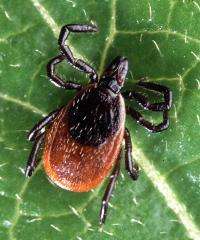
Adult deer tick, Ixodes scapularis. Image: Wikimedia Commons.

It may be one of nature's repulsive little blood-sucking parasites, but the humble tick could yield a future cure for cancers of the skin, liver and pancreas, Brazilian researchers have discovered.

They have identified a protein in the saliva of a common South American tick, Amblyomma cajennense, that apparently reduces and can even eradicate cancerous cells while leaving healthy cells alone.

"This is a radical innovation," said Ana Marisa Chudzinski-Tavassi, the molecular biologist at the Instituto Butantan in Sao Paulo who is leading the research.

"The component of the saliva of this tick... could be the cure for cancer," she told AFP.

She said she stumbled on the properties of the protein, called Factor X active, while testing the anti-coagulant properties of the tick's saliva -- the way it stops blood thickening and clotting so the tick can keep gorging itself on its host.

The protein shares some characteristics with a common anti-coagulant called TFPI (Tissue Factor Pathway Inhibitor), specifically a Kunitz-type inhibitor which also has been shown to interfere with cell growth.

A theory that the protein might have an effect on led to laboratory tests on cell cultures -- which exceeded all expectations.

"To our surprise it didn't kill normal cells, which were also tested," Chudzinski-Tavassi said. "But it did kill the tumorous cells that were being analyzed."

In her modest lab in the institute, housed in a rundown building, a line of immobile bloated ticks could be seen lined up with straws under their heads.

The small amounts of captured that way was reproduced many times over in yeast vats so that tests could be carried out on lab rats with cancer.

The results have been more than promising.

"If I treat every day for 14 days an animal's , a small tumor, this tumor doesn't develop -- it even regresses. The tumor mass shrinks. If I treat for 42 days, you totally eliminate the tumor," the scientist said.

Producing a medicine from the find, though, will require years of clinical tests and a significant financial investment -- neither of which Brazil is geared to provide.

Chudzinski-Tavassi has applied for a patent on the tick , and is presenting her team's discovery in medical journals and conferences around the world.

But she says moving beyond her lab "proof of concept" will be frustratingly difficult.

"To discover this is one thing. To turn it into a medicine is a whole other thing entirely," she said.

(c) 2009 AFP

4.8 /5 (18 votes)  

Filter


Move the slider to adjust rank threshold, so that you can hide some of the comments.


Display comments: newest first

earls
Aug 28, 2009

Rank: 3 / 5 (5)
Great, and here I thought they were useless.

Next we'll find out fly shit cures AIDS.
MongHTanPhD
Aug 28, 2009

Rank: 5 / 5 (1)
RE: Standard anticancer drug discovery procedures!?

Chudzinski-Tavassi has applied for a patent on the tick protein, and is presenting her team's discovery in medical journals and conferences around the world.

But she says moving beyond her lab "proof of concept" will be frustratingly difficult.

"To discover this is one thing. To turn it into a medicine is a whole other thing entirely," she said.


Contrary to difficulties that she might have had anticipated: I think if her discovery had had been properly conducted -- especially in and under the universal drug discovery procedures and standards -- and proved to be as good as what she has had claimed, the big biopharmas would show up at her doorsteps in no time!? Good luck to Ms Chudzinski-Tavassi of Brazil!

Best wishes, Mong 8/28/9usct9:08a; practical science-philosophy critic; author "Decoding Scientism" and "Consciousness & the Subconscious" (works in progress since July 2007), "Gods, Genes, Conscience" (2006: http://www.iunive...95379907 ) and "Gods, Genes, Conscience: Global Dialogues Now" (blogging avidly since 2006: http://www2.blogg...50569778 ).
googleplex
Aug 28, 2009

Rank: 3 / 5 (1)
It wouldn't be the first time that a parasite had some symbiotic payback to its host (e.g. maggots and leaches). However announcing a cure for cancer has to be treated with some scepticism. If there is even a thread of truth in this we can expect to see billions poored into R&D and drug production.
Shaffer
Aug 28, 2009

Rank: 5 / 5 (1)
My only comment.....BITE ME
John_balls
Aug 28, 2009

Rank: not rated yet
My only comment.....BITE ME

lololol.
rfw
Aug 28, 2009

Rank: not rated yet
Create mutant ticks that cure cancer in every cancer-positive person they bite. Turn them loose in the fields and plains to breed and eat well.....
zevkirsh
Aug 29, 2009

Rank: not rated yet
yea i think what they are looking for is lime disease.
Rank 4.8 /5 (18 votes)
Related Stories
Relevant PhysicsForums posts
  • Is Everyday Technology Killing Us?
    createdFeb 08, 2012
  • Exercise and weight loss
    createdFeb 08, 2012
  • Why do we have head aches? Our brains can't feel anything.
    createdFeb 07, 2012
  • "The end of diseases" by David Agus, interview from Daily Show with Jon Stewart
    createdFeb 04, 2012
  • Oncolytic adenovirus
    createdFeb 04, 2012
  • Nutrition label stuffs and diets
    createdFeb 02, 2012
  • More from Physics Forums - Medical Sciences

More news stories

Complex wiring of the nervous system may rely on a just a handful of genes and proteins

Researchers at the Salk Institute have discovered a startling feature of early brain development that helps to explain how complex neuron wiring patterns are programmed using just a handful of critical genes. ...

Medicine & Health / Research

created 5 hours ago | popularity 5 / 5 (7) | comments 0 | with audio podcast

Both maternal and paternal age linked to autism

Older maternal and paternal age are jointly associated with having a child with autism, according to a recently published study led by researchers at The University of Texas Health Science Center at Houston (UTHealth).

Medicine & Health / Psychology & Psychiatry

created 9 hours ago | popularity 5 / 5 (1) | comments 0 | with audio podcast

New understanding of DNA repair could eventually lead to cancer therapy

A research group in the Faculty of Medicine & Dentistry at the University of Alberta is hoping its latest discovery could one day be used to develop new therapies that target certain types of cancers.

Medicine & Health / Cancer

created 9 hours ago | popularity 4.8 / 5 (4) | comments 0 | with audio podcast

Curry spice component may help slow prostate tumor growth

Curcumin, an active component of the Indian curry spice turmeric, may help slow down tumor growth in castration-resistant prostate cancer patients on androgen deprivation therapy (ADT), a study from researchers ...

Medicine & Health / Cancer

created 10 hours ago | popularity 4.5 / 5 (6) | comments 0 | with audio podcast

Human cognitive performance suffers following natural disasters, researchers find

Not surprisingly, victims of a natural disaster can experience stress and anxiety, but a new study indicates that it might also cause them to make more errors - some serious - in their daily lives. In their upcoming Human Fa ...

Medicine & Health / Psychology & Psychiatry

created 6 hours ago | popularity 4 / 5 (1) | comments 0


Google users warned of threat to smartphone wallets

Users of Google smartphone wallets were being warned on Friday that there is a way to crack pass codes intended to thwart thieves from going on illicit shopping sprees.

Anonymous knocks CIA website offline (Update)

The website of the Central Intelligence Agency was inaccessible on Friday after the hacker group Anonymous claimed to have knocked it offline.

New error-correcting codes guarantee the fastest possible rate of data transmission

Error-correcting codes are one of the triumphs of the digital age. They’re a way of encoding information so that it can be transmitted across a communication channel — such as an optical fiber o ...

The power of estrogen -- male snakes attract other males

A new study has shown that boosting the estrogen levels of male garter snakes causes them to secrete the same pheromones that females use to attract suitors, and turned the males into just about the sexiest ...

Putting the squeeze on planets outside our solar system

(PhysOrg.com) -- Using high-powered lasers, scientists at Lawrence Livermore National Laboratory and collaborators discovered that molten magnesium silicate undergoes a phase change in the liquid state, abruptly ...

Humans may have helped the decline of African rainforests 3000 years ago

(PhysOrg.com) -- Large areas of rainforests in Central Africa mysteriously disappeared over three thousand years ago, to be replaced by savannas. The prevailing theory has been that the cause was a change ...