Scientists Use Squid Ink to Draw its Jurassic Period Owner
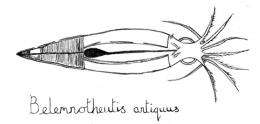
August 28, 2009 by Lin Edwards Scientists Use Squid Ink to Draw its Jurassic Period Owner

Drawing: British Geological Survey (BGS), (c)NERC

(PhysOrg.com) -- Scientists digging in Trowbridge, Wiltshire in England have uncovered the fossilized remains of a prehistoric squid-like creature that lived in the Jurassic period around 150 million years ago. Among their finds was a rock, which they broke open to reveal the intact one-inch long fossilized ink sac.

The ink sac was found to be similar to modern-day ink, and as an experiment, the researchers extracted a sample of the black ink and dissolved the ground specimen in an ammonia solution. To their amazement they were able to use the black, inky solution to write with and even to draw a picture of the animal.

The leader of the paleontological dig, Dr Phil Wilby said it is usually only hard parts such as bone and shell that become fossilized, and soft tissue fossils have only been found in a few dozen sites around the world. Dr Wilby explained that sometimes soft-bodied creatures could be turned to stone within a matter of days after death in an effect paleontologists call the Medusa effect, or instantaneous fossilization. The result is a that can be dissected to show even cells and cell nuclei in 3D images when viewed with powerful microscopes.

One of the sites where soft tissue fossils had been discovered in the past was in Trowbridge, where thousands of fossils of Jurassic period fossils were found in the 1840s during the construction of the Great Western Railway. Two years ago, Wilby and his team decided to try and find the almost forgotten site. After locating the site through a series of trial drills, they received funding from the Curry Fund and the British Geological Survey, and were able to carry out a ten-day dig to look for fossils.

During their excavations the team exposed several thousand fossils of the squid-like creature, Belemnotheutis Antiques, in the 265 tons of rock they examined. Dr Wilby explained that it seems likely the area was a breeding site and the thousands of congregated animals were poisoned by . In total the team found a couple of dozen specimens with soft parts such as eyes and muscles perfectly preserved. But the ink sac was the most exciting find.

Part of the fossilized sac has been sent to a Yale University laboratory in the US for detailed chemical analysis. The rest of the specimen is now in Nottingham in the British Geological Survey collection.

More information: Geology Today, Volume 24 Issue 3, Pages 95 - 98. DOI: 10.1111/j.1365-2451.2008.00666.x

© 2009 PhysOrg.com


print this article email this article download pdf blog this article bookmark this article     Stumble it Digg this share on Facebook retweet share on Reddit add to delicious
Rate this story - 4.3 /5 (8 votes)


August 28, 2009 all stories

Comments: 0

4.3 /5 (8 votes)
  • Stumble this up

  • Digg this

  • share this

  • hide
  • Related Stories

  • An X-ray Time Machine?
    created Apr 05, 2007 | popularity not rated yet | comments 0
  • Deep heat solution to 500-million year mystery
    created Nov 12, 2008 | popularity not rated yet | comments 0
  • Dino Team Returns to SSRL
    created Jan 11, 2008 | popularity not rated yet | comments 0
  • Soft Body Fossils of Extinct “Lamp Shell” Digitally Reconstructed
    created Aug 17, 2005 | popularity not rated yet | comments 0
  • Cretaceous octopus with ink and suckers -- the world's least likely fossils?
    created Mar 17, 2009 | popularity not rated yet | comments 0


  • hide
  • Relevant PhysicsForums posts

Other News

Explained: The Discrete Fourier Transform

Explained: The Discrete Fourier Transform

Other Sciences / Mathematics

created 23 hours ago | popularity 4.3 / 5 (24) | comments 8

(PhysOrg.com) -- In 1811, Joseph Fourier, the 43-year-old prefect of the French district of Isčre, entered a competition in heat research sponsored by the French Academy of Sciences. The paper he submitted ...


Ancient Greek Temple

Houses of the rising sun: Research sheds new light on Ancient Greeks

Other Sciences / Archaeology & Fossils

created 19 hours ago | popularity 5 / 5 (2) | comments 3

New research at the University of Leicester has identified scores of Sicilian temples built to face the rising Sun, shedding light on the practices of the Ancient Greeks.


Biology, training and profit sharing make best traders

Biology, training and profit sharing make best traders

Other Sciences / Mathematics

created 23 hours ago | popularity 5 / 5 (1) | comments 1

(PhysOrg.com) -- Cambridge researchers have identified a group of traders consistently able to outperform the market, even during the credit crisis.


Study: Race, class and gender shape religion's effect on American voters

Other Sciences / Social Sciences

created 15 hours ago | popularity not rated yet | comments 0

(PhysOrg.com) -- How Americans vote is strongly linked to their religious identities, but it is not an independent influence that transcends race, socio-economic class and gender, reports a new Cornell study.


Researcher: Faint writing seen on Shroud of Turin (AP)

Researcher: Faint writing seen on Shroud of Turin (Update)

Other Sciences / Archaeology & Fossils

created Nov 20, 2009 | popularity 2.4 / 5 (30) | comments 40

(AP) -- A Vatican researcher has rekindled the age-old debate over the Shroud of Turin, saying that faint writing on the linen proves it was the burial cloth of Jesus. Experts say the historian may be reading ...