Appetite spells three wolves' doom in Switzerland
August 28, 2009 by Agnes Pedrero
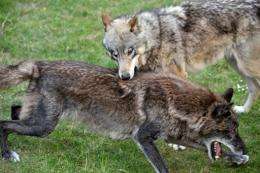
Wolves are seen here in Nantes, western France. Swiss authorities have issued a death warrant for 3 offending wolves originating from Italy and France that violated Swiss law by killing more sheep than they should.
It is unclear if the three wolves were too greedy or simply hungry, but what is certain is that by killing more sheep than they should, they have violated Swiss law.
Swiss authorities have issued a death warrant for the three offending wolves originating from Italy and France, and wardens have 60 days to hunt them down.
Over the last few weeks, herders raised the alarm that their sheep were being attacked.
Dozens have been reported to have fallen prey in western Switzerland's canton Valais, with some 15 sheep killed on the night of August 1 and 2 alone. Meanwhile, 27 sheep were killed in July in the central Swiss canton of Lucerne.
Unbeknownst to the predators, the rampage had exceeded those tolerated under the official quota.
Swiss law allows predators to kill only 35 animals in four months, while in a month, the quota is 25.
However, that limit falls to 15 a month for protected herds, as in the case of the wolves' prey.
Animals violating this law can be shot.
Taking into account the recent damage, cantonal authorities in Valais and Lucerne in early August gave their nod to hunt down the three guilty wolves.
The first was killed on August 20.
"When the wolf was on the way back in the early morning, it was less suspicious. It was at this moment when the warden surprised it. He was alone, 150 metres from the wolf, when he shot it," said Jacques Blanc, deputy chief of Valais' hunting service.
The other two wolves may have to raise their guard, as some 20 wardens from the two cantons will be lying in wait through September.
Environment groups are however up in arms against the cantons' decision.
For conservation group WWF, the decision to hunt these wolves was made "too quickly." It has therefore put forward an appeal to the judicial authorities.
"In most cases, the sheep which were attacked had not been efficiently protected," said WWF's spokeswoman Pierrette Rey.
She added that if the wolves had such a good haul on the night of August 1, they were perhaps aided by fireworks set off amid the Swiss National Day celebrations that prompted the sheep to wander out of their pens.
But farmers want the animal eliminated from Swiss soil.
Wolves had disappeared from Swiss territories in the last century but after several appearances since 1995, they seem to have returned more permanently.
For the head of the association of herders in Valais Romand, Florian Volluz, wolves "have no place here."
He said he was "exasperated by a situation that has lasted 15 years," adding that protection measures proposed by the authorities, such as installation of enclosures, guards, and watch dogs, were "inefficient."
"These measures are like bandaging a wooden leg," said Volluz, who believes that the only solution is to root out the wolves.
His troubles may be far from over.
While the 12 wolves known to be in Switzerland have not formed into a pack, they may soon do so, said the Swiss Federal Office of the Environment's species management chief Thomas Briner.
"At the moment, the young males are looking for new territories and the first packs will form because there are two females," he said.
Once the first cubs emerge, the wolf could once again become a permanent resident of the Swiss alps.
(c) 2009 AFP
-
Many in West fear wolf reintroduction
Dec 27, 2005 |
not rated yet |
0
-
Wolves may be back in Oregon
Sep 09, 2006 |
not rated yet |
0
-
Wolves making comeback in Germany
Oct 27, 2007 |
not rated yet |
0
-
Killing wolves doesn't protect livestock
Apr 04, 2006 |
not rated yet |
0
-
Bears may be back in the Swiss Alps
Jul 27, 2005 |
not rated yet |
0
-
Engineers build first sub-10-nm carbon nanotube transistor
Feb 01, 2012 |
4.9 / 5 (31) |
30
-
Something old, something new: Evolution and the structural divergence of duplicate genes
Jan 31, 2012 |
4.6 / 5 (7) |
1
-
The hidden nanoworld of ice crystals: Revealing the dynamic behavior of quasi-liquid layers
Jan 30, 2012 |
5 / 5 (3) |
1
-
Stock market network reveals investor clustering
Jan 27, 2012 |
3.9 / 5 (23) |
8
-
Of microchemistry and molecules: Electronic microfluidic device synthesizes biocompatible probes
Jan 26, 2012 |
5 / 5 (1) |
0
-
Stem cell question.
Feb 10, 2012
-
Protease cleavage
Feb 10, 2012
-
Pertubance in a model
Feb 10, 2012
-
Cancer drugs and Alzheimer's, Oh my!
Feb 09, 2012
-
Squishing cells
Feb 09, 2012
-
Any books/articles for evolutionary stable strategy models in humans?
Feb 09, 2012
- More from Physics Forums - Biology
More news stories
Entire genome of extinct human decoded from fossil
(PhysOrg.com) -- In 2010, Svante Pääbo and his colleagues presented a draft version of the genome from a small fragment of a human finger bone discovered in Denisova Cave in southern Siberia. The ...
Feb 07, 2012 |
4.7 / 5 (58) |
45
|
Why are there so few fish in the Earth's oceans?
(PhysOrg.com) -- A Stony Brook University researcher has found that, contrary to popular belief, there are not plenty of fish in the sea.
Feb 08, 2012 |
4.3 / 5 (17) |
26
|
Miami battling invasion of giant African snails
No one knows how they got there. But an invasion of African giant snails has southern Florida in a panic over potential crop damage, disease and general yuckiness surrounding the slimy gastropods.
Feb 10, 2012 |
4.5 / 5 (2) |
5
Deciding to go left or right: Researchers use device to determine that lower animals can navigate too
For decades, scientists have associated binary decision making opting to go left or right with higher-ranking animals, including humans. A team of Harvard researchers, however, is rewriting that ...
Feb 09, 2012 |
4 / 5 (1) |
4
|
Study shows chimps able to understand needs of others
(PhysOrg.com) -- By setting up a unique experiment, a small team of researchers has found that chimpanzees are able to understand need in other chimps, despite their general disinclination to offer aid when ...
Google might launch Drive for cloud storage soon
(PhysOrg.com) -- Google's next big move, according to the Wall Street Journal, is a cloud storage service called Drive. Hardly first to the plate, Google is simply catching up to introducing its cloud reposi ...
Latin America mining boom clashes with conservation
Latin America is experiencing a mining boom as prices rise fuelled by a hike in global demand, but the region is also being hit by a wave of violent protests, strikes and rallies by environmentalists.
Walney offshore wind farm is world's biggest (for now)
(PhysOrg.com) -- The Walney wind farm on the Irish Sea--characterized by high tides, waves and windy weather--officially opened this week. The farm is treated in the press as a very big deal as the Walney ...
Love a click away in Indonesia's Twitter Republic
He was a geeky kid from Yogyakarta, she a glamorous city girl in Jakarta. In a country with one of the world's most vibrant social networking scenes they fell in love on Twitter.
GPS court ruling leaves US phone tracking unclear
A US Supreme Court decision requiring a warrant to place a GPS device on the car of a criminal suspect leaves unresolved the bigger issue of police tracking using mobile phones, legal experts say.
Europeans protest controversial Internet pact
Tens of thousands of people marched in protests in more than a dozen European cities Saturday against a controversial anti-online piracy pact that critics say could curtail Internet freedom.