Big Blue dreams of a big green battery
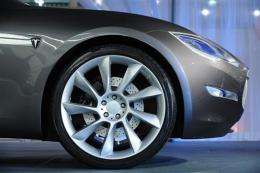
August 28, 2009 by Ian Sherr View of a Tesla electric sports car

Enlarge

A view of the Tesla Model S all-electric sedan in March 2009. After watching a Tesla electric sports car rocket from zero to 60 mph (100 kph) in less than four seconds, Spike Narayan, a researcher for IBM has been working on Lithium-Air batteries, which the company said has the potential to pack up to 10 times the power stored in Lithium-Ion batteries commonly found in cell phones and laptops.

Spike Narayan watched a Tesla electric sports car rocket from zero to 60 mph (100 kph) in less than four seconds and knew batteries would be the next big thing.

"It's hard to understand you're not in a gas powered Porsche," Narayan said as he recalled the demonstration outside IBM's Almaden Research Center in the heart of .

"Your head snaps back from the speed."

The vision underscored the importance of to Narayan and other IBM researchers who led a future-of-batteries conference that ended Thursday at the center.

Scientists spent two days discussing potential new ways to store electricity and chart paths for research.

IBM is focusing on Lithium-Air batteries, which the company said has the potential to pack up to 10 times the power stored in Lithium-Ion batteries commonly found in cell phones and laptops.

The US technology giant and its partners expect to invest approximately 10 million dollars in the project during the next three years.

Narayan said that the time is right to strive for battery breakthroughs.

A Chevrolet Volt car poised for release in the United States has batteries that can power it for 40 miles (64 kilometers) without help from a gas engine built into the vehicle.

Toyota will soon launch a third-generation of the Japanese auto titan's popular hybrid gas-electric Prius, sporting even more .

just recently received a 465 million dollar loan from the US Department of Energy to build an electric family sedan to accompany the Roadster sports car that is the young US company's sole offering.

IBM believes Lithium-Air could be the next big thing when it comes to providing batteries for those and other such innovations.

Big Blue's big green project has skeptics, some of whom debate whether consumers will be interested in energy efficient cars.

"Consumers are not willing to pay for fuel-efficient technology if they don't know the future of fuel prices, or even their own job," said Daniel Sperling, who co-authored the book 'Two Billion Cars' about the challenges of fuel efficiency.

While some electric car backers are encouraged by the success of a US "Cash for Clunkers" program which subsidized purchases of fuel-efficient cars by those trading in gas guzzlers, Sperling believes that more needs to be done.

"Consumer behavior is a big part of this," he said. "We need to do our best to align market forces to encourage them."

Some conference attendees claimed that a lack of guidelines at the US Environmental Protection Agency was leaving car makers free to promise mileage performance that vehicles aren't likely to deliver on.

Nissan announced its coming Leaf car will get 367 miles (590 kilometers) per gallon of gasoline, while Chevrolet says the Volt will squeeze 230 miles (370 kilometers) from each gallon of fuel.

"I would have never announced those numbers," Nobel Prize winner Burton Richter said of General Motors, which owns Chevrolet. "It was a stupid thing to do."

Richter and other conference-goers suspected that the performance by the cars may not be as spectacular as the companies claim, which could sour the consumers' tastes for alternative energy technologies.

Since hydrogen fuel cells aren't yet practical, Richter said, battery power is the best alternative to oil.

"The stars are aligned between national security freaks and climate change freaks," the Stanford University professor said of increased interest in oil independence.

"The world is eager for this stuff."

For conference speaker Ted Miller of Ford Motor Company's research division, better batteries go far beyond cars to better performing devices such as smaller iPods and longer lasting laptops.

"But these things take time," Miller said.

In the mean time, Miller was just glad to see progress.

"It's delightful to see 100 miles (161 kilometers) per gallon," he said with a smile. "It's a phenomenal feeling."

(c) 2009 AFP


print this article email this article download pdf blog this article bookmark this article     Stumble it Digg this share on Facebook retweet share on Reddit add to delicious
Rate this story - 4.3 /5 (17 votes)

Rank Filter

Move the slider to adjust rank threshold, so that you can hide some of the comments.


Display comments: newest first

  • Mr_Frontier - Aug 28, 2009
    • Rank: 4 / 5 (2)
    Now is the time for a breakthrough in everything; energy.

    This article describes nothing new about the developing technology.

    We'll miss it.
  • lengould100 - Aug 28, 2009
    • Rank: 2.5 / 5 (2)
    It sort of rankels to read that smug dismissal from the Ford speaker, like "batteries are fine in Ipods, but CARS? Fugedaboudid!" I know, it could be read differently, but he also could have said something a bit smarter and on point.
  • Royale - Aug 28, 2009
    • Rank: 5 / 5 (2)
    yea. i wanted to learn the physics behind lithium-air, and perhaps what makes them different from lithium-ion.
  • jimbo92107 - Aug 28, 2009
    • Rank: 5 / 5 (2)
    Wow, they're willing to spend over $10 million dollars to invent new battery tech? Gosh, that will buy a lab and some beakers!
  • John_balls - Aug 28, 2009
    • Rank: 3 / 5 (1)
    Wow, they're willing to spend over $10 million dollars to invent new battery tech? Gosh, that will buy a lab and some beakers!

    My sentiments exactly , I was like WTF. Was this article even necessary considering the robust spending of IBM?
  • MrFred - Aug 29, 2009
    • Rank: 4.5 / 5 (2)
    "A Chevrolet Volt car poised for release in the United States has batteries that can power it for 40 miles (64 kilometers) without help from a gas engine built into the vehicle."

    Oh WOW... yet more proof that the big oil conglomerates are slowing and even rewinding battery tech!

    Back in 1913 a 1 ton car powered by an Edison battery made a 1000mile journey. They got 100 miles per charge on that journey...in freakin' 1913!!!

    I will support any energy program that gets us OFF of foreign oil. We live in the land of the Free! Not the land of 'slaves to foreign oil'.

    Sorry... a bit off topic. ;-)
  • PPihkala - Aug 29, 2009
    • Rank: 1 / 5 (2)
    Back in 1913 a 1 ton car powered by an Edison battery made a 1000mile journey. They got 100 miles per charge on that journey...in freakin' 1913!!!

    And the top speed with this trip was what? With today's tech it's possible to drive hundreds of miles with one liter of gasoline, but no-one will want to buy those 'vehicles'. That is because they are not any more practical for normal people's use than those 1913 EV-automobiles are. GM made EV1 to be sleek, to get it to have a low wind resistance and people balked that it was ugly. When do people learn that there's no free lunch? Any time the speed of vehicle is doubled, the energy needed to move it is multiplied by eight (8!). So you want a long range one? buy one that is sleek and has limited top speed. Or pay the price in larger motor and bigger energy costs, whether that is gasoline, electricity or something else.

    While battery tech matures I expect that new gasoline-diesel -engine with 50% efficiency to replace current gasoline engines, which are only 25% efficient. Yeah, one needs both gasoline and diesel tanks, but you end up paying less at the pump.
  • earls - Aug 29, 2009
    • Rank: 4.5 / 5 (2)
    Why Ford? Why now?

    Because they won't be around much longer.
  • milad - Aug 29, 2009
    • Rank: 2 / 5 (1)
    wow! wow!
  • VOR - Aug 29, 2009
    • Rank: 4 / 5 (1)
    plug-in hybrids are clearly the best path, (despite plans and implementation of others like hydrogen fuel cell and nat gas). This is because the elect veh can use ALL energy sources including home-based solar energy, which is already here in small numbers, but on the verge of exploding as panel/film and battery cost/watt continue to improve. Nat gas is best employed in power plants, which it already feeds. In distant future we could drop the hybrid part, as batteries hopefully become quick-charging and/or, less attractively, we find a good modular way of quick-changing them at 'gas' stations (which is being tried in at least one country I've heard of). I think the quick-charge is ultimately the goal. The 'station' could have a large 'buffer' (batteries/capacitors) that could deliver the charges without requiring such a 'spike' demand (and the heavy hardware that would require) from local grid.
  • Gosha - Aug 29, 2009
    • Rank: 1 / 5 (2)
    On sites of automobile factories the prevention(warning) often lays that the letters with the offers of new ideas are thrown out in a garbage basket.
    How to inform the manufacturers of automobiles the information? Is open and is confirmed by a working breadboard model: it is possible to not develop expensive(dear) accumulators, and as a source of a current on the automobile to put heatvoltaic.
    Heatvoltaic by capacity 1000 kW has weight of 200 kg, cost no more than 20 (twenty)) thousand US dollars. 100 kW has weight of 50 kg. And cost no more than 2 (two) thousand US dollars.
    The automobile with heatvoltaic. does not require(demand) fuel, takes away heat in air and is efficient in conditions, when temperature of an environment is higher a minus of 60 degrees.
    Up to the designers of automobiles the information to inform there is no opportunity.

August 28, 2009 all stories

Comments: 11

4.3 /5 (17 votes)
  • Stumble this up

  • Digg this

  • share this

  • hide
  • Related Stories


  • hide
  • Relevant PhysicsForums posts

  • Aspiring Engineering major looking for general answers
    created Nov 19, 2009
  • Calculating max load of square tube (steel)
    created Nov 19, 2009
  • Passive Chemical Heating
    created Nov 19, 2009
  • Shortening Boat Trailer
    created Nov 18, 2009
  • Strain Gage Test Advice
    created Nov 17, 2009
  • How Could I do This? Motor to open and close doors on a timer??
    created Nov 17, 2009
  • More from Physics Forums - General Engineering

Other News

China is the world's largest emitter of the greenhouse gases blamed for global warming

China harnesses mountain wind power

Technology / Energy

created 4 hours ago | popularity 5 / 5 (1) | comments 0

In the mountains above the southwestern Chinese town of Dali, dozens of new wind turbines dot the landscape -- a symbol of the country's sky-high ambitions for clean, green energy.


Analysts say AmEx is most interested in the so-called peer-to-peer services of Revolution

American Express takes aim at PayPal with Revolution

Technology / Internet

created 1hour ago | popularity not rated yet | comments 0

With its deal to buy Revolution Money, American Express is taking aim at the growing market for online and alternative payments, in a challenge to recognized leader PayPal, analysts say.


Hackers leak e-mails, stoke climate debate

Technology / Internet

created 15 hours ago | popularity 4.4 / 5 (20) | comments 17

(AP) -- Computer hackers have broken into a server at a well-respected climate change research center in Britain and posted hundreds of private e-mails and documents online - stoking debate over whether some scientists have ...


Ubisoft steps up videogame fitness with virtual coach

Technology / Software

created 4 hours ago | popularity not rated yet | comments 0

French videogame powerhouse Ubisoft will have a virtual fitness coach whipping Wii users into shape starting Tuesday.


plug-in hybrid electric vehicle

Pulling the plug on hybrid myths

Technology / Energy

created Nov 19, 2009 | popularity 3.8 / 5 (12) | comments 17

(PhysOrg.com) -- Whether you call them myths, urban legends, fables or old wives' tales, there's a lot of misinformation out there about plug-in electric hybrid vehicles. These vehicles, abbreviated PHEVs, ...