Warped debris disks around stars are blowin' in the wind (w/ Video)
August 28, 2009 by Francis Reddy Warped debris disks around stars are blowin' in the wind

Enlarge

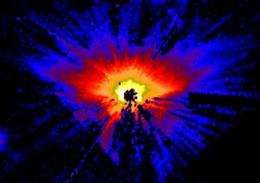
The inner, yellow portion of HD 61005's disk spans 5.4 billion miles, or about the width of Neptune's orbit in our own solar system. This false-color Hubble view masks the star's direct light to bring out detail in the disk. Credit: NASA/ESA/D. Hines (Space Science Inst., New Mexico) and G. Schneider (Univ. of Arizona)

(PhysOrg.com) -- The dust-filled disks where new planets may be forming around other stars occasionally take on some difficult-to-understand shapes. Now, a team led by John Debes at NASA's Goddard Space Flight Center in Greenbelt, Md., finds that a star's motion through interstellar gas can account for many of them.

"The disks contain small comet- or asteroid-like bodies that may grow to form planets," Debes said. "These small bodies often collide, which produces a lot of fine dust." As the star moves through the galaxy, it encounters thin gas clouds that create a kind of interstellar wind. "The small particles slam into the flow, slow down, and gradually bend from their original trajectories to follow it."

FLV player

This movie compares a Hubble image of the debris disk around HD 61005, a young star located 100 light-years away in the constellation Puppis, to a three-dimensional model based on gas drag. Credit: NASA/J. Debes, M. Kuchner (GSFC) and A. Weinberger (CIW)

Far from being empty, the space between stars is filled with patchy clouds of low-density gas. When a star encounters a relatively dense clump of this gas, the resulting flow produces a drag force on any orbiting dust particles. The force only affects the smallest particles -- those about one micrometer across, or about the size of particles in smoke.

"This fine dust is usually removed through collisions among the particles, from the star's light and other forces," explained Debes. "The drag from just takes them on a different journey than they otherwise would have had."

Working with Alycia Weinberger at the Carnegie Institution of Washington and Goddard astrophysicist Marc Kuchner, Debes was using the to investigate the composition of dust around the star HD 32297, which lies 340 light-years away in the . He noticed that the interior of the dusty disk -- a region comparable in size to our own -- was warped in a way that matched a previously known warp at larger distances.

"Other research indicated there were interstellar gas clouds in the vicinity," Debes said. "The pieces came together to make me think that gas drag was a good explanation for what was going on."

"It looks like interstellar gas helps young planetary systems shed dust much as a summer breeze helps dandelions scatter seeds," Kuchner said.

As respond to the interstellar wind, a debris disk can morph into peculiar shapes determined by the details of its collision with the gas cloud. In a face-on encounter, such as that of the star HD 61005 in the constellation Puppis, the disk's edge bends gently away from the direction of motion. Fine dust trails behind, forming a cylindrical wake. If the disk instead slices edgewise through interstellar gas, the resulting headwind blows away fine dust from the portion inside the cloud, resulting in a lop-sided disk.

"The drag from interstellar gas only affects the outskirts of the disk, where the star's gravity can't really hold onto the material," Weinberger said.

The systems studied are about 100 million years old and resemble our own solar system shortly after the major planets formed. Although astronomers don't know whether planets lurk within the disks of these systems, a better understanding of processes affecting a disk's outer regions will shed light on how "ice giant" planets like Uranus and Neptune -- and the more distant swarm of small, icy bodies known as the Kuiper Belt -- formed within the solar system.

Astronomers have sometimes attributed warps and bends in debris disks to the presence of undiscovered planets or to past encounters with another star. "But we expect interstellar gas to be around -- it's everywhere," Debes said. "It's important to consider the ecology of these debris disks before running to such conclusions, and this model explains a lot of the weirdly shaped disks we see."

A paper describing the model appears in the September 1 issue of The Astrophysical Journal.

Source: NASA/Goddard Space Flight Center


print this article email this article download pdf blog this article bookmark this article     Stumble it Digg this share on Facebook retweet share on Reddit add to delicious
Rate this story - 4.3 /5 (3 votes)

Rank Filter

Move the slider to adjust rank threshold, so that you can hide some of the comments.


Display comments: newest first

  • omatumr - Sep 04, 2009
    • Rank: 3.5 / 5 (2)
    INTRIGUING!

    Comets, asteroids, dust and meteorites contain large amounts of elements like Fe, O, Ni, Si and S that were produced in the deep interior of supernova.

    Do they know why such dust surrounds the star HD 32297?

    With kind regards,
    Oliver K. Manuel
    http://www.omatumr.com

    Any chance that the

August 28, 2009 all stories

Comments: 1

4.3 /5 (3 votes)
  • Stumble this up

  • Digg this

  • share this

  • hide
  • Related Stories

  • Circumstellar Dust Takes Flight in 'The Moth'
    created Jan 10, 2008 | popularity not rated yet | comments 0
  • Planets Living on the Edge
    created Dec 17, 2008 | popularity not rated yet | comments 0
  • Hubble Observations Provide Insight into Planet Birth
    created Jan 08, 2007 | popularity not rated yet | comments 0
  • Red dust in planet-forming disk may harbor precursors to life
    created Jan 03, 2008 | popularity not rated yet | comments 0
  • Newly Forming Solar System Has Planets Running Backwards
    created Feb 15, 2006 | popularity not rated yet | comments 0


  • hide
  • Relevant PhysicsForums posts

  • Question about 2-body gravity
    created Nov 24, 2009
  • life on Mars
    created Nov 24, 2009
  • Semi-major axis from cartesian co-ordinates
    created Nov 23, 2009
  • Primary Mirror grinding
    created Nov 23, 2009
  • dark energy can escape black holes.
    created Nov 23, 2009
  • Are there green, purple and pink stars?
    created Nov 22, 2009
  • More from Physics Forums - General Astronomy

Other News

Mars Reconnaissance Orbite

Mars Reconnaissance Orbite Team Plans Uplink of Protective Files

Space & Earth / Space Exploration

created 1hour ago | popularity not rated yet | comments 0

(PhysOrg.com) -- The team operating NASA's Mars Reconnaissance Orbiter plans to uplink protective files to the spacecraft next week as one step toward resuming the orbiter's research and relay activities.


First black holes may have incubated in giant, starlike cocoons, says CU-Boulder study

First black holes may have incubated in giant, starlike cocoons

Space & Earth / Astronomy

created 19 hours ago | popularity 4.5 / 5 (11) | comments 15

(PhysOrg.com) -- The first large black holes in the universe likely formed and grew deep inside gigantic, starlike cocoons that smothered their powerful x-ray radiation and prevented surrounding gases from ...


America's increasing food waste is laying waste to the environment

Space & Earth / Environment

created 3 hours ago | popularity not rated yet | comments 0

Food waste contributes to excess consumption of freshwater and fossil fuels which, along with methane and carbon dioxide emissions from decomposing food, impacts global climate change. In a new paper published in the open-access, ...


Shuttle Atlantis leaves space station, headed home (AP)

Shuttle Atlantis leaves space station, headed home

Space & Earth / Space Exploration

created 3 hours ago | popularity not rated yet | comments 0

(AP) -- Atlantis and its seven astronauts have left the International Space Station.


Cassini Captures Ghostly Dance of Saturn's Northern Lights

Cassini Captures Ghostly Dance of Saturn's Northern Lights (w/ Video)

Space & Earth / Space Exploration

created 16 hours ago | popularity 5 / 5 (7) | comments 1

(PhysOrg.com) -- In the first video showing the auroras above the northern latitudes of Saturn, Cassini has spotted the tallest known "northern lights" in the solar system, flickering in shape and brightness ...