The nutritional value of Andalusian lupines is revealed
August 28, 2009 The nutritional value of Andalusian lupines is revealed

Enlarge

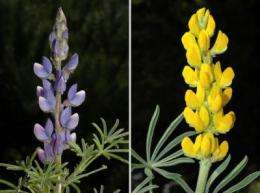
Pictured are Lupinus luteus and Lupinus angustifolius. Credit: Vioque et al. / SINC

A group of researchers from the Fat Institute (CSIC) and the University of Seville have confirmed that some wild plants have a high nutritional value. The scientists have found that several species of lupins from the mountains of Andalusia have a protein content similar to that of other cultivated legumes, as they publish in the online version of the Food Chemistry magazine.

Javier Vioque is a scientific researcher from the Fat Institute (CSIC) in Seville. "We have studied the seeds of six species of lupin (Lupinus sp.) in the south of Spain and we believe that they may represent new sources of quality proteins", he explained to SINC.

The cultivated lupin, a legume which is used as cattle fodder (although its grains are also edible if the bitterness is removed with water and salt), belongs to the Lupinus albus species, but the researchers have focused on six other species which grow wild in Andalusia or are cultivated in a marginal manner: Lupinus angustifolius, L. cosentinii, L. gredensis, L. hispanicus, L. luteus and L. micranthus.

Vioque and other colleagues from the Fat Institute and the University of Seville have analyzed the composition of the which make up the seed proteins, as well as the " digestibility" (percentage of protein digested) and other nutritional parameters. The results of the work will be published at the end of the year in the magazine, although they can already be viewed online.

The data reflect that the species studied display a high protein content fluctuating between 23.8% and 33.6%, very similar to that observed in other legumes. Moreover, the protein digestibility of these lupins is high (between 82% and 89%) and is also similar to that of other legumes and cereals. The study concludes that L. luteus, L. hispanicus and L. cosentinii contain the proteins with the best nutritional properties and that the amino acid composition of the latter species is the most balanced.

Legumes as a source of proteins

Legumes, together with cereals, represent the main source of vegetable proteins in the human diet. The beans and fruits of these plants, as well as having a high content of quality protein, are rich in fibre and carbohydrates and contain other components like polyphenols. For this reason, several studies have confirmed that the consumption of these legumes is beneficial for our health and may help to prevent illnesses such as diabetes and colon cancer.

Despite the above, the consumption of legumes has decreased in recent years, especially that of autochthonous and locally-distributed species. The legumes of the Lupinus species are no exception to the problem.

"For the conservation and expansion of these local crops, we need to continue studying their characteristics as a source of food", indicated Vioque, who emphasizes that research like this "confirms the interest in studying populations of wild species, cultivated or not, so that they can provide seeds with good nutritional properties".

More information: Elena Pastor-Cavada, Rocío Juan, Julio E. Pastor, Manuel Alaiz y Javier Vioque. "Analytical nutritional characteristics of seed proteins in six wild Lupinus species from Southern Spain". Food Chemistry 117 (3): 466-469, 2009.

Source: FECYT - Spanish Foundation for Science and Technology


print this article email this article download pdf blog this article bookmark this article     Stumble it Digg this share on Facebook retweet share on Reddit add to delicious
Rate this story - 4 /5 (1 vote)


August 28, 2009 all stories

Comments: 0

4 /5 (1 vote)
  • Stumble this up

  • Digg this

  • share this

  • hide
  • Related Stories

  • Rice that 'Snaps, Crackles and Pops' with Protein
    created Jan 14, 2008 | popularity not rated yet | comments 0
  • Wheat gene may boost foods' nutrient content
    created Nov 27, 2006 | popularity not rated yet | comments 0
  • Small rodents encourage the formation of scrubland in Spain
    created Aug 27, 2009 | popularity not rated yet | comments 0
  • Boiled peanuts pack big antioxidant punch
    created Oct 26, 2007 | popularity not rated yet | comments 0
  • Scientists explain why insects don’t get fat
    created Sep 27, 2006 | popularity not rated yet | comments 0


  • hide
  • Relevant PhysicsForums posts

  • Putting every element in a box
    created Nov 25, 2009
  • a question in Lewis structure???
    created Nov 25, 2009
  • Paint Technology
    created Nov 24, 2009
  • About pH, Metallic electrodes
    created Nov 24, 2009
  • More from Physics Forums - Chemistry

Other News

Research sheds light on workings of anti-cancer drug

Chemistry / Analytical Chemistry

created 12 hours ago | popularity not rated yet | comments 0

(PhysOrg.com) -- The copper sequestering drug tetrathiomolybdate (TM) has been shown in studies to be effective in the treatment of Wilson disease, a disease caused by an overload of copper, and certain metastatic cancers. ...


New chemical reaction offers opportunities for drug development

Chemistry / Biochemistry

created 16 hours ago | popularity not rated yet | comments 2

Researchers led by Conway Fellow, Professor Pat Guiry have solved a chemistry problem that has stumped researchers worldwide for more than a decade. The results have earned the group the cover story of the leading scientific ...


Sandia CR5

Machine Converts CO2 into Gasoline, Diesel, and Jet Fuel

Chemistry / Biochemistry

created Nov 23, 2009 | popularity 4.6 / 5 (30) | comments 20

(PhysOrg.com) -- Researchers at Sandia National Laboratories have built a machine that uses the sun's energy to convert carbon dioxide waste from power plants into transportation fuels such as gasoline, diesel, ...


New hydrogen-storage method discovered

New hydrogen-storage method discovered

Chemistry / Materials Science

created Nov 22, 2009 | popularity 4.3 / 5 (42) | comments 15

Scientists at the Carnegie Institution have found for the first time that high pressure can be used to make a unique hydrogen-storage material. The discovery paves the way for an entirely new way to approach ...


New on-off 'switch' triggers and reverses paralysis in animals with a beam of light

New on-off 'switch' triggers and reverses paralysis in animals with a beam of light (w/ Video)

Chemistry / Biochemistry

created Nov 18, 2009 | popularity 4.8 / 5 (5) | comments 4

In an advance with overtones of Star Trek phasers and other sci-fi ray guns, scientists in Canada are reporting development of an internal on-off "switch" that paralyzes animals when exposed to a beam of ultraviolet ...