Researchers Hope to Mass-Produce Tiny Robots
August 28, 2009 By Lisa Zyga
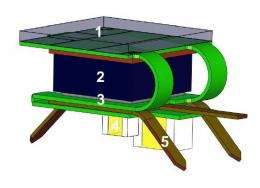
An illustration of the I-SWARM robot: (1) solar cell, (2) IR-communication module, (3) an ASIC, (4) capacitors, (5) locomotion module. Image credit: Edqvist, et al.
(PhysOrg.com) -- Tiny robots the size of a flea could one day be mass-produced, churned out in swarms and programmed for a variety of applications, such as surveillance, micromanufacturing, medicine, cleaning, and more. In an effort to reach this goal, a recent study has demonstrated the initial tests for fabricating microrobots on a large scale.
The researchers, from institutes in Sweden, Spain, Germany, Italy, and Switzerland, explain that their building approach marks a new paradigm of robot development in microrobotics. The technique involves integrating an entire robot - with communication, locomotion, energy storage, and electronics - in different modules on a single circuit board. In the past, the single-chip robot concept has presented significant limitations in design and manufacturing. However, instead of using solder to mount electrical components on a printed circuit board as in the conventional method, the researchers use conductive adhesive to attach the components to a double-sided flexible printed circuit board using surface mount technology. The circuit board is then folded to create a three-dimensional robot.
The resulting robots are very small, with their length, width, and height each measuring less than 4 mm. The robots are powered by a solar cell on top, and move by three vibrating legs. A fourth vibrating leg is used as a touch sensor. As the researchers explain, a single microrobot by itself is a physically simple individual. But many robots communicating with each other using infrared sensors and interacting with their environment can form a group that is capable of establishing swarm intelligence to generate more complex behavior. The framework for this project, called I-SWARM (intelligent small-world autonomous robots for micro-manipulation) is inspired by the behavior of biological insects.
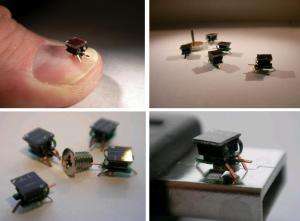
Images of the robots showing their size proportional to various objects. Image credit: Edqvist, et al.
“I look upon them more like a manufacturing way for future robots,” Erik Edqvist of Uppsala University in Sweden told PhysOrg.com. “There are cool experiments going on with flying insects, swimming robots and so on. But it is time for the miniaturized robots to leave the research laboratories and find useful applications. That is where this work fits in. It is an attempt (with a somewhat small budget) to try to build robots in a mass-fabricated way.”As this was the first test of this fabrication technique, the researchers noted that they encountered some fabrication problems. The single largest problem was to connect the naked integrated circuit to the flexible printed circuit board by the conductive adhesive. Also, some solar cells did not stick due to weak adhesion. At this stage in the production process, the robots were folded manually, but the researchers hope to design a tool to enable a faster and more accurate alignment when folding. Many of these complications could likely be corrected, with the important result being that the microrobots can be assembled using a surface mounting machine, whereas prior robots have usually been manually assembled with a soldering iron.
In the future, the researchers hope to move from building academic prototypes to manufacturing the robot on a commercial basis, which is necessary for overcoming some of the technical issues. By mass-producing swarms of robots, the loss of some robotic units will be negligible in terms of cost, functionality, and time, yet still achieve a high level of performance. Currently, the researchers hope to find funding to reach these goals.
“Right now the robots need a new ASIC [application-specific integrated circuit] and some other redesigns to be able to work properly,” Edqvist said.
More information: Erik Edqvist, et al. “Evaluation of building technology for mass producible millimeter-sized robots using flexible printed circuit boards.” J. Micromech. Microeng. 19 (2009) 075011 (11pp).
Copyright 2009 PhysOrg.com.
All rights reserved. This material may not be published, broadcast, rewritten or redistributed in whole or part without the express written permission of PhysOrg.com.
-
Mini robots to undertake major tasks?
Feb 24, 2006 |
not rated yet |
0
-
Robotic ants building homes on Mars?
Oct 21, 2008 |
not rated yet |
0
-
Researchers investigate evolving 'swarm' robots
Mar 13, 2008 |
not rated yet |
0
-
Japanese Firms Start Testing Robots In Office Buildings
Feb 07, 2009 |
not rated yet |
0
-
Futuristic robots, friend or foe?
Apr 22, 2008 |
not rated yet |
0
-
Engineers build first sub-10-nm carbon nanotube transistor
Feb 01, 2012 |
5 / 5 (21) |
19
-
Something old, something new: Evolution and the structural divergence of duplicate genes
Jan 31, 2012 |
4.6 / 5 (7) |
1
-
The hidden nanoworld of ice crystals: Revealing the dynamic behavior of quasi-liquid layers
Jan 30, 2012 |
5 / 5 (2) |
1
-
Stock market network reveals investor clustering
Jan 27, 2012 |
4.1 / 5 (21) |
8
-
Of microchemistry and molecules: Electronic microfluidic device synthesizes biocompatible probes
Jan 26, 2012 |
not rated yet |
0
-
Tennis Court Speed Measurement
11 hours ago
-
Fastest way to cool water
19 hours ago
-
Counter-weights
Feb 02, 2012
-
Composite electric glass heating elements
Feb 02, 2012
-
pipe stress analysis
Feb 02, 2012
-
Interested in average household energy consumption in 2011...
Feb 01, 2012
- More from Physics Forums - General Engineering
More news stories
Researchers find social robots require astute tuning to improve acceptability by the human mind
After years of existing only in fiction, social robots are finally being designed that can more closely emulate how people express themselves, interact and learn and doing so while performing jobs like teaching social ...
7 hours ago |
not rated yet |
0
GPS shoe lets families keep track of elderly relatives
A Teaneck, N.J., shoe maker has joined with a California technology company to create a shoe that uses GPS technology that records where a wearer walks - and can send alerts to caregivers if someone suffering from Alzheimer's ...
Electronics / Consumer & Gadgets
9 hours ago |
not rated yet |
0
New Nokia phone no standout, but worth a look
The first of Nokia's new generation of smartphones isn't flashy and certainly isn't an iPhone killer. But it's a nice device, and at $40 with a two-year contract, a bargain.
Electronics / Consumer & Gadgets
10 hours ago |
1 / 5 (2) |
2
Motorola: Some refurbished tablets weren't wiped
Motorola Mobility says about 100 Xoom tablet computers that it refurbished for sale on Woot.com may not have been properly wiped of the previous owners' data.
Electronics / Consumer & Gadgets
8 hours ago |
not rated yet |
1
A boom in smarter baby monitors
The cry has been heard: After 20 years with little change to baby monitoring devices, new designs premiered in January at the Consumer Electronics Show promising Wi-Fi connectivity and high-definition video that streams live ...
Electronics / Consumer & Gadgets
8 hours ago |
not rated yet |
0
Amazon fungi found that eat polyurethane, even without oxygen
(PhysOrg.com) -- Until now polyurethane has been considered non-biodegradable, but a group of students from Yale University in the US has found fungi that will not only eat and digest it, they will do so even in the absence ...
Scientists chart high-precision map of Milky Way's magnetic fields
(PhysOrg.com) -- Scientists at the Naval Research Laboratory (NRL) are part of an international team that has pooled their radio observations into a database, producing the highest precision map to date of ...
Whole exome sequencing identifies cause of metabolic disease
Sequencing a patient's entire genome to discover the source of his or her disease is not routine yet. But geneticists are getting close.
Hearing metaphors activates brain regions involved in sensory experience
When a friend tells you she had a rough day, do you feel sandpaper under your fingers? The brain may be replaying sensory experiences to help understand common metaphors, new research suggests.
Renowned physicist invents microscope that can peer at living brain cells
(PhysOrg.com) -- Ever since scientists began studying the brain, theyve wanted to get a better look at what was going on. Researchers have poked and prodded and looked at dead cells under electron microscopes, ...
New kind of high-temperature photonic crystal could someday power everything from smartphones to spacecraft
A team of MIT researchers has developed a way of making a high-temperature version of a kind of materials called photonic crystals, using metals such as tungsten or tantalum. The new materials which ...

Aug 28, 2009
Rank: 5 / 5 (4)
Aug 28, 2009
Rank: 5 / 5 (2)
Aug 28, 2009
Rank: 5 / 5 (2)
DEATH!
Aug 28, 2009
Rank: 1 / 5 (2)
Sounds like Grey Ooze to me.
Aug 28, 2009
Rank: not rated yet
Even if you program them to cooperatively build more of their brethren they still need the parts to be given to them (solar cells don't exactly grow on trees)
Aug 28, 2009
Rank: 5 / 5 (1)
Aug 28, 2009
Rank: 3.5 / 5 (2)
The first generation "does none of that". Who's to say what the 10,000th generation would do?
Aug 28, 2009
Rank: 3 / 5 (2)
Poul Anderson wrote a science fiction novel where astronauts reanimated from suspended animation find an earth that has changed dramatically. All protoplasmic creatures were replaced by robotic silicon lifeforms in an ecology as broad as living things on earth now.
Aug 28, 2009
Rank: not rated yet
Aug 28, 2009
Rank: not rated yet
Aug 28, 2009
Rank: not rated yet
Aug 28, 2009
Rank: 2 / 5 (2)
Aug 28, 2009
Rank: not rated yet
I imagine there is no wind in the Pentagon, to answer the wind question from above
Aug 28, 2009
Rank: 1 / 5 (2)
Nah. Worry now. It saves time, as the Red Queen said in "Alice in Wonderland".
If we were to stop, or at least regulate this now, we wouldn't have to face the clear and present danger 20 years hence.
Aug 29, 2009
Rank: not rated yet
Aug 29, 2009
Rank: not rated yet
Aug 29, 2009
Rank: not rated yet
Unless they could stick to surfaces like an insect, which is probably a bit hard with vibrating legs, I don't really see a great deal of applications for this particular design. The choice of power supply isn't very flexible either. Why not some form of short distance wireless power transfer? It should be feasible on such a small scale.
The manufacturing process is quite smart, though, and if I understood it right, these little fellas could be fabricated en masse from a desktop sized printer. If they come up with a working design capable of manufacturing tasks, that might have some serious economical implications. Just print more printers...
Aug 29, 2009
Rank: 2.5 / 5 (2)
Nature's not done inventing yet. If you accept that intelligence evolves naturally, then Nature is now "inventing" through us -- just as it would on any other planet where intelligent life evolved. Is gray ooze a likely consequence of the natural evolution of intelligence? We won't know that until we see many other planets which evolved intelligent life (or until we make the ooze ourselves!) But the fact that it has not existed yet doesn't mean it can't -- Nature has only just very recently created us, and, transitively, it has just created the potential for a near infinite array of radically novel types of creatures undreamt of by the Earth until now. The only question is how responsible we're capable of being with this power.
Aug 29, 2009
Rank: not rated yet
Creating something that ends up devouring your species and planet doesn't sound very intelligent. If we ever get around to developing that level of technology, I hope we'll at least have a the processing power to simulate the effects of mass distribution of self-assembling nanotech, if not a backup planet or two. At any rate, it shouldn't end up in a disaster, unless we're very, very stupid or lazy.
Then again, there's the idea of transcendence. Something along the lines of a grey singularity. One with the ooze.
Aug 29, 2009
Rank: 5 / 5 (2)
Sounds like the human race to me.
Aug 30, 2009
Rank: not rated yet
Aug 30, 2009
Rank: not rated yet
a) Do not make the bots energy-autonomous (make them dependent on energy transmitted via a specific radio frequency). Turn off the transmitter and the ooze stops. This would also confine them to the area where you want them to do their work.
b) Make them dependent on a meterial not found in nature (one that they cannot synthesize). Once the initially given supply runs out the ooze stops growing.
Aug 30, 2009
Rank: 5 / 5 (1)
Sep 01, 2009
Rank: not rated yet
Sep 01, 2009
Rank: not rated yet
I am aware of this, the point is, I was working with a 30 year timespan. If we are now capable of this level of miniaturization, then I may have to revise my professional opinion on the point we will be capable of in three decades.
I did not believe we had achieved this level of swarm AI for this size of robot, now, if that makes sense. I apologize for the confusion.
Sep 02, 2009
Rank: not rated yet
Hi
The multilayered used for the legs do have electrodes that are about 15 nm thick (evaporated Al). The active piezopolymer (PVDF-TrFE) are about 2.5 µm thick. So there are structures in the robot in these ranges, but you are right that it is not a true microrobot. I personally don't think there are microrobots yet, since the once presented are controlled externally.
Your ideas about the powering is interesting and one of the problems all/most scientist building small robots have struggled with since the first once in the eighties. Early on in the project thin film batteries were considered as a solution on how to power the robots, these were however not small enough. In the Micron project an inductive coil was used to power the robots on a power floor. Such a coil was abandon since it was too large, leaving solar energy (with its limitations) as an alternative. I guess the future will tell us how really small structures should be powered. Most suggestions today have limitations, If you strip the structure of intelligence you could use magnetic force (Prof Nelson, EPFL), or inductive coupling (need a special floor) (Prof. Donalds, MIT).
Cheers!
Sep 02, 2009
Rank: 3 / 5 (1)
I think a power floor would be even more limiting than solar power. The problem with these thingies is that they're too big to benefit from nano-scale powering opportunities, but also too small to be completely autonomous.
Hmm...One application that just crossed my mind would be on water surfaces. The current propulsion system is ideal, you would just need to stabilise it somehow, with some sort of filament, or anchor, so it keeps the solar cell upwards and doesn't capsize. In sufficient numbers they could be used to clear oil leaks, maybe by some electrochemical effect. You'd have to keep hungry fish away, though.
Sep 02, 2009
Rank: not rated yet
Functionally doesn’t always give you the big bucks…. Right now nano is a buzz word often used in scientific applications, some 10-20 years ago micro was the hottest word to use.
I-SWARM had two primarily objectives: The first was to produce a large swarm of low level intelligent robots probably capable of producing collective intelligence. The second was to solve the hard ware manufacturing of such a swarm. But I guess other areas like distributed sensor researchers, might show some interest in the technology.
Another unofficial objects from the EU (which funded the entire project) was to improve the possibility for researchers from different European countries to work together.
A solution to the power problem of a microrobot or a distributed sensor is energy scavenging from the surrounding environment (and not just solar cells). This would be very interesting to continue doing.
Sep 02, 2009
Rank: not rated yet
So is there any chance of continued funding, or was the EU just happy to prove that European scientists can get along? It'd be a shame not to try to build an automated fabricator, since that's a pretty crucial element for any swarm tech.
Energy could be extracted from all sorts of EM waves in the environment, maybe even acoustic ones. You're already using PVDF for locomotion, couldn't you use it to receive an acoustic signal, at resonant frequency, and harness the piezoelectric effect? I imagine each bot would also act as a relay, increasing the signal's strength throughout the swarm. I'm way out of my area of expertise, though...
Sep 03, 2009
Rank: not rated yet
We are driving the legs (resonating cantilevers) at the first natural resonance or at multiples of the resonance in order to increase the tip deflection of the legs at voltage minimum, so I guess it would be hard to harvest from the same three cantilevers. Maybe extra structures would have to be developed in that case, and definitely improved versions of PVDF should be used.
Sep 03, 2009
Rank: not rated yet
Or why not put legs up and on the sides, as well as down? When not used for moving, they could act as antennas for harvesting energy from an ultrasonic signal emitted nearby, and the units get some all-terrain abilities, too. Since friction with the ground changes the resonant frequency of the cantilever, you don't risk having all of them running at the same time. Friction with obstacles would do the same, therefore they could also act as collision sensors. It would have to be a very symmetrical shape, though. Maybe a tetrahedron, with 3 legs for locomotion and one for energy at all times? Kinda like a caltrop, but it wouldn't work as a sensor that way.
Like I said, I'm no expert and I'm lacking a lot of technical details, but I somehow think the whole concept could function entirely micromechanical, i.e. without any electronic/digital components. You'd have this programmed audio track to which the swarm starts dancing. The paradigm might work at nano level, too, with EM instead of acoustic waves.
Can't wait to finish my education and do actual R&D...