Acoustic tweezers can position tiny objects
August 28, 2009 Acoustic tweezers can position tiny objects

Enlarge

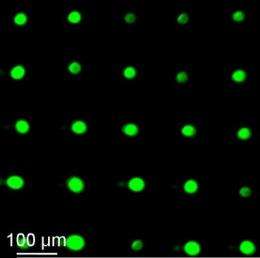
Dynamic patterning of polystyrene beads (diameter of 1.9 μm) through "acoustic tweezers" technology. The wavelength of the applied standing acoustic wave was 200 micrometers and the power intensity was 2,000 watts per meter squared. Credit: Tony Jun Huang, Jinjie Shi, Penn State

(PhysOrg.com) -- Manipulating tiny objects like single cells or nanosized beads often requires relatively large, unwieldy equipment, but now a system that uses sound as a tiny tweezers can be small enough to place on a chip, according to Penn State engineers.

"Current methods for moving individual cells or tiny beads include such devices as , which require a lot of energy and could damage or even kill live cells," said Tony Jun Huang, assistant professor of engineering science and mechanics. "Acoustic tweezers are much smaller than optical tweezers and use 500,000 times less energy."

While optical tweezers are large and expensive, acoustic tweezers are smaller than a dime, small enough to fabricate on a chip using standard chip manufacturing techniques. They can also manipulate live cells without damaging or killing them.
Acoustic tweezers can position tiny objects
Enlarge

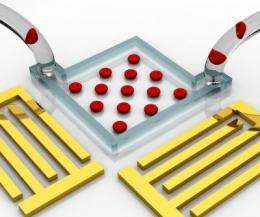
"Acoustic tweezers" enable flexible on-chip manipulation and patterning of cells using standing surface acoustic waves. Credit: Tony Jun Huang, Jinjie Shi, Penn State

Acoustic tweezers differ from eyebrow tweezers in that they position many tiny objects simultaneously and place them equidistant from each other in either parallel lines or on a grid. The grid configuration is probably the most useful for biological applications where researchers can place stem cells on a grid for testing or on a grid to grow new skin. This allows investigators to see how any type of cell grows.

"Acoustic tweezers are not just useful in biology," said Huang. "They can be used in physics, chemistry and to create patterns of for coatings or to etch surfaces."

Acoustic tweezers work by setting up a standing surface acoustic wave. If two sound sources are placed opposite each other and each emits the same of sound, there will be a location where the opposing sounds cancel each other. This location can be considered a trough. Because sound waves have pressure, they can push very small objects, so a cell or nanoparticle will move with the until it reaches the trough where there is no longer movement. The particle or cell will stop and "fall" into the trough.

If the sound comes from two parallel sound sources facing each other, the troughs form a line or series of lines. If the sound sources are at right angles to each other, the troughs form an evenly spaced set of rows and columns like a checkerboard. Here too, the particles are pushed until they reach the location where the sound is no longer moving.

The acoustic tweezers are manufactured by fabricating an interdigital transducer onto a piezoelectric chip surface. These transducers are the source of the sound. Next, using standard photolithography, microchannels are fabricated in which a small amount of liquid with the cells or particles can move around freely. These microchannels were bonded to the chip to create the area for particle movement.
Acoustic tweezers can position tiny objects
Enlarge

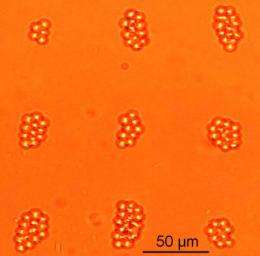
Pictured is dynamic patterning of bovine red blood cells (diameter of 5.8 micrometers) through "acoustic tweezers" technology. The wavelength of the applied standing acoustic wave was 100 micrometers, and the power intensity was 2,000 watts per meter square. Credit: Tony Jun Huang, Jinjie Shi, Penn State

To test their device, the researchers, who include Jinjie Shi, Daniel Ahmed and Sz-Chin Steven Lin, graduate students, engineering science and mechanics; Xiaole Mao, graduate student in bioengineering, and Aitan Lawit, undergraduate in engineering science and mechanics, used Dragon Green fluorescent polystyrene beads about 1.9 micrometers in diameter. They then used cows red blood cells and the single cell bacteria E. coli to test the acoustic tweezers.

"The results verify the versatility of our technique as the two groups of cells differ significantly in both shape (spherical beads vs. rod-shaped E. coli) and size," the researchers reported in a recent issue of Lab on a Chip. They note that the patterning performance is independent of the particle's electrical, magnetic and optical properties.

"Most cells or particles patterned in a few seconds," said Huang. "The energy used is very low and the acoustic tweezers should not damage cells at all. Because they have different properties, the acoustic tweezers could also separate live from dead cells, or different types of particles."

Acoustic tweezers technology has significant advantages over existing technologies because of its versatility, miniaturization, power consumption and technical simplicity. Huang expects it to become a powerful tool for many applications such as tissue engineering, cell studies, and drug screening and discovery.

Source: Pennsylvania State University (news : web)


print this article email this article download pdf blog this article bookmark this article     Stumble it Digg this share on Facebook retweet share on Reddit add to delicious
Rate this story - 5 /5 (7 votes)

Rank Filter

Move the slider to adjust rank threshold, so that you can hide some of the comments.


Display comments: newest first

  • canuckit - Oct 02, 2009
    • Rank: not rated yet
    The article below is the first describing the holding action of a field of ultrasonic standing waves on (macro) particles. The principle is the same with smaller particles.
    "Ultrasonic inspection of fiber suspensions"
    Dion, J. L.; Malutta, A.; Cielo, P.
    The Journal of the Acoustical Society of America, Volume 72, Issue 5, November 1982, pp.1524-1526
    An invention award was granted to the inventor.

August 28, 2009 all stories

Comments: 1

5 /5 (7 votes)
  • Stumble this up

  • Digg this

  • share this

  • hide
  • Related Stories

  • Optoelectronic tweezers push nanowires around
    created Apr 27, 2007 | popularity not rated yet | comments 0
  • Liquid lens creates tiny flexible laser on a chip
    created May 11, 2009 | popularity not rated yet | comments 0
  • Team 'tractor beam' for manipulation of cells on silicon
    created Oct 30, 2007 | popularity not rated yet | comments 0
  • White-light laser is basis of new optical tweezers and microscope
    created May 27, 2005 | popularity not rated yet | comments 0
  • Student Creates Electric Tweezers
    created Aug 18, 2006 | popularity not rated yet | comments 0


  • hide
  • Relevant PhysicsForums posts

  • dynamic hardness measurements
    created 8 hours ago
  • May i know is structure such as bcc, fcc depends on how it process?
    created 14 hours ago
  • Wear patterns
    created Nov 18, 2009
  • What is meant by 'as-cast'?
    created Nov 18, 2009
  • Iron-rich spheres
    created Nov 18, 2009
  • Catalyst External and Internal Mass Transfer
    created Nov 16, 2009
  • More from Physics Forums - Materials & Chemical Engineering

Other News

Using superconducting probes to get a picture of what it's like inside CNTs

Nanotechnology / Nanophysics

created Nov 20, 2009 | popularity 4.9 / 5 (7) | comments 0

(PhysOrg.com) -- "Carbon nanotubes are exciting for fundamental physics, and for potential technological applications," Nadya Mason tells PhysOrg.com. "However, we are generally limited in the way that we can study them. ...


Nanoparticles used in common household items caused genetic damage in mice

Nanotechnology / Bio & Medicine

created Nov 16, 2009 | popularity 4.7 / 5 (22) | comments 11

Titanium dioxide (TiO2) nanoparticles, found in everything from cosmetics to sunscreen to paint to vitamins, caused systemic genetic damage in mice, according to a comprehensive study conducted by researchers at UCLA's Jonsson ...


Nanotube defects equal better energy and storage systems

Nanotube defects equal better energy and storage systems

Nanotechnology / Nanomaterials

created Nov 19, 2009 | popularity 4.4 / 5 (9) | comments 2

(PhysOrg.com) -- Most people would like to be able to charge their cell phones and other personal electronics quickly and not too often. A recent discovery made by UC San Diego engineers could lead to carbon ...


When It Comes to Drug Delivery, Size Matters

Nanotechnology / Bio & Medicine

created Nov 20, 2009 | popularity 5 / 5 (1) | comments 0

(PhysOrg.com) -- One of the great promises of nanotechnologies lies in its ability to create drug-containing nanoparticles decorated with targeting molecules that recognize and bind to cancer cells, providing drug delivery ...


Scientists synthesize graphene-like material: Polymer with honeycomb structure

Scientists synthesize graphene-like material: Polymer with honeycomb structure

Nanotechnology / Nanomaterials

created Nov 19, 2009 | popularity 4.5 / 5 (6) | comments 1

Two-dimensional carbon layers, so-called graphenes, are regarded as a possible substitute for silicon in the semiconductor industry. The electronic properties of these layers can be varied by "building in" ...