Horse dies, France faces reality of toxic beaches
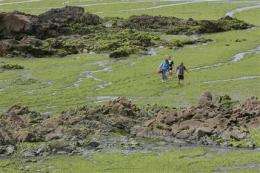
(AP) -- It should have been a perfect day for Vincent Petit, finishing up an afternoon gallop on a wide expanse of beach along a pastel-colored bay. Instead, he and his mount were sucked into a hole of noxious black sludge.
The horse died within seconds, the rider lost consciousness and a dirty secret on the Brittany coast reverberated across France - decaying green algae was fouling some of its best beaches.
A report ordered by the government after the accident found concentrations of hydrogen sulfide gas emitted by the rotting algae were as high as 1,000 parts per million on the beach where the horse died - an amount that "can be fatal in several minutes."
There had been signs of a crisis for years in this idyllic corner of Brittany. But scaring away tourists was in no one's interest, including the farming industry - the region's economic backbone - whose nitrate-packed fertilizers power algae blooms.
So, while tongues wagged, folks whispered and acrimony grew, an official hush prevailed. It took the death of the horse to bring the problem into the open.
Decaying ulva algae threatens other beaches around France and the world, from the United States to China, experts say. Last year, the Chinese government brought in the army to remove the slimy growths so the Olympic sailing competition could be held.
In Brittany's Cote d'Armor region, conditions are perfect for its spread - sunlight, shallow waters and flat beaches. Chemical and natural fertilizers like pig excrement, loaded with nitrates and phosphorous, have saturated the land, spilling into rivers and the ocean, feeding the algae that then proliferate.
Harmless while in water, the algae form dangerous gases - notably hydrogen sulfide, with its characteristic rotten-egg smell - when they wash up on land and decay. A white crust forms and traps the gases, which are released when stepped on or otherwise disturbed. Over time, putrefied algae turns sand into a black silt muck, sometimes containing pockets of poison gas.
On July 28, Petit, a 28-year-old researcher in a state-run virology lab, had just finished riding his thoroughbred Sir Glitter, a retired racehorse, on the Saint-Michel-en-Greves beach, when the two were suddenly mired in muck as he led the horse on foot in search of a place to cross a stream running through the sand.
"The horse and I slid in," said Petit, who is also trained in veterinary studies. "A horse in that situation is in an enormous panic, but he didn't have time to struggle."
Petit said he watched horrified as his horse stopped breathing and died within about 30 seconds, then he himself passed out. Petit was pulled from the mire by a bulldozer shovel after a man who witnessed the accident gave the alert.
While locals are aware of the perils posed by the silt traps that lurk under the sand around streams that feed from the beach into the ocean, Petit did not sense the danger until the ground gave way and he and his horse were sucked into the noxious ooze up to the man's chest.
Police initially ruled the horse suffocated, but an autopsy showed the animal died of an acute pulmonary edema with symptoms "compatible with gaseous intoxication in a brutal manner," Petit said, quoting the report, which he paid for.
There was no foreign matter in the horse's throat, lungs or stomach and no sign of a heart attack, he said.
There have been local efforts to clear the blight. Mayor Rene Ropartz said Saint-Michel-en-Greve, a village of 480 people, collected 10,000 tons of algae from the mile-long beach by the end of July; several years ago they cleaned up 21,000 tons.
"This bay is magnificent and, unfortunately, this tarnishes the image," said Ropartz, adding that the horse's death shows the role of the algae "is no longer in doubt" and spurred the government into action.
Prime Minister Francois Fillon visited Saint-Michel-en-Greve last week, pledging measures to control the algae by next spring.
The horse is only the latest victim of the algae's noxious fumes. A man was found dead on the same beach two decades ago, his arm sticking out from a pile of algae. Another man fell into a four-day coma after cleaning algae 10 years later. And last year, two dogs died while romping on an algae-covered beach 60 miles to the east.
At Grandville beach, where the dogs died, putrefying algae has turned the sand to blackened silt, spotted with green swampland and white crusty clumps of algae in decay. The stench of hydrogen sulfide hangs heavy in the area, where people occasionally show up to gawk at the ruined beach.
"Once you could swim here. Now, it's no longer a beach, it's a garbage dump," said Andre Ollivro, a founder of Halt the Green Tide, one of several ecology groups that has warned of the algae peril as bad blood built with farmers.
After the dogs died, scientists at CEVA, a state-run institute that tracks algae in France, began protecting themselves with hand-held instruments to measure hydrogen sulfide, said agency official Sylvain Ballu.
Ballu said he found 500 parts per million of hydrogen sulfide in the area where the dogs died.
Solving the problem will take far more than cleaning algae from beaches.
Water in the affected region currently measures 32-33 milligrams per liter of nitrate - compared to a normal level of 5 milligrams, said Alain Menesguen, a biologist with the French Institute for Exploitation of the Sea. Some rivers reach 60-70 milligrams and the ground water in some areas reaches 100 milligrams, he said.
"We've reached saturation," he said. Returning to normal levels will require huge changes in the agricultural sector without seeing any immediate drop in the algae mass.
"This is very difficult for farmers and politicians to accept," Menesguen said.
Solange Le Guen, who raises 80 cows on a farm planted with corn, wheat and other crops in the hills behind Saint-Michel-en-Greve, says farmers aren't the only ones to blame.
Fault also lies with water purification plants located too close to the ocean, she said. She conceded, when pressed, that "people have abused" fertilizers. "We were badly advised," she said.
For Petit, it comes down to assuring some good comes from the tragedy and his scrape with death.
"I'm trying to do everything so that my horse didn't die for nothing, that this won't just end as a simple accident," he said. "It could have been worse, for me."
©2009 The Associated Press. All rights reserved. This material may not be published, broadcast, rewritten or redistributed.


