Kenya's hippos hard hit by drought
August 30, 2009 by Francois Ausseill
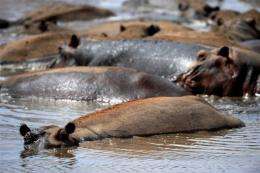
A group of hippos bathe in a shallow pool of water in the Tsavo West National Park, in southern Kenya. Kenya's persistant and bruising drought is having a serious impact on the country's wildlife, one of its main tourist attractions, obliging the Kenya Wildlife Service (KWS) to feed hippos to keep them alive.
Kenya's persistent and bruising drought is having a serious impact on the country's wildlife, one of its main tourist attractions, obliging the Kenya Wildlife Service (KWS) to feed hippos to keep them alive.
In Tsavo West national park, a vast expanse of shrubby savannah and majestic rocky outcrops in the south east of the country, hippos are dying in large numbers and other species have been forced to change their diet.
Some 15 hippos have been found dead in the park in the past few weeks for lack of any grass to graze on around the pools where they spend their days submerged to keep out of the sun.
"For the past one month, the research team has recommended that in order to have the hippos in (good) condition... we give them four bales of hay every two days," KWS ranger Edward Njuguna told AFP.
Edward and his colleague spread out the hay on the bank of a small pool where a dozen or so hippos are splashing about, just metres (yards) away from the remains of one of their number who died a month ago.
"It has been a challenge to remove the carcass. The other hippos are very defensive, one in particular - we suspect him to be a son of the dead hippo," Njuguna said.
Some of the park's lodges have followed KWS's lead and have started spreading hay or vegetable peelings to feed the hippos and keep them in the vicinity of the lodge to ensure that their visitors can enjoy the sight of hippos feeding as they sip their gin and tonic on the verandah.
Cedric Khayale, a KWS research scientist, explained that hippos have been particularly hard hit because in periods of drought other species that would normally graze further away come closer to the banks and eat the grass the hippos would normally eat.
This forces the hippos to look for grass further away and many succumb to exhaustion. Even a healthy hippo can only look for food in a radius of about seven kilometres from the river or lake bank.
Other herbivores have responded to the absence of grazing land by changing what they eat.
"When the situation worsens buffaloes start eating leaves and branches and elephants uproot trees and strip the bark from acacias. That's not something you see often when there's rain," Njuguna said.
The situation is by no means unique to Tsavo. In the past 12 months, the parks and reserves of the Samburu region, further to the north have recorded 38 deaths of elephants directly linked to the drought.
In the park on the banks of Lake Nakuru, world famous for its flamingoes, KWS has set up artificial water points. The lake water is too salty for the animals and the rivers that normally flow into the lake have dried up.
The drought has also brought about a massive and illegal intrusion of livestock into the country's national parks.
"What is happening now is the result of three consecutive failed rainy seasons," said Daniel Woodley who heads the KWS team at Tsavo West.
"The communities around Tsavo didn't get crops... Their reliance on other natural resources increased: timber, honey, charcoal, which is probably the main cash crop in drought period, bush meat, and illegal fishing."
Woodley said that in times of drought people take their livestock wherever they see a patch of green and some water.
"It's easy to manage the communities that are living outside our boundaries through community programs, rotation grazing," Woodley said.
But when the number of head of livestock hits 200,000 in Tsavo West park and a similar number in Tsavo East it has a hugely disruptive effect on the environment, he said.
Some of the cattle brought into Tsavo have been herded hundreds of kilometres in search of grass and watering points.
The more cattle are herded into the park, the more elephants move out, destroying the already poor harvests of local farmers.
"Helicopters, aircraft, rangers... We put a lot of effort into getting livestock out of the park and elephants back into it," Woodley said.
Kenya is normally hit by severe drought once every 10 to 15 years, Woodley said.
"But not on this scale. We've never had such a huge livestock invasion... nor was the population around the park so reliant on other natural resources. And nor was the country was so economically week."
(c) 2009 AFP
-
DR Congo hippos face extinction
Sep 13, 2005 |
not rated yet |
0
-
Hippos are being decimated in the DR Congo
Nov 15, 2005 |
not rated yet |
0
-
Rare pygmy hippos photographed
Mar 11, 2008 |
not rated yet |
0
-
Hippo ancestry disputed: Researchers rebut family tree involving hippos, whales and pigs
Mar 18, 2009 |
not rated yet |
0
-
Kenya's national parks not free from wildlife declines
Jul 08, 2009 |
not rated yet |
0
-
Fast photon control brings quantum photonic technologies closer
1 hour ago |
5 / 5 (2) |
0
-
Engineers build first sub-10-nm carbon nanotube transistor
Feb 01, 2012 |
4.9 / 5 (33) |
30
-
Something old, something new: Evolution and the structural divergence of duplicate genes
Jan 31, 2012 |
4.6 / 5 (7) |
1
-
The hidden nanoworld of ice crystals: Revealing the dynamic behavior of quasi-liquid layers
Jan 30, 2012 |
5 / 5 (5) |
1
-
Stock market network reveals investor clustering
Jan 27, 2012 |
3.9 / 5 (23) |
8
-
Factors affecting beet root cell membrane
Feb 12, 2012
-
Stem cell question.
Feb 10, 2012
-
Protease cleavage
Feb 10, 2012
-
Pertubance in a model
Feb 10, 2012
-
Cancer drugs and Alzheimer's, Oh my!
Feb 09, 2012
-
Squishing cells
Feb 09, 2012
- More from Physics Forums - Biology
More news stories
Big Society could threaten biodiversity conservation
A study of the Moray Firth Seal Management Plan (MFSMP), in north-east Scotland, identified four key conditions for long-term success, three of which pointed to the importance of direct government involvement.
1 hour ago |
not rated yet |
0
New molecule has potential to help treat genetic diseases and HIV
(PhysOrg.com) -- Chemists at The University of Texas at Austin have created a molecule that's so good at tangling itself inside the double helix of a DNA sequence that it can stay there for up to 16 days before ...
3 hours ago |
5 / 5 (2) |
0
|
Biobased approaches examined in fight against zebra chip
Thanks to investigations by scientists-turned-detectives with the U.S. Department of Agriculture (USDA) and other agencies, potato growers in the western United States and abroad now know the identities of ...
1 hour ago |
not rated yet |
0
Integrated pest management recommendations for the southern pine beetle
The southern pine beetle, Dendroctonus frontalis Zimmermann, is a chronic insect pest within pine forests in the southeastern United States. Under favorable environmental and host conditions, it is an agg ...
6 hours ago |
not rated yet |
0
A mitosis mystery solved: How chromosomes align perfectly in a dividing cell
Although the process of mitotic cell division has been studied intensely for more than 50 years, Whitehead Institute researchers have only now solved the mystery of how cells correctly align their chromosomes during symmetric ...
21 hours ago |
4.5 / 5 (24) |
0
|
Fast photon control brings quantum photonic technologies closer
(PhysOrg.com) -- Using photons instead of electrons to transmit information could lead to faster and more secure ways to communicate, among other advantages. Now a team of physicists has taken another step toward realizing ...
Planck mission steps closer to the cosmic blueprint
(PhysOrg.com) -- ESA's Planck mission has revealed that our Galaxy contains previously undiscovered islands of cold gas and a mysterious haze of microwaves. These results give scientists new treasure to mine ...
New ability to regrow blood vessels holds promise for treatment of heart disease
(Medical Xpress) -- University of Texas at Austin researchers have demonstrated a new and more effective method for regrowing blood vessels in the heart and limbs a research advancement that could have ...
Slowing ocean current caused Earth to spin faster
(PhysOrg.com) -- Most people probably didn’t notice it, but back in 2009, the Earth spun around on its axis a tiny bit faster than usual, making for some slightly shorter days. It only happened for a ...
Myths and shame keep many from seeking bankruptcy protection
(PhysOrg.com) -- Two interesting facts that may counter modern ideas about bankruptcy: The overwhelming majority of U.S. filings belong to individuals rather than corporations or entities, and most of these ...
Motivation to exercise affects behavior
(Medical Xpress) -- For many people, the motivation to exercise fluctuates from week to week, and these fluctuations predict whether they will be physically active, according to researchers at Penn State. In an effort to ...