Researchers improve zebrafish cloning methods
August 30, 2009 MSU researchers improve zebrafish cloning methods

Enlarge

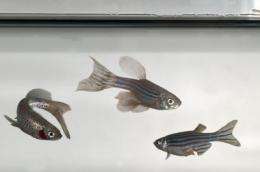
These are zebrafish that were cloned in the Michigan State University Cellular Reprogramming Laboratory. Credit: G.L. Kohuth, MSU University Relations

A team of Michigan State University researchers has developed a new, more efficient way of cloning zebra fish, a breakthrough that could have implications for human health research.

The work of the MSU researchers, detailed in the recent issue of the journal , is important because , small striped fish common to many aquariums, are quickly becoming the animal of choice for many researchers.

"After the mouse, it is the most commonly used vertebrate in genetic studies," said Jose Cibelli, an MSU professor of animal science and one of the paper's co-authors. "It is used in cancer research and cardiovascular research because they have many of the same genes we have."

For more than 20 years, Cibelli said, zebra fish have also served as an excellent model for understanding normal development and birth defects. More recently, research with zebra fish has extended to model human diseases and to analyze the formation and functions of cell populations within organs.

Previous methods of cloning zebra fish have had very low success rates. But using this new method, the number of cloned fish that can be obtained from an adult fin cell or an embryonic tail clip increased by 2 percent to 13 percent respectively.

The normal cloning technique uses an unfertilized egg and a donor cell. The DNA is removed from the egg and replaced by the DNA taken from the donor. The is then coaxed into dividing. The resulting fish is an exact genetic copy of the donor.
MSU researchers improve zebrafish cloning methods
Enlarge

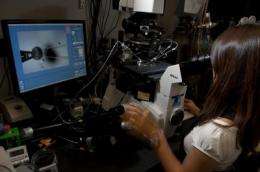
Kannika Siripattarapravat works in the Cellular Reprogramming Laboratory at Michigan State University. A doctoral student, she is the main author of a paper in Nature Methods that outlines a new, more efficient method of cloning zebra fish. Credit: G.L. Kohuth, MSU University Relations

Using Cibelli and colleagues' technique, the egg is gently removed from the female zebra fish and placed in a solution of ovarian fluid from a Chinook salmon.

"This worked well," he said, "because it kept the egg inactive for some time. It gave us two or three hours to work with.

"It was also useful that we are working in Michigan. The state's Department of Natural Resources was very generous in helping us collect fluid from female Chinooks."

Then, borrowing a technique from human in vitro fertilization, the DNA was removed from the egg by using a laser.

Next, Cibelli's team devised a novel, more efficient way of transplanting the donor cells into the egg.

"The tricky part was finding a way to get into the egg," he said. "We used the same entrance that sperm uses. There was only one spot on the egg, and we had to find it."

What makes zebra fish so useful in research is their are transparent and the fish's development is easy to follow.

Improving on the techniques of zebra fish cloning also is important because currently only the mouse remains the best model for gene targeting.

"So far the mouse is the only one from which you can delete genes in a reliable fashion," Cibelli said. "What researchers do is mutate a gene, abolish its function completely, and then study the consequences."

Source: Michigan State University (news : web)


print this article email this article download pdf blog this article bookmark this article     Stumble it Digg this share on Facebook retweet share on Reddit add to delicious
Rate this story - 4 /5 (3 votes)


August 30, 2009 all stories

Comments: 0

4 /5 (3 votes)
  • Stumble this up

  • Digg this

  • share this

  • hide
  • Related Stories

  • Genetic secrets of human egg discovered
    created Sep 05, 2006 | popularity not rated yet | comments 0
  • Gene in male fish lures females into sex
    created Nov 15, 2007 | popularity not rated yet | comments 0
  • Fetal alcohol study uncovers new facts
    created Jan 23, 2007 | popularity not rated yet | comments 0
  • Therapeutic cloning treats Parkinson's disease in mice
    created Mar 23, 2008 | popularity not rated yet | comments 0
  • Scientists create new cloning method
    created Oct 04, 2006 | popularity not rated yet | comments 0


  • hide
  • Relevant PhysicsForums posts

  • Super quick question about Starling forces?
    created 9 hours ago
  • Questions about diffusion
    created 15 hours ago
  • Human Leukocyte Antigen (HLA) typing
    created 22 hours ago
  • Breeding program
    created Nov 20, 2009
  • How does a concentration gradient provide energy?
    created Nov 20, 2009
  • Eyesight and Neural Damage from Electronics
    created Nov 19, 2009
  • More from Physics Forums - Biology

Other News

Beyond sunlight: Explorers census 17,650 ocean species between edge of darkness and black abyss

Beyond sunlight: Explorers census 17,650 ocean species between edge of darkness and black abyss (w/ Video)

Biology / Plants & Animals

created 3 hours ago | popularity 5 / 5 (3) | comments 0

Census of Marine Life scientists have inventoried an astonishing abundance, diversity and distribution of deep sea species that have never known sunlight - creatures that somehow manage a living in a frigid ...


Rare Charles Darwin book found on toilet bookshelf (AP)

Rare Charles Darwin book found on toilet bookshelf

Biology / Other

created 2 hours ago | popularity not rated yet | comments 0

(AP) -- An auction house says it is selling a rare first edition of Charles Darwin's "On the Origin of Species" found in a family's guest lavatory in southern England.


The Monarchs' annual migration ritual has yet to be scientifically explained

Tree-eating bugs threaten Monarch butterfly in Mexico

Biology / Ecology

created 23 hours ago | popularity 4 / 5 (1) | comments 0

The mysterious Monarch butterfly, which migrates en masse annually between Canada and Mexico, is now facing a new peril: another insect thriving in Western Mexican forests.


Bigger not necessarily better, when it comes to brains

Bigger not necessarily better, when it comes to brains

Biology / Plants & Animals

created Nov 17, 2009 | popularity 4.5 / 5 (18) | comments 11

(PhysOrg.com) -- Tiny insects could be as intelligent as much bigger animals, despite only having a brain the size of a pinhead, say scientists at Queen Mary, University of London.


Extinct goat Myotragus balearicus

Extinct goat was cold-blooded

Biology / Plants & Animals

created Nov 18, 2009 | popularity 4.9 / 5 (33) | comments 10

(PhysOrg.com) -- An extinct goat that lived on a barren Mediterranean island survived for millions of years by reducing in size and by becoming cold-blooded, which has never before been discovered in mammals.