Neuroscientists find brain region responsible for our sense of personal space
August 30, 2009
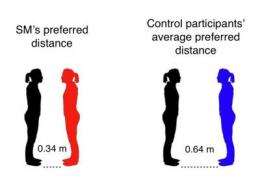
Patient SM, a woman with complete bilateral amygdala lesions (red), preferred to stand close to the experimenter (black). On average, control participants (blue) preferred to stand nearly twice as far away from the same experimenter. Images drawn to scale. Credit: Nature Neuroscience/Dan Kennedy (Caltech)
In a finding that sheds new light on the neural mechanisms involved in social behavior, neuroscientists at the California Institute of Technology have pinpointed the brain structure responsible for our sense of personal space.
The discovery, described in the August 30 issue of the journal Nature Neuroscience, could offer insight into autism and other disorders where social distance is an issue.
The structure, the amygdala—a pair of almond-shaped regions located in the medial temporal lobes—was previously known to process strong negative emotions, such as anger and fear, and is considered the seat of emotion in the brain. However, it had never been linked rigorously to real-life human social interaction.
The scientists, led by Ralph Adolphs, Bren Professor of Psychology and Neuroscience and professor of biology and postdoctoral scholar Daniel P. Kennedy, were able to make this link with the help of a unique patient, a 42-year-old woman known as SM, who has extensive damage to the amygdala on both sides of her brain.
"SM is unique, because she is one of only a handful of individuals in the world with such a clear bilateral lesion of the amygdala, which gives us an opportunity to study the role of the amygdala in humans," says Kennedy, the lead author of the new report.
SM has difficulty recognizing fear in the faces of others, and in judging the trustworthiness of someone, two consequences of amygdala lesions that Adolphs and colleagues published in prior studies.
During his years of studying her, Adolphs also noticed that the very outgoing SM is almost too friendly, to the point of "violating" what others might perceive as their own personal space. "She is extremely friendly, and she wants to approach people more than normal. It's something that immediately becomes apparent as you interact with her," says Kennedy.
Previous studies of humans never had revealed an association between the amygdala and personal space. From their knowledge of the literature, however, the researchers knew that monkeys with amygdala lesions preferred to stay in closer proximity to other monkeys and humans than did healthy monkeys.
Intrigued by SM's unusual social behavior, Adolphs, Kennedy, and their colleagues devised a simple experiment to quantify and compare her sense of personal space with that of healthy volunteers.
The experiment used what is known as the stop-distance technique. Briefly, the subject (SM or one of 20 other volunteers, representing a cross-section of ages, ethnicities, educations, and genders) stands a predetermined distance from an experimenter, then walks toward the experimenter and stops at the point where they feel most comfortable. The chin-to-chin distance between the subject and the experimenter is determined with a digital laser measurer.
Among the 20 other subjects, the average preferred distance was .64 meters—roughly two feet. SM's preferred distance was just .34 meters, or about one foot. Unlike other subjects, who reported feelings of discomfort when the experimenter went closer than their preferred distance, there was no point at which SM became uncomfortable; even nose-to-nose, she was at ease. Furthermore, her preferred distance didn't change based on who the experimenter was and how well she knew them.
"Respecting someone's space is a critical aspect of human social interaction, and something we do automatically and effortlessly," Kennedy says. "These findings suggest that the amygdala, because it is necessary for the strong feelings of discomfort that help to repel people from one another, plays a central role in this process. They also help to expand our understanding of the role of the amygdala in real-world social interactions."
Adolphs and colleagues then used a functional magnetic resonance imaging (fMRI) scanner to examine the activation of the amygdala in a separate group of healthy subjects who were told when an experimenter was either in close proximity or far away from them. When in the fMRI scanner, subjects could not see, feel, or hear the experimenter; nevertheless, their amygdalae lit up when they believed the experimenter to be close by. No activity was detected when subjects thought the experimenter was on the other side of the room.
"It was just the idea of another person being there, or not, that triggered the amygdala," Kennedy says. The study shows, he says, that "the amygdala is involved in regulating social distance, independent of the specific sensory cues that are typically present when someone is standing close, like sounds, sights, and smells."
The researchers believe that interpersonal distance is not something we consciously think about, although, unlike SM, we become acutely aware when our space is violated. Kennedy recounts his own experience with having his personal space violated during a wedding: "I felt really uncomfortable, and almost fell over a chair while backing up to get some space."
Across cultures, accepted interpersonal distances can vary dramatically, with individuals who live in cultures where space is at a premium (say, China or Japan) seemingly tolerant of much closer distances than individuals in, say, the United States. (Meanwhile, our preferred personal distance can vary depending on our situation, making us far more willing to accept less space in a crowded subway car than we would be at the office.)
One explanation for this variation, Kennedy says, is that cultural preferences and experiences affect the brain over time and how it responds in particular situations. "If you're in a culture where standing close to someone is the norm, you'd learn that was acceptable and your personal space would vary accordingly," he says. "Even then, if you violate the accepted cultural distance, it will make people uncomfortable, and the amygdala will drive that feeling."
The findings may have relevance to studies of autism, a complex neurodevelopmental disorder that affects an individual's ability to interact socially and communicate with others. "We are really interested in looking at personal space in people with autism, especially given findings of amygdala dysfunction in autism. We know that some people with autism do have problems with personal space and have to be taught what it is and why it's important," Kennedy says.
He also adds a word of caution: "It's clear that amygdala dysfunction cannot account for all the social impairments in autism, but likely contributes to some of them and is definitely something that needs to be studied further."
More information: "Personal Space Regulation by the Human Amygdala," Nature Neuroscience, August 30, 2009.
-
Heightened level of amygdala activity may cause social deficits in autism
Mar 19, 2009 |
not rated yet |
0
-
Brain’s 'fear center' may underlie autistic behaviors
Dec 13, 2006 |
not rated yet |
0
-
Researchers find further evidence for genetic contribution to autism
Jul 15, 2008 |
not rated yet |
0
-
Trust-building hormone found
Dec 08, 2005 |
not rated yet |
0
-
Imaging study finds evidence of brain abnormalities in toddlers with autism
May 04, 2009 |
not rated yet |
0
-
Engineers build first sub-10-nm carbon nanotube transistor
Feb 01, 2012 |
4.9 / 5 (30) |
30
-
Something old, something new: Evolution and the structural divergence of duplicate genes
Jan 31, 2012 |
4.6 / 5 (7) |
1
-
The hidden nanoworld of ice crystals: Revealing the dynamic behavior of quasi-liquid layers
Jan 30, 2012 |
5 / 5 (3) |
1
-
Stock market network reveals investor clustering
Jan 27, 2012 |
3.9 / 5 (23) |
8
-
Of microchemistry and molecules: Electronic microfluidic device synthesizes biocompatible probes
Jan 26, 2012 |
5 / 5 (1) |
0
-
Is Everyday Technology Killing Us?
Feb 08, 2012
-
Exercise and weight loss
Feb 08, 2012
-
Why do we have head aches? Our brains can't feel anything.
Feb 07, 2012
-
"The end of diseases" by David Agus, interview from Daily Show with Jon Stewart
Feb 04, 2012
-
Oncolytic adenovirus
Feb 04, 2012
-
Nutrition label stuffs and diets
Feb 02, 2012
- More from Physics Forums - Medical Sciences
More news stories
FDA-approved drug rapidly clears amyloid from the brain, reverses Alzheimer's symptoms in mice
Neuroscientists at Case Western Reserve University School of Medicine have made a dramatic breakthrough in their efforts to find a cure for Alzheimer's disease. The researchers' findings, published in the journal Science, show t ...
Medicine & Health / Neuroscience
13 hours ago |
4.9 / 5 (34) |
14
|
Anyone can learn to be more inventive, cognitive researcher says
There will always be a wild and unpredictable quality to creativity and invention, says Anthony McCaffrey, a cognitive psychology researcher at the University of Massachusetts Amherst, because an "Aha moment" is rare and ...
Medicine & Health / Psychology & Psychiatry
9 hours ago |
4.7 / 5 (7) |
1
|
Researchers weigh in on ethics of H5N1 research
(Medical Xpress) -- In a commentary on the biosecurity controversy surrounding publication of bird flu research details, a bioethicist and a vaccine expert at Johns Hopkins reaffirm that "all scientists have an affirmativ ...
12 hours ago |
not rated yet |
0
|
Cell biologists describes mechanism by which some people may be more susceptible to colon cancer
An international research team led by cell biologists at the University of California, Riverside has uncovered a new insight into colon cancer, the third leading cause of cancer-related deaths in the United ...
10 hours ago |
5 / 5 (3) |
0
|
To perform with less effort, practice beyond perfection
Whether you are an athlete, a musician or a stroke patient learning to walk again, practice can make perfect, but more practice may make you more efficient, according to a surprising new University of Colorado Boulder study.
Medicine & Health / Neuroscience
12 hours ago |
4.6 / 5 (9) |
3
|
'Dark plasmons' transmit energy
Microscopic channels of gold nanoparticles have the ability to transmit electromagnetic energy that starts as light and propagates via "dark plasmons," according to researchers at Rice University.
Hydrogen from acidic water: Researchers develop potential low cost alternative to platinum for splitting water
A technique for creating a new molecule that structurally and chemically replicates the active part of the widely used industrial catalyst molybdenite has been developed by researchers with the Lawrence Berkeley ...
Ultraviolet protection molecule in plants yields its secrets
Lying around in the sun all day is hazardous not just for humans but also for plants, which have no means of escape. Ultraviolet (UV) radiation from the sun can damage proteins and DNA inside cells, leading ...
Soraa LED light may dim 50-watt halogen rivals
(PhysOrg.com) -- Soraa, a Fremont, California company founded in 2008, this week launched its first product, a light that uses LEDS (light emitting diodes). The "Soraa LED MR16 lamp" is the "perfect" replacement ...
Flexible paper robots
(PhysOrg.com) -- These inexpensive robots can stretch, bend and twist under control, and lift objects up to 120 times their own weight. Being soft, they can apply gentle and even pressure, and adapt to varied ...
Engineers find inspiration for new materials in Piranha-proof armor
(PhysOrg.com) -- Its a matchup worthy of a late-night cable movie: put a school of starving piranha and a 300-pound fish together, and who comes out the winner?
Aug 30, 2009
Rank: 1 / 5 (6)
And to boot, they had a testing sample of 20 people! Nineteen, furthermore, were used as a baseline, and the entire study is based off the fact the the last one hapenned to have a brain disfunction. I think this is more correlation than causation.
Aug 30, 2009
Rank: 1.5 / 5 (2)
"why assume that humans prefer to have personal space naturally, and not the other way round?"
What other way around? Magic?
All behavior originates in the brain. Plasticity exists, obviously or selection would have nothing to work with, but that plasticity is produced by environment (culture) acting on genetics (brain). There is no "other way around".
Read some cognitive neuoroscience-- I recommend Michael Gazzaniga, Robert Ornstein, or Steven Pinker.
Aug 31, 2009
Rank: not rated yet
Aug 31, 2009
Rank: not rated yet
Aug 31, 2009
Rank: 5 / 5 (2)
Neuroscientists find brain region partaking in our sense of personal space.
From what I've learning the amygdala is mainly a switching board.
Aug 31, 2009
Rank: 5 / 5 (2)
Isn't it pretty ridiculous to attribute abnormal proximity to assumed brain dysfunction when the individual doesn't have a clue what social proximity even is? (See DSM for details on social development).
How about NOT assuming the person with autism is whole, healthy, completely aware of social norms and expectations before setting up a study that makes those assumptions? It's really, REALLY hard to come up with good stats when the bias screams out like a banshee.
Sep 23, 2009
Rank: not rated yet
Caucasians is too general. I hate to argue, but while I have seen your suggestion to be true in most of Europe, Americans tend to distrust strangers as a rule. I have travelled most of the country, and my experiance as a young female on the road (on business, not road-tripping) refutes your statement. In the north-eastern part of the country at least, you don't see people saying "hi" to someone they don't know just to be neighborly or friendly. And normally "Excuse me" or "Sorry" don't include eye contact. Alot of people are even reluctant to shake hands when being introduced; they suffice with a nod and, at times, a reluctant smile.
Sep 23, 2009
Rank: not rated yet
This includes both caucasians and people of other ethnicities. Environment and experiance are key in relation to the test sample as opposed to race or ethnicity. We learn from those around us and adapt to cope. (See third to last paragraph "One explaination for this...")
IE: The article is Not about the normal person's preference, but about how the brain damage affects SM's conduct. Its point is to present findings that "suggest that the amygdala, because it is necessary for... strong feelings of discomfort..., plays a central role" in some of our social interaction.