Climate trouble may be bubbling up in far north
August 30, 2009 By CHARLES J. HANLEY , AP Special Correspondent
Climate trouble may be bubbling up in far north (AP)

Enlarge

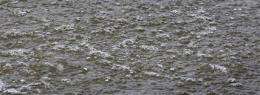
In this Aug. 10, 2009 photo, pure methane, gas bubbles up from underwater vents from a lake, in the Mackenzie River Delta in the Northwest Territories, Canada. (AP Photo/Rick Bowmer)

(AP) -- Only a squawk from a sandhill crane broke the Arctic silence - and a low gurgle of bubbles, a watery whisper of trouble repeated in countless spots around the polar world.

"On a calm day, you can see 20 or more `seeps' out across this lake," said Canadian researcher Rob Bowen, sidling his small rubber boat up beside one of them. A tossed match would have set it ablaze.

"It's essentially pure methane."

Pure methane, gas bubbling up from underwater vents, escaping into northern skies, adds to the global-warming gases accumulating in the atmosphere. And pure methane escaping in the massive amounts known to be locked in the Arctic permafrost and seabed would spell a climate catastrophe.

Is such an unlocking under way?

Researchers say air temperatures here in northwest Canada, in Siberia and elsewhere in the Arctic have risen more than 2.5 C (4.5 F) since 1970 - much faster than the global average. The summer thaw is reaching deeper into , at a rate of 4 centimeters (1.5 inches) a year, and a further 7 C (13 F) temperature rise is possible this century, says the authoritative, U.N.-sponsored Intergovernmental Panel on Climate Change (IPCC).

In 2007, air monitors detected a rise in methane concentrations in the atmosphere, apparently from far northern sources. Russian researchers in Siberia expressed alarm, warning of a potential surge in the powerful , additional warming of several degrees, and unpredictable consequences for Earth's climate.

Others say massive seeps of methane might take centuries. But the Russian scenario is disturbing enough to have led six U.S. national laboratories last year to launch a joint investigation of rapid methane release. And IPCC Chairman Rajendra Pachauri in July asked his scientific network to focus on "abrupt, irreversible climate change" from thawing permafrost.

The data will come from teams like one led by Scott Dallimore, who with Bowen and others pitched tents here on the remote, boggy fringe of North America, 2,200 kilometers (1,400 miles) from the North Pole, to learn more about seeps in the 25,000 lakes of this vast river delta.

A "puzzle," Dallimore calls it.

"Many factors are poorly studied, so we're really doing frontier science here," the Geological Survey of Canada scientist said. "There is a very large storehouse of greenhouse gases within the permafrost, and if that storehouse of greenhouse gases is fluxing to the surface, that's important to know. And it's important to know if that flux will change with time."

Permafrost, tundra soil frozen year-round and covering almost one-fifth of Earth's land surface, runs anywhere from 50 to 600 meters (160 to 2,000 feet) deep in this region. Entombed in that freezer is carbon - plant and animal matter accumulated through millennia.

As the soil thaws, these ancient deposits finally decompose, attacked by microbes, producing carbon dioxide and - if in water - methane. Both are greenhouse gases, but methane is many times more powerful in warming the atmosphere.

Researchers led by the University of Florida's Ted Schuur last year calculated that the top 3 meters (10 feet) of permafrost alone contain more carbon than is currently in the atmosphere.

"It's safe to say the surface permafrost, 3 to 5 meters, is at risk of thawing in the next 100 years," Schuur said by telephone from an Alaska research site. "It can't stay intact."

Methane also is present in another form, as hydrates - ice-like formations deep underground and under the seabed in which methane molecules are trapped within crystals of frozen water. If warmed, the methane will escape.

Dallimore, who has long researched hydrates as energy sources, believes a breakdown of such huge undersea formations may have produced conical "hills" found offshore in the Beaufort Sea bed, some of them 40 meters (more than 100 feet) high.

With underwater robots, he detected leaking from these seabed features, which resemble the strange hills ashore here that the Inuvialuit, or Eskimos, call "pingos." And because the coastal plain is subsiding and seas are rising from warming, more permafrost is being inundated, exposed to water warmer than the air.

The methane seeps that the Canadians were studying in the Mackenzie Delta, amid grassy islands, steel-gray lakes and summertime temperatures well above freezing, are saucer-like indentations just 10 meters (30 feet) or so down on the lake bed.

The ultimate source of that gas - hydrates, decomposition or older natural gas deposits - is unclear, but Dallimore's immediate goal is quantifying the known emissions and finding the unknown.

With tent-like, instrument-laden enclosures they positioned over two seeps, each several meters (yards) wide, the researchers have determined they are emitting methane at a rate of up to 0.6 cubic meters (almost 1 cubic yard) per minute.

Dallimore's team is also monitoring the seeps with underwater listening devices, to assess whether seasonal change - warming - affects the emissions rate.

Even if the lake seeps are centuries old, Bowen said, the question is, "Will they be accelerated by recent changes?"

A second question: Are more seeps developing?

To begin answering that, Dallimore is working with German and Canadian specialists in aerial surveying, teams that will fly over swaths of Arctic terrain to detect methane "hot spots" via spectrometric imagery, instruments identifying chemicals by their signatures on the light spectrum.

Research crews are hard at work elsewhere, too, to get a handle on this possible planetary threat.

"I and others are trying to take field observations and get it scaled up to global models," said Alaska researcher Schuur. From some 400 boreholes drilled deep into the tundra worldwide, "we see historic warming of permafrost. Much of it is now around 2 below zero (28 F)," Schuur said.

A Coast Guard C-130 aircraft is overflying Alaska this summer with instruments sampling the air for methane and carbon dioxide. In parts of Alaska, scientists believe the number of "thermokarst" lakes - formed when terrain collapses over thawing permafrost and fills with meltwater - may have doubled in the past three decades. Those lakes then expand, thawing more permafrost on their edges, exposing more carbon.

Off Norway's Arctic archipelago of Svalbard last September, British scientists reported finding 250 methane plumes rising from the shallow seabed. They're probably old, scientists said, but only further research can assess whether they're stable. In March, Norwegian officials did say methane levels had risen on Svalbard.

Afloat above the huge, shallow continental shelf north of Siberia, Russian researchers have detected seabed "methane chimneys" sending gas bubbling up to the surface, possibly from hydrates.

Reporting to the European Geophysical Union last year, the scientists, affiliated with the University of Alaska and the Russian Academy of Sciences, cited "extreme" saturation of methane in surface waters and in the air above. They said up to 10 percent of the undersea permafrost area had melted, and it was "highly possible" that this would open the way to abrupt release of an estimated 50 billion tons of methane.

Depending on how much dissolved in the sea, that might multiply methane in the atmosphere several-fold, boosting temperatures enough to cause "catastrophic greenhouse warming," as the Russians called it. It would be self-perpetuating, melting more permafrost, emitting more methane.

Some might label that alarmism. And Stockholm University researcher Orjan Gustafsson, a partner in the Russians' field work, acknowledged that "the scientific community is quite split on how fast the permafrost can thaw."

But there's no doubt the north contains enough potential and carbon dioxide to cause abrupt climate change, Gustafsson said by telephone from Sweden.

Canada's pre-eminent permafrost expert, Chris Burn, has trekked to lonely locations in these high latitudes for almost three decades, meticulously chronicling the changes in the tundra.

On a stopover at the Aurora Research Institute in the Mackenzie Delta town of Inuvik, the Carleton University scientist agreed "we need many, many more field observations." But his teams have found the frozen ground warming down to about 80 meters, and he believes the world is courting disaster in failing to curb warming by curbing greenhouse emissions.

"If we lost just 1 percent of the carbon in permafrost today, we'd be close to a year's contributions from industrial sources," he said. "I don't think policymakers have woken up to this. It's not in their risk assessments."

How likely is a major release?

"I don't think it's a case of likelihood," he said. "I think we are playing with fire."

©2009 The Associated Press. All rights reserved. This material may not be published, broadcast, rewritten or redistributed.

4.7 /5 (78 votes)  

Filter


Move the slider to adjust rank threshold, so that you can hide some of the comments.


Display comments: newest first

NeilFarbstein
Aug 30, 2009

Rank: 1.8 / 5 (5)
We should have something that eats methane. There are lot of bugs that eat methane we should genetically engineer them to make super methane eaters out of them...or else.
miles_away
Aug 30, 2009

Rank: 1 / 5 (3)
We should have something that eats methane. There are lot of bugs that eat methane we should genetically engineer them to make super methane eaters out of them...or else.

One exists already, its current diet consists of petroleum, sugars and lipids in frighteningly vast quantities. Wouldn't take anything as drastic as GE to get them to get addicted to an over-abundance of methane resources...
Caliban
Aug 30, 2009

Rank: 2.3 / 5 (3)
Perhaps we can modify some of those English CO2 capturing "trees" to capture methane instead, and "plant" them around the Arctic. Then, somebody gets the money they want, and maybe we get greenhouse gas reduction and perhaps even cheap energy. If anyone wants that idea- feel free to take it and run with it.
NeilFarbstein
Aug 30, 2009

Rank: 1 / 5 (4)
We should have something that eats methane. There are lot of bugs that eat methane we should genetically engineer them to make super methane eaters out of them...or else.

Are you sure they consume methane?

One exists already, its current diet consists of petroleum, sugars and lipids in frighteningly vast quantities. Wouldn't take anything as drastic as GE to get them to get addicted to an over-abundance of methane resources...

NeilFarbstein
Aug 30, 2009

Rank: 2 / 5 (4)
What does ozone do to methane? The navy has huge complex of antennas they are using it to probe the arctic atmosphere. They can bring the ionosphere down to 10 km of the surface of the arctic. They might be able to make ozone in huge amounts that can react with methane.
NeilFarbstein
Aug 30, 2009

Rank: 2 / 5 (4)
http://pubs.acs.o...0839a035
links to an old article that say ozone does react with methane. If the HAARP project can generate big amounts of ozone it can help solve the greenhouse problem.
N_O_M
Aug 30, 2009

Rank: 2.8 / 5 (4)
Wow. Then there must be an opportunity for a scientist and inventor, say with his own bio/nanotechnology company, to come forth and save the planet, become famous and even rather wealthy.

... now if only such a paragon of the scientific virtues existed ...
NeilFarbstein
Aug 30, 2009

Rank: 2.2 / 5 (6)
yeah...superinventor comes to the rescue!
It's been a thankless job
Damon_Hastings
Aug 31, 2009

Rank: 3.7 / 5 (3)
Hey, N_O_M, I've noticed that you seem to be stalking me and leaving 1's on all my posts. Have I done something to offend you? I can't even remember ever interacting with you.
dachpyarvile
Aug 31, 2009

Rank: 3 / 5 (2)
The summer thaw is reaching deeper into frozen soil, at a rate of 4 centimeters (1.5 inches) a year, and a further 7 C (13 F) temperature rise is possible this century, says the authoritative, U.N.-sponsored Intergovernmental Panel on Climate Change (IPCC).


So what?!? 1,000 years ago the settlers in Greenland were digging holes deep enough to bury people with their hands! There was no permafrost then in that place. There was no global catastrophe then. What makes them think there will be one now?
NeilFarbstein
Aug 31, 2009

Rank: 2.6 / 5 (5)
There will be a catastrophic event sometime somewhere. Caused by the greehouse effect.
lengould100
Aug 31, 2009

Rank: 2.7 / 5 (3)
A very sobering piece of information. AntiGW arguers are always trying to dismiss the relationship between CO2 and atmospheric temperature in Antartic ice cores by claiming that CO2 levels follow temperatures, not precede. But even they must admit that methane rises clearly precede temperature rise. We may be triggering a genie here.
NeilFarbstein
Aug 31, 2009

Rank: 2 / 5 (4)
we have to do something about it. Simply conserving energy and reducing greenhouse emissions may not be enough. We have to reduce global warming before the rise in temperatures heats up the arctic mud and causes a runaway greenhouse effect.

Lasers of a carefully tuned frequency might be able to "ignite" methane and make it react with oxygen at much faster rates. It might be too expensive. Since the methane chimneys off the Siberian coast are already mapped, semi permanently emplaced boats boats can trigger explosions and combust the methane.
NeilFarbstein
Aug 31, 2009

Rank: 3.4 / 5 (5)
we have to do something about it. Simply conserving energy and reducing greenhouse emissions may not be enough. We have to reduce global warming before the rise in temperatures heats up the arctic mud and causes a runaway greenhouse effect.


Lasers of a carefully tuned frequency might be able to "ignite" methane and make it react with oxygen at much faster rates. It might be too expensive. Since the methane chimneys off the Siberian coast are already mapped, semi permanently em-placed boats boats can trigger explosions and combust the methane.
We have to do everything possible as quickly as possible, including building vast solar thermal complexes to provide CO2 free electricity.
Velanarris
Aug 31, 2009

Rank: 2 / 5 (4)
A very sobering piece of information. AntiGW arguers are always trying to dismiss the relationship between CO2 and atmospheric temperature in Antartic ice cores by claiming that CO2 levels follow temperatures, not precede. But even they must admit that methane rises clearly precede temperature rise. We may be triggering a genie here.

Yes but methane could be rising for many reasons, least of which being catastophic releases due to undersea thermal vents hitting clathrate stockpiles due to the speed and rapidity of sea floor turnover.
We have to do everything possible as quickly as possible, including building vast solar thermal complexes to provide CO2 free electricity.

Why solar? Solar requires production of NF3, just go nuclear.
Arkaleus
Aug 31, 2009

Rank: 2.4 / 5 (5)
I can't help but notice how some people anthropomorphize natural processes. It's like how children and primitives draw faces on the sun, or in the mountains. If it's happening in nature, they must somehow tie humans to it. The earth's climate cycles are quite independent of human silliness and have been cycling and changing for billions of years.

Any rational examination of human effects of climate must have a premise of tiny contributary effects of man, not primary effects. We do not drive the climate any more than we drive the sun across the sky, and any change in climate must first be considered the result of non-human phenomena, as the sheer quantity of such activity is massively superior to mans'.

But of course the purpose of most climate catastrophe propaganda is to justify radical political and social initiatives, rather than to advance any real science.
NeilFarbstein
Aug 31, 2009

Rank: 2.3 / 5 (3)
A very sobering piece of information. AntiGW arguers are always trying to dismiss the relationship between CO2 and atmospheric temperature in Antartic ice cores by claiming that CO2 levels follow temperatures, not precede. But even they must admit that methane rises clearly precede temperature rise. We may be triggering a genie here.


Yes but methane could be rising for many reasons, least of which being catastophic releases due to undersea thermal vents hitting clathrate stockpiles due to the speed and rapidity of sea floor turnover.


We have to do everything possible as quickly as possible, including building vast solar thermal complexes to provide CO2 free electricity.


Why solar? Solar requires production of NF3, just go nuclear.


The process can be adapted to use something else in manufacturing silicon panels. Copper indium selenide panels are an alternative already. Dont go nuclear

it might cause worse problems than global warming!
Velanarris
Aug 31, 2009

Rank: 3 / 5 (4)
The process can be adapted to use something else in manufacturing silicon panels. Copper indium selenide panels are an alternative already. Dont go nuclear

it might cause worse problems than global warming!

Name one problem that current reactor designs would cause.

As a secondary, NF3 is used for cleaning purposes in regards to solar, not just manufacture. The Selenide panels you're referring to also use NF3 during the manufacture process.
NeilFarbstein
Aug 31, 2009

Rank: 3 / 5 (4)
we could locate all of the gas vents and cover them with canopies that collect all the gas and either burn it in situ or sell it.
Caliban
Aug 31, 2009

Rank: 2.3 / 5 (3)
If this process goes on unchecked, and average temperatures increase outwards from the artic, then this will probably slowly heat the oceans, which may also lead to the "melting" of methane ice beneath the coastal seafloor- more bang for your buck?
dachpyarvile
Aug 31, 2009

Rank: 2 / 5 (3)
There will be a catastrophic event sometime somewhere. Caused by the greehouse effect.


And, one billion years (if we are off on our timeline, a million years) from now, if we do not get our CO2 levels up and thicken the atmosphere a bit with it, the Sun will blast all water off of this planet and exterminate all life on earth with no help from mankind.

The only alternative is to bleed off or permanently sequester nitrogen before that time. You are not thinking in the long term.

If this process goes on unchecked, and average temperatures increase outwards from the artic, then this will probably slowly heat the oceans, which may also lead to the "melting" of methane ice beneath the coastal seafloor- more bang for your buck?


I highly doubt it. The methane hydrates are pretty deep down and kept together by the immense pressure down there. Aside from this, there are worms munching around in it as we speak, consuming the methane locked in the ice day in and day out.

I have no worries about the dire predictions of the IPCC, NSIDC, or any other organization claiming what they do. The NSIDC already has had failed predictions such as an ice-free Arctic in 2007 and in 2008. It never happened.

And, Neil, increasing solar tech will only serve to increase the levels of NF3 in the atmosphere. I should not need to remind anybody that NF3 is 17000 plus times the GHG that CO2 or Methane is. Same with another manmade GHG we use.

And their half-lives are in the hundreds to thousands of years. We still do not know the precise half-lives of either of them, being only guesses at present.
Velanarris
Aug 31, 2009

Rank: 3 / 5 (2)
So otto, just swinging through to downrank everyone and run off? How intellectually cowardly of you.
dachpyarvile
Aug 31, 2009

Rank: 1 / 5 (1)
we have to do something about it. Simply conserving energy and reducing greenhouse emissions may not be enough. We have to reduce global warming before the rise in temperatures heats up the arctic mud and causes a runaway greenhouse effect.

...


There never will be a runaway greenhouse effect on earth. There is not enough organic material in the world to do it. We do not have the atmospheric composition of Venus and we are not near enough to the Sun.

It will never happen no matter what mankind does with its emissions or even with natural Methane emissions. That is just pseudoscientific paranoia talking.
lengould100
Sep 01, 2009

Rank: not rated yet
That is just pseudoscientific paranoia talking.
Much like your own presumptions i presume?
dachpyarvile
Sep 01, 2009

Rank: 3.7 / 5 (3)
Len, how would you know? You clearly do not understand the science well, as has been proved severally in various threads scattered across this forum. This is not your elementary school project with a bottle filled with CO2 under a heat lamp.

Climate science is so much more complex than that but many of those who are so-called climate scientists keep making predictions that fail with religious ferver.

To date, the claims of groups like the NSIDC have gone unfulfilled, such as the so-called ice-free Arctic of 2008 that never came.

By the way, I just saw flocks of migratory birds fly south that normally do not do so until mid-October where I live. That does not bode well for the coming Winter, which appears to be coming early and may well be nastier.
Caliban
Sep 06, 2009

Rank: 1 / 5 (1)
http://www.physor...588.html

Right here at physorg this week- possible evidence of emission from methane hydrate sub-seafloor deposits. Can probably search out more evidence/speculation on same subject from these very pages. Doesn't prove anything, but to say that 1+20=1/2 is actively stupid.
dachpyarvile
Sep 06, 2009

Rank: not rated yet
You did not read the article very carefully. This plume of gas came up through a fracture in the sea bed and took some clathrate with the plume. It is believed (and there is evidence to the effect) that there are vents and fractures on the sea floor where the gas will seep from the sea floor.

Fractures and vents on the sea floor cannot be helped. After all, it is off the coast of California where siesmic activity must be accounted for in the equation.

I do not see anything to be worried about, yet. Besides that, note also that the article mentioned past climate fluctuations before the present as also being responsible for the "leakage" from the vents.

Now, if we compare past climate variation with todays climate we can find several periods where the temperatures were comparable and even higher at points than anything we have recorded today. Yet, there was no runaway Greenhouse Effect then, and we expect none now or in the future.

People need to stop panicking about nothing and get back to the science.
Rank 4.7 /5 (78 votes)
Relevant PhysicsForums posts
  • Discrepancy between oxygen and carbon-dioxide levels
    created9 hours ago
  • where gems are found in the world
    created12 hours ago
  • Wind Waves in Reservoir ~ Wind run-up and Wind set-up
    createdFeb 08, 2012
  • Balance of oxygen in the atmosphere
    createdFeb 01, 2012
  • The case for a methanol-based economy
    createdJan 30, 2012
  • Weather in a rotating cylinder
    createdJan 25, 2012
  • More from Physics Forums - Earth

More news stories

Humans may have helped the decline of African rainforests 3000 years ago

(PhysOrg.com) -- Large areas of rainforests in Central Africa mysteriously disappeared over three thousand years ago, to be replaced by savannas. The prevailing theory has been that the cause was a change ...

Space & Earth / Environment

created 1 hour ago | popularity not rated yet | comments 0 | with audio podcast report

NASA budget will axe Mars deal with Europe: scientists

US President Barack Obama's budget proposal to be submitted next week for 2013 will cut NASA's budget by 20 percent and eliminate a major partnership with Europe on Mars exploration, scientists said Thursday.

Space & Earth / Space Exploration

created 27 minutes ago | popularity not rated yet | comments 0

New views show old NASA Mars landers

(PhysOrg.com) -- The High Resolution Imaging Science Experiment (HiRISE) camera on NASA's Mars Reconnaissance Orbiter recorded a scene on Jan. 29, 2012, that includes the first color image from orbit showing ...

Space & Earth / Space Exploration

created 22 hours ago | popularity 4.9 / 5 (7) | comments 9 | with audio podcast

Black holes and star formation

(PhysOrg.com) -- It has long been recognized that galaxy mergers or even close interactions can play a vital role in shaping the morphology of galaxies. One way they can do so, it is thought, is by triggering ...

Space & Earth / Astronomy

created 21 hours ago | popularity 4.1 / 5 (7) | comments 5 | with audio podcast

Deconstructing a mystery: What caused Snowmaggedon?

In the quiet after the storms, streets and cars had all but disappeared under piles of snow. The U.S. Postal Service suspended service for the first time in 30 years. Snow plows struggled to push the evidence ...

Space & Earth / Earth Sciences

created 14 hours ago | popularity 4.7 / 5 (3) | comments 1 | with audio podcast


Protein libraries in a snap

(PhysOrg.com) -- A Rice University undergraduate will depart with not only a degree but also a possible patent for his invention of an efficient way to create protein libraries, an important component of biomolecular ...

Sleep breathing machine shows clear benefits in children with sleep apnea

Children and adolescents with obstructive sleep apnea had substantial improvements in attention, anxiety and quality of life after treatment with positive airway pressure (PAP)—a nighttime therapy in which a machine ...

Neurologic improvement detected in rats receiving stem cell transplant

In a study to be presented today at the Society for Maternal-Fetal Medicine's annual meeting, The Pregnancy Meeting, in Dallas, Texas, researchers will report that early transplantation of human placenta-derived mesenchymal ...

Miami battling invasion of giant African snails

No one knows how they got there. But an invasion of African giant snails has southern Florida in a panic over potential crop damage, disease and general yuckiness surrounding the slimy gastropods.

Researchers show benefits of local anesthesia after knee replacement surgery

Researchers at the Rothman Institute at Jefferson have shown that local anesthesia delivered through a catheter in the joint, intraarticularly, may be more beneficial than traditional opioids such as morphine and Oxycontin ...

Study finds massively parallel sequencing can detect fetal aneuploidies, including Down syndrome

In a study to be presented today at the Society for Maternal-Fetal Medicine's annual meeting, The Pregnancy Meeting, in Dallas, Texas, researchers will report findings that indicate that massively parallel sequencing can ...