SKorean cloning expert to re-create dogs for province
August 31, 2009 South Korean scientist Hwang Woo-Suk plans to present two cloned dogs to one of the country's provinces

Enlarge

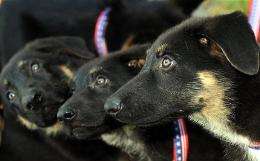
Pictured are the 6-month to 2-month-old cloned puppies of Trakr, a German shepherd, who sniffed out survivors from under the rubble of New York's World Trade Center after the 2001 terror strikes. South Korean scientist Hwang Woo-Suk plans to present two cloned dogs to one of the country's provinces to help it nurture a bio-technology industry, his research centre said Monday.

South Korean scientist Hwang Woo-Suk plans to present two cloned dogs to one of the country's provinces to help it nurture a bio-technology industry, his research centre said Monday.

The Sooam Biotech Research Foundation led by Hwang said it was ready to clone a Tibetan Mastiff for North Chungcheong province.

"We are willing to provide two cloned between late September and early October," Hyun Sang-Hwan, chief adviser at the foundation, told AFP.

"We hope our symbolic work will help the province's drive to nurture its bio-engineering industrial complex."

Hwang has been banned from research using human eggs after some of his work was found to be fake. But his work in creating Snuppy, the world's first cloned dog, has been verified by his university and other authorities.

Hyun denied Hwang would clone a German shepherd named Trakr, which helped locate people trapped in the rubble of the 9/11 attacks in New York in 2001.

The province said last week that Hwang would deliver two clones of the dog to a zoo in Cheongju, 90 kilometres (54 miles) south of Seoul.

Hwang's team had presented five clones of Trakr to its former US handler in June. The dog itself died in April.

Hyun said there had been discussions with the province about cloning Trakr but the project was shelved.

Once a national hero, Hwang was stripped of all government honours and funds including the title "Supreme Scientist" after his university concluded that some of his claims were fake.

He is on trial for fraud, embezzlement, ethical breaches and other charges, but insists he can prove he created the world's first cloned from a human embryo.

(c) 2009 AFP


print this article email this article download pdf blog this article bookmark this article     Stumble it Digg this share on Facebook retweet share on Reddit add to delicious
Rate this story - not rated yet


August 31, 2009 all stories

Comments: 0

not rated yet
  • Stumble this up

  • Digg this

  • share this

  • hide
  • Related Stories

  • Clones of 9/11 hero dog unveiled in Los Angeles
    created Jun 18, 2009 | popularity not rated yet | comments 0
  • South Korean customs deploy six cloned sniffer dogs
    created Jul 19, 2009 | popularity not rated yet | comments 0
  • Disgraced Scientist to Resume Research
    created Jun 28, 2006 | popularity not rated yet | comments 0
  • Some vindication for S. Korean scientist?
    created Mar 13, 2006 | popularity not rated yet | comments 0
  • DNA: Yes, Snuppy is definitely a clone
    created Mar 08, 2006 | popularity not rated yet | comments 0


  • hide
  • Relevant PhysicsForums posts

  • Questions about diffusion
    created 4 hours ago
  • Human Leukocyte Antigen (HLA) typing
    created 10 hours ago
  • Breeding program
    created Nov 20, 2009
  • How does a concentration gradient provide energy?
    created Nov 20, 2009
  • More from Physics Forums - Biology

Other News

The Monarchs' annual migration ritual has yet to be scientifically explained

Tree-eating bugs threaten Monarch butterfly in Mexico

Biology / Ecology

created 12 hours ago | popularity 4 / 5 (1) | comments 0

The mysterious Monarch butterfly, which migrates en masse annually between Canada and Mexico, is now facing a new peril: another insect thriving in Western Mexican forests.


Bigger not necessarily better, when it comes to brains

Bigger not necessarily better, when it comes to brains

Biology / Plants & Animals

created Nov 17, 2009 | popularity 4.5 / 5 (17) | comments 11

(PhysOrg.com) -- Tiny insects could be as intelligent as much bigger animals, despite only having a brain the size of a pinhead, say scientists at Queen Mary, University of London.


Extinct goat Myotragus balearicus

Extinct goat was cold-blooded

Biology / Plants & Animals

created Nov 18, 2009 | popularity 4.9 / 5 (33) | comments 10

(PhysOrg.com) -- An extinct goat that lived on a barren Mediterranean island survived for millions of years by reducing in size and by becoming cold-blooded, which has never before been discovered in mammals.


Right-handed chimpanzees provide clues to the origin of human language

Biology / Plants & Animals

created Nov 16, 2009 | popularity 3 / 5 (1) | comments 7

Most of the linguistic functions in humans are controlled by the left cerebral hemisphere. A study of captive chimpanzees at the Yerkes National Primate Research Center (Atlanta, Georgia), reported in the January 2010 issue ...


The creature was found at a depth of 161 metres

Japanese researchers film rare baby fish 'fossil'

Biology / Plants & Animals

created Nov 17, 2009 | popularity 4.7 / 5 (7) | comments 4

Japanese marine researchers said Tuesday they had found and successfully filmed a young coelacanth -- a rare type of fish known as "a living fossil" -- in deep water off Indonesia.