MSU scientists to design optics for new solar mission
August 31, 2009 By Evelyn Boswell
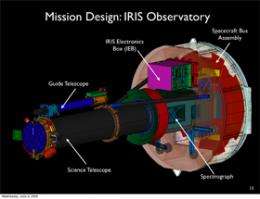
The IRIS observatory will carry an optical system developed at Montana State University. (Graphic courtesy of Charles Kankelborg).
Montana State University scientists are involved in a new space mission to figure out how energy is transferred through the sun's atmosphere.
As a partner on the IRIS team headed by Lockheed Martin, MSU will receive about $3 million to design an optical system for a telescope that could be launched on a NASA rocket in 2012, said solar physicist Charles Kankelborg. If Lockheed Martin agrees, MSU could receive another $2 million for an associated project involving MSU students.
"It is really exciting," Kankelborg said.
IRIS, short for Interface Region Imaging Spectrograph, was one of two missions that recently won NASA's Small Explorer Competition. The other was GEMS, or Gravity and Extreme Magnetism Small Explorer. When NASA announced the winners in June, it gave the go-ahead for development teams to turn IRIS and GEMS into complete missions for up to $105 million each.
The IRIS team will design its telescope to face the sun at all times, orbit the Earth at least three years and gather images from the sun's chromosphere and transition region, Kankelborg said. The sun's transition region is invisible from the ground. During a total eclipse of the sun, the chromosphere is seen as a thin red layer of atmosphere just above the bright yellow photosphere.
Dave Klumpar, director of MSU's Space Science and Engineering Laboratory, said the MSU student project, if allowed to continue, would ride on the same spacecraft as MSU's optical system. Instead of facing the sun, however, it would face away from the sun and gather information from the dust particles that scatter sunlight in space. Called the Gegenschein Imager, the instrument would be built largely by MSU undergraduates with oversight by Klumpar and Larry Springer, senior engineer and project manager for SSEL, formerly of Lockheed Martin.
"By looking at that reflected light coming off these little dust particles, we can learn a lot about how that dust gets generated, how it behaves, how it moves around, what the sources are and how it finally dissipates and if there are variations in dust distribution in time or space," Klumpar said.
The Gegenschein Imager would be about the size of a shoe box. It would include, among other things, a digital camera, electronic control box and passive shield against light and radiation, Klumpar said. He added that the project would be a "perfect opportunity for students to apply their skills, the knowledge that they get in the classroom and bring it into a real life design fabrication and operation effort that involves students from a wide variety of disciplines."
IRIS is the latest in a string of solar missions involving MSU scientists. TRACE, or Transition Region and Coronal Explorer, was the one that drew Kankelborg to MSU in 1996. The same scientist who headed that mission -- Alan Title from Lockheed Martin -- is heading the IRIS mission.
Kankelborg said Lockheed Martin scientists approached him two years ago to see if he might be interested in joining the IRIS team. After signing on, Kankelborg helped develop the concept for the mission. Nathan Pust, a postdoctoral researcher at MSU, built and tested a prototype of the optical system that would ride on IRIS.
-
MSU scientists to design optics for new solar mission
Jul 24, 2009 |
not rated yet |
0
-
Crash of Russian rocket destroys Montana's first satellite
Jul 27, 2006 |
not rated yet |
0
-
First Images from Hinode Offer New Clues About Our Violent Sun
Dec 22, 2006 |
not rated yet |
0
-
QUT researcher eyes off a biometric future
Dec 04, 2007 |
not rated yet |
0
-
SwRI Will Lead Interstellar Boundary Explorer Mission
Feb 02, 2005 |
not rated yet |
0
-
Engineers build first sub-10-nm carbon nanotube transistor
Feb 01, 2012 |
4.9 / 5 (31) |
30
-
Something old, something new: Evolution and the structural divergence of duplicate genes
Jan 31, 2012 |
4.6 / 5 (7) |
1
-
The hidden nanoworld of ice crystals: Revealing the dynamic behavior of quasi-liquid layers
Jan 30, 2012 |
5 / 5 (3) |
1
-
Stock market network reveals investor clustering
Jan 27, 2012 |
3.9 / 5 (23) |
8
-
Of microchemistry and molecules: Electronic microfluidic device synthesizes biocompatible probes
Jan 26, 2012 |
5 / 5 (1) |
0
-
Never ending outer space.....
8 hours ago
-
Neutron Star fragments?
10 hours ago
-
stationary or not?
14 hours ago
-
Scale of the Universe
Feb 10, 2012
-
Titan's lack of impact craters
Feb 09, 2012
-
Real pictures of black hole eating a star?
Feb 08, 2012
- More from Physics Forums - General Astronomy
More news stories
Latin America mining boom clashes with conservation
Latin America is experiencing a mining boom as prices rise fuelled by a hike in global demand, but the region is also being hit by a wave of violent protests, strikes and rallies by environmentalists.
2 hours ago |
not rated yet |
0
Europe stakes billion-dollar bet on new rocket
A pencil-slim rocket is scheduled to lift into space from South America on Monday, carrying a billion-dollar bet that Europe can grab a juicy slice of the market to place satellites in low orbit.
Space & Earth / Space Exploration
21 hours ago |
4 / 5 (3) |
0
Political leaders play key role in how worried Americans are by climate change: study
More than extreme weather events and the work of scientists, it is national political leaders who influence how much Americans worry about the threat of climate change, new research finds.
Feb 06, 2012 |
5 / 5 (6) |
72
NASA budget will axe Mars deal with Europe: scientists
US President Barack Obama's budget proposal to be submitted next week for 2013 will cut NASA's budget by 20 percent and eliminate a major partnership with Europe on Mars exploration, scientists said Thursday.
Space & Earth / Space Exploration
Feb 10, 2012 |
5 / 5 (3) |
55
Humans may have helped the decline of African rainforests 3000 years ago
(PhysOrg.com) -- Large areas of rainforests in Central Africa mysteriously disappeared over three thousand years ago, to be replaced by savannas. The prevailing theory has been that the cause was a change ...
Google might launch Drive for cloud storage soon
(PhysOrg.com) -- Google's next big move, according to the Wall Street Journal, is a cloud storage service called Drive. Hardly first to the plate, Google is simply catching up to introducing its cloud reposi ...
Love a click away in Indonesia's Twitter Republic
He was a geeky kid from Yogyakarta, she a glamorous city girl in Jakarta. In a country with one of the world's most vibrant social networking scenes they fell in love on Twitter.
Walney offshore wind farm is world's biggest (for now)
(PhysOrg.com) -- The Walney wind farm on the Irish Sea--characterized by high tides, waves and windy weather--officially opened this week. The farm is treated in the press as a very big deal as the Walney ...
GPS court ruling leaves US phone tracking unclear
A US Supreme Court decision requiring a warrant to place a GPS device on the car of a criminal suspect leaves unresolved the bigger issue of police tracking using mobile phones, legal experts say.
Europeans protest controversial Internet pact
Tens of thousands of people marched in protests in more than a dozen European cities Saturday against a controversial anti-online piracy pact that critics say could curtail Internet freedom.
Study finds that anti-diabetic medication can prevent the long-term effects of maternal obesity
In a study to be presented today at the Society for Maternal-Fetal Medicine's annual meeting, The Pregnancy Meeting, in Dallas, Texas, researchers will report findings that show that short therapy with the anti-diabetic medication ...
Sep 01, 2009
Rank: not rated yet
Sep 01, 2009
Rank: not rated yet
And let's not forget that just as many people (if not more) insist this is the singular 100% correct story, as opposed to all the other tomes.