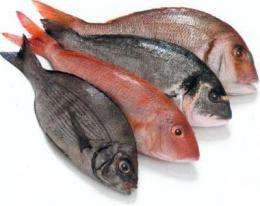
Algae-Based Biofuel From Fish

September 1, 2009 by Miranda Marquit Fish

Enlarge

Image source: ValleyFoods.je

Right now, when biofuel is produced using algae, cultures are grown and then processed into fuel. But the process is expensive and difficult. Now a company in Texas, LiveFuels, Inc., hopes that it will be able to change all that. The idea is to create a biofuel based on the oils from the fish that eat the algae.

LiveFuels plans to make use of natural food chains in order to get biofuels. Gas 2.0 reports on the facilities used by the Brownsville company:

The company-who develops renewable algae-based biofuels-has a test facility in Brownsville, TX. At the location they have 45 acres of open saltwater ponds which will be used for optimizing the algal production.... LiveFuels plans to grow a mix of regional species in low-cost, open-water systems. The algae will be "harvested" with filter-feeding and other aquatic herbivores.

The idea is that the fish can harvest the , grazing on it, and then those fish can in turn be processed for the biofuel base. This is a different approach from current algae-based biofuel processes that may have some merit. After all, something similar is being done in Greenland, where sharks caught in fishing nets are being processed as biofuel.

It will be interesting to see whether this process saves on costs and creates a more cost-efficient biofuel.

© 2009 PhysOrg.com


print this article email this article download pdf blog this article bookmark this article     Stumble it Digg this share on Facebook retweet share on Reddit add to delicious
Rate this story - 3.9 /5 (12 votes)

Rank Filter

Move the slider to adjust rank threshold, so that you can hide some of the comments.


Display comments: newest first

  • Soylent - Sep 01, 2009
    • Rank: 2 / 5 (4)
    That's retarded. If this was remotely viable you could grow high quality food(e.g. shrimp or herring) instead, which people are willing to pay a lot more for than a couple of bucks per gallon and you wouldn't have to waste any effort squeezing oil out of it.
  • powercosmic - Sep 01, 2009
    • Rank: 2.3 / 5 (3)
    Look, this is stupid.

    Everyone has to realize that we have to use Thermal-Solar to make heat and electricity, then use that abundant and free energy to liquefy hydrogen for vehicles.

    Regardless of what we do our energy usage MUST COME DOWN, public transport, mass transit, stay-at-home jobs, whatever.

    This fish for algae fuel is dipwank stupidity!
  • Husky - Sep 01, 2009
    • Rank: 4 / 5 (2)
    its not efficient, it takes more algae to cook the same amount of oil if processed from fish higher up the chain, but then again, if the cooking is cheaper than processing raw algae, it could be worth while, and turning electricity into hydrogen is another loss factor, just like the fish, turning one energycarrier into another before actual use, high density lightweight battery storage is the way to go
  • Soylent - Sep 01, 2009
    • Rank: 3 / 5 (1)
    Solar thermal will forever remain a cute dream that simply stands in the way of doing the right thing and does nothing more than help dreamers cling onto dangerous fossil fuels.

    It's extremely mature tech. It's just metalized glass reflectors, heliostats, pumps, steam turbines, molten salt thermal storage, heat exchangers; the usual stuff. There's miniscule headroom for improvement in there and the math isn't anywhere close to working.

    "Sun power is now a fact and no longer in the 'beautiful possibility' stage... It will have a history like aerial navigation. Up to twelve years ago it was a mere possibility and no one took it seriously." - Frank Schuman, 1910.

    The guy built a big parabolic through-array; it was a cute idea but the economics just didn't work. In the 70's and 80's the DOE took a lot of really smart people gave them a chance to make it work. The best idea they could come up with was a slightly updated version of the same parabolic through-array built by Schuman before world war I. It still blows chunks.

    The worst design they managed to come up with was the 'solar power tower' design with a bunch of heliostats focusing the sunlight on a central tower. The economics were so awful that even in the desert of California, one of the indisputably best places in the world for solar energy the power tower design wasn't even worth operating because the operating and maintenance cost for the heliostats was more than the power it could produce was worth. It has the dubious distinction of being one of only two powersources worse than solar photovoltaics(the other being space solar power).

    We're going to have to relearn the lesson that solar thermal sucks every 30 years or so aren't we?
  • mertzj - Sep 01, 2009
    • Rank: 3 / 5 (1)
    Think maybe you should do your research on solar towers Soylent.
  • Soylent - Sep 02, 2009
    • Rank: not rated yet
    Think maybe you should do your research on solar towers Soylent.


    I have. The only place you can make any money building them is where they offer 500% subsidies like Spain. This still ignores the fact that they need to be balanced with fossil fuels or by overbuilding by a factor of ~3 for winter; dumping the surplus energy as waste to protect the grid in summer.
  • Shaffer - Sep 02, 2009
    • Rank: 1 / 5 (1)
    Any good reason to kill all the fish in the oceans seems to be the key here...I think I'm gunna get my old skiff out right now and get me some fish oil to heat my house this winter. This will need to happen to save the trees. Heaven forbid there be nothing left to hug.

  • tkjtkj - Sep 02, 2009
    • Rank: not rated yet
    I've heard of stupid ideas before, but this one takes the cake .. Is this just another ploy to justify our present 'lets sterilize the seas to protect nature' approach?? What it does say is that the 'algae energy' people are up against a brick wall of economics. When it takes 2 gallons of oil to produce 1 gallon of ethanol (which itself has remarkeably-lower energy content than oil) and its actuall being DONE .. further depleting our food supply .. im then not really surprised to see this wasteful, inefficient, and morally wrong idea put forth.

    I can see the bumper stickers now: "Crush a Fish for Mother Nature!"

    idiots.
  • Husky - Sep 02, 2009
    • Rank: 4 / 5 (1)
    I've been reading about duckweed as a biofuel source and it has several advantages to algae, duckweed thrives on/and cleans many wastewaters, hifg starch concentration, not as poisenous or sufficating to wiuldlife as many algae blooms
  • Sean_W - Sep 02, 2009
    • Rank: not rated yet
    The use of fish is an attempt to make open systems more practical but I have my doubts. The closed systems require more capital investment but are just more efficient.

    If it ever did take two gallons of oil to produce a gallon of ethanol it doesn't anymore. Even corn ethanol is able to generate more energy than it uses and no one (except a few farm lobbyists) are banking on corn ethanol.

    The big future for biofuels is not really fuels at all but as chemicals to replace the petrochemical industry. The ability to catalyze reactions that replace petroleum as a single source of many feed stocks is increasing all the time. It's hard to do that with solar and nuclear.

    I can't fathom what growing algae in the desert has to do with sterilizing the seas.
  • Ant - Sep 02, 2009
    • Rank: not rated yet
    just a test to see if I am allowed to make comments again however, there is a small problem I forsee in that the planet is killing all the fish stocks by simply eating them which will be more of a problem than the oil wells running dry and oh yes, what do you then run the fishing boats on.
  • Ricochet - Sep 03, 2009
    • Rank: not rated yet

    If it ever did take two gallons of oil to produce a gallon of ethanol it doesn't anymore...


    That's about right, but the byproducts of the process are used to make other products like heating oil.
  • sender - Sep 05, 2009
    • Rank: not rated yet
    Bacterial and Fungal cultures for biofuel production would be exponentially greater than fish over volume.
  • Husky - Sep 07, 2009
    • Rank: not rated yet
    Agreed, eventually they will engineer organisms that will break down any cellulose wastes effective and costefficient, In the meantime, sumbody develope a methode to squeeze oil out of swarms of locusts including the chitine scales, that would be a double edged sword, not producing biofuel from food , but from a feedstock that threatens the food

September 1, 2009 all stories

Comments: 14

3.9 /5 (12 votes)
  • Stumble this up

  • Digg this

  • share this

  • hide
  • Related Stories

  • Montana researchers to study algae as a source of biofuel
    created Nov 13, 2008 | popularity not rated yet | comments 0
  • Greenland shark may become new source of biofuel
    created Jul 20, 2009 | popularity not rated yet | comments 0
  • Algae: Biofuel of the future?
    created Aug 19, 2008 | popularity not rated yet | comments 0
  • Nanofarming technology harvest biofuel oils without harming algae
    created Apr 07, 2009 | popularity not rated yet | comments 0
  • Success for first outdoor, large-scale algae-to-biofuel research project in Nevada
    created Jan 29, 2009 | popularity not rated yet | comments 0


  • hide
  • Relevant PhysicsForums posts

  • What is it called?
    created 3 hours ago
  • Does anyone know the ionic radius of hydride(anion of hydrogen)?
    created 14 hours ago
  • Lowing boiling point of water
    created 15 hours ago
  • thermodynamic
    created 16 hours ago
  • More from Physics Forums - Chemistry

Other News

'Smell of old books' offers clues to help preserve them

'Smell of old books' offers clues to help preserve them

Chemistry / Analytical Chemistry

created 5 minutes ago | popularity not rated yet | comments 0

Scientists may not be able to tell a good book by its cover, but they now can tell the condition of an old book by its smell. In a report in ACS' Analytical Chemistry, a semi-monthly journal, they describe develo ...


A little magic provides an atomic-level look at bone

Chemistry / Analytical Chemistry

created 1hour ago | popularity 5 / 5 (1) | comments 0

(PhysOrg.com) -- A new study using solid-state NMR spectroscopy to analyze intact bone paves the way for atomic-level explorations of how disease and aging affect bone. The research by scientists at the University of Michigan ...


Soy peptide lunasin has anti-cancer, anti-inflammatory properties

Chemistry / Biochemistry

created 3 hours ago | popularity not rated yet | comments 0

Two new University of Illinois studies report that lunasin, a soy peptide often discarded in the waste streams of soy-processing plants, may have important health benefits that include fighting leukemia and blocking the inflammation ...


The hidden lives of proteins

The hidden lives of proteins

Chemistry / Biochemistry

created 3 hours ago | popularity 5 / 5 (2) | comments 0

An important Brandeis study appearing in the December 3 issue of Nature raises the curtain on the hidden lives of proteins at the atomic level. The study reports that for the first time, researchers used x ...


Nervy research: Researchers take initial look at ion channels in a model system

Nervy research: Researchers take initial look at ion channels in a model system

Chemistry / Biochemistry

created 6 hours ago | popularity 5 / 5 (1) | comments 0

Before one of your muscles can twitch, before the thought telling it to flex can race down your nerve, a tiny floodgate of sorts -- called an ion channel -- must open in the surface of each cell in these organs ...