Carbon nanoballs as data storage units
September 1, 2009 Carbon nanoballs as data storage units

Enlarge

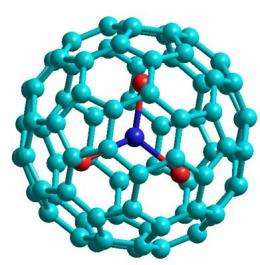
Model of the metallofullerene studied consisting of 80 carbon atoms (light blue), 3 dysprosium atoms (red) and 1 nitrogen atom (dark blue).

Small, smaller, "nano" data storage! Interest is growing in the use of metallofullerenes - carbon “cages” with embedded metallic compounds - as materials for miniature data storage devices. Researchers at Empa have discovered that metallofullerenes are capable of forming ordered supramolecular structures with different orientations. By specifically manipulating these orientations it might be possible to store and subsequently read out information.

Carbon exists in the form of diamond, and nanotubes- and also as so-called fullerenes. The spherical structures of such fullerene "cages" - the most frequently-observed representative of which contains 60 atoms and looks exactly like a football - may also serve as “nanocontainers” for metallic compounds. These so-called metallofullerenes have special , which are of particular interest to the IT industry for use as possible "nano" data .

Together with colleagues at the University of Zurich, the Paul Scherrer Institute and the Leibniz Institute in Dresden, researchers in Empa’s “nanotech@surfaces" laboratory have been studying metallofullerenes and have been able to show that, when deposited on a surface, these form ordered islands with domains of identically orientated molecules. Different orientations have, however, been found for the endohedral metallic compounds. Provided an external stimulus could be found which would be able to bring about a change between different orientations - like a switch - the basic mechanism for would have been achieved.

Empa researchers published their results in the journal “Physical Review B” and their article has been highlighted on the home page of the American Physical Society.

Footballs with content

Fullerenes were discovered in the 1980’s as the third modification of carbon. Soon after, researchers began working on the idea of embedding clusters consisting of individual elements or compounds into the structures of these “nano-cages”. The synthesis of such molecules - so-called endohedral fullerenes - was achieved just a few years later. Metallofullerenes have primarily attracted interest in the IT and pharmaceutical sectors. Among other applications, metallofullerenes can be used to provide a contrast medium for use in magnetic resonance tomography.

The molecules studied by Empa researchers are endohedral metallofullerenes, consisting of 80 forming the carbon cage with an embedded tri-metal nitride (1 nitrogen atom, 3 metal atoms) unit. The metal used is dysprosium (Atomic Number 66), an element of the lanthanides group. Endohedral complexes cannot be formed with all metallic elements in the periodic table - the lanthanides, however, can be successfully put inside the carbon cage. There are, in fact, very few alternative uses of the element dysprosium. One application is the use of the metal as an alloy with lead for the shielding of nuclear reactors.

The research was carried out by producing a single molecule-thin layer of the metallofullerene on a copper substrate. The ordering of the metallofullerene on the substrate was then investigated by means of a scanning tunnelling microscope and through photoelectron diffraction performed at the “Swiss Light Source” (SLS) - the Paul Scherrer Institute's synchrotron facility. The experiments showed that the embedded metallic compound “feels” the substrate and takes compatible orientations.

More information: http://physics.aps.org/synopsis-for/10.1103/PhysRevB.80.081403

Provided by EMPA


print this article email this article download pdf blog this article bookmark this article     Stumble it Digg this share on Facebook retweet share on Reddit add to delicious
Rate this story - 4.8 /5 (36 votes)

Rank Filter

Move the slider to adjust rank threshold, so that you can hide some of the comments.


Display comments: newest first

  • defunctdiety - Sep 01, 2009
    • Rank: 5 / 5 (1)
    The spherical structures of such fullerene "cages" - the most frequently-observed representative of which contains 60 carbon atoms- looks exactly like a football

    Me and my American brain...

    I was thinking, well that picture they show doesn't look like a football... o.0
  • acarrilho - Sep 01, 2009
    • Rank: not rated yet
    Ant it's funny how the definition of "ball" now accomodates something that's obviously far too oval to be considered a "ball" in any other context.
  • holoman - Sep 01, 2009
    • Rank: 5 / 5 (1)
    the 3 to 5 nanometer domain will never be
    reached with this technology. It uses rare elements
    and has so many problems as a storage solution I
    don't even know where to begin.
  • jcrow - Sep 02, 2009
    • Rank: not rated yet
    Thats nothing. My Gigaballs store DNA data!

September 1, 2009 all stories

Comments: 4

4.8 /5 (36 votes)
  • Stumble this up

  • Digg this

  • share this

  • hide
  • Related Stories

  • Carbon molecule with a charge could be tomorrow's semiconductor
    created Sep 08, 2008 | popularity not rated yet | comments 0
  • Carbon fullerenes now have metallic cousins, 'hollow golden cages'
    created May 15, 2006 | popularity not rated yet | comments 0
  • Novel forms of the elements predicted by simulation
    created Jun 22, 2006 | popularity not rated yet | comments 0
  • Improbable 'buckyegg' hatched
    created Sep 28, 2006 | popularity not rated yet | comments 0
  • Discovery of new family of pseudo-metallic chemicals
    created Apr 24, 2007 | popularity not rated yet | comments 0


  • hide
  • Relevant PhysicsForums posts

Other News

Nanoparticles used in common household items caused genetic damage in mice

Nanotechnology / Bio & Medicine

created Nov 16, 2009 | popularity 4.7 / 5 (22) | comments 11

Titanium dioxide (TiO2) nanoparticles, found in everything from cosmetics to sunscreen to paint to vitamins, caused systemic genetic damage in mice, according to a comprehensive study conducted by researchers at UCLA's Jonsson ...


Using superconducting probes to get a picture of what it's like inside CNTs

Nanotechnology / Nanophysics

created Nov 20, 2009 | popularity 4.9 / 5 (7) | comments 0

(PhysOrg.com) -- "Carbon nanotubes are exciting for fundamental physics, and for potential technological applications," Nadya Mason tells PhysOrg.com. "However, we are generally limited in the way that we can study them. ...


Nanotube defects equal better energy and storage systems

Nanotube defects equal better energy and storage systems

Nanotechnology / Nanomaterials

created Nov 19, 2009 | popularity 4.4 / 5 (9) | comments 2

(PhysOrg.com) -- Most people would like to be able to charge their cell phones and other personal electronics quickly and not too often. A recent discovery made by UC San Diego engineers could lead to carbon ...


When It Comes to Drug Delivery, Size Matters

Nanotechnology / Bio & Medicine

created Nov 20, 2009 | popularity 5 / 5 (1) | comments 0

(PhysOrg.com) -- One of the great promises of nanotechnologies lies in its ability to create drug-containing nanoparticles decorated with targeting molecules that recognize and bind to cancer cells, providing drug delivery ...


New study confirms exotic electric properties of graphene

New study confirms exotic electric properties of graphene

Nanotechnology / Nanomaterials

created Nov 17, 2009 | popularity 4.8 / 5 (23) | comments 1

(PhysOrg.com) -- First, it was the soccer-ball-shaped molecules dubbed buckyballs. Then it was the cylindrically shaped nanotubes. Now, the hottest new material in physics and nanotechnology is graphene: ...