Coherent X-Ray Diffraction Patterns of Collagen Measured in Soft Tissues
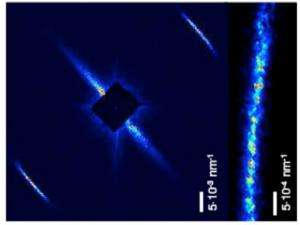
Coherent X-ray Diffraction patterns of collagen in soft tissues have been measured for the first time by Dr Felisa Berenguer at the London Centre for Nanotechnology with her colleagues.
This development opens doors to better understanding of living tissues like skin and bones, as well as the bio-mineralization processes which turn flexible collagen into semi-flexible cartilage and eventually into rigid bones. In a distant future, the understanding of the collagen structure will eventually lead to cures for of bone diseases, notably osteoporosis, or assist ongoing efforts to develop artificial skin.
Dr Berenguer is part of Prof Ian Robinson’s group in the London Centre for Nanotechnology. This group is developing methods of using the coherence properties of these X-rays for imaging materials on the nanoscale. They use new synchrotron X-ray sources with extremely high brightness such as the Diamond Light Source on the Harwell campus near Oxford.
While new light lines at the Diamond Light Source are still under construction, the London Centre Nanotechnology operates one of the experimental out-stations of the Advanced Photon Source (APS), an X-ray synchrotron in Chicago, USA. The group is focusing its efforts on X-rays because this type of light has small wavelengths and is strongly penetrating into material. There is thus an opportunity for imaging physical structures in three dimensions with resolution well beyond that of the visible light microscope. The group is also developing phase-contrast methods that are sensitive to nanoscale strains, or the detailed packing arrangement of molecules in biological tissues.
Dr Berenguer used whole dissected tendons from the tail of a rat in this study as a source of native collagenous tissue. The tendons contained micron size fibrils of collagen about one micron in diameter, tightly packed and well-aligned in the tissue. In traditional small-angle X-ray scattering these give rise to sharp diffraction peaks due to the array of collagen molecules within each fibril, similar to those appearing at the edge of the picture.
The breakthrough realized by Dr Berenguer et al is to use a coherent beam of X-rays produced by the APS to measure the coherent diffraction pattern before radiation damage sets in. In place of the normal diffraction peak they observed a distinct array of diffraction speckles, as can be seen in the zoomed part of the picture. These speckles arise from interferences between the signals from the individual fibrils due to their relative positions within the tissue - i.e. the nanoscale structure of the tendon. This diffraction information is especially useful since it comes exclusively from the collagen and so ignores all the other components of the tissue.
The pattern of speckles changes gradually as the beam is scanned across the tendon. This provides additional information on the ‘phases’ of the diffraction pattern, which are not measurable, but vitally needed to convert the diffraction patterns into images of the tissue. This is the complete form of the data needed for a new "ptychography" algorithm under development with collaborators at the University of Sheffield. Once the researchers have obtained real images of the arrangement of fibrils within the tendons, they plan to study how the internal arrangement becomes modified as the collagenous tissues develop into related biological structures like skin and bone or how they are altered in disease. Much is still to be understood about the bio-mineralization processes, which turns flexible collagen into semi-flexible cartilage and eventually into rigid bones.
Dr Berenguer reports her results in a paper about to be published in the Proceedings of the National Academy of Sciences.
More information: www.pnas.org/content/early/200 … /0905151106.abstract
Provided by London Centre for Nanotechnology


