Oceanographers examine mercury levels of pelagic fish in Hawaii
In the open ocean, species of large predatory fish will swim and hunt for food at various depths, which leads to unique diets in these fish. Oceanographers and geologists in the School of Ocean and Earth Science and Technology (SOEST) at the University of Hawaiʻi at Mānoa (UHM) and colleagues have found that those fish that hunt deeper in the open ocean have higher mercury concentrations than those that feed near the surface of the ocean because their deep water food has higher mercury. This research was detailed in the August 18th early edition of the prestigous journal the Proceedings of the National Academy of Sciences.
Mercury is a naturally-occurring trace element distributed throughout the Earth's oceans, land and air. The general public is interested in mercury levels in fish because the organic form, methylmercury, can be toxic at elevated levels if ingested by humans and animals. Mercury enters open ocean food webs, where it bioaccumulates, leading to higher levels in large predatory animals.
Researchers looking at mercury levels in the open ocean have indicated that deeper waters have elevated levels relative to the surface waters. "Building on this information, we thought that deeper-dwelling open ocean animals might have more mercury, as well as the predatory fishes that feed on them," says Anela Choy, a Department of Oceanography Graduate Student at UHM and lead author in this study. This was indeed the case, and the results of their work show that large pelagic fish like bigeye tuna and swordfish that feed deeper in the ocean have elevated total mercury levels relative to their shallower-dwelling counterparts like yellowfin tuna and mahi-mahi.
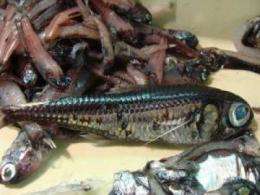
"We show that this is because the food items that they eat also have varying levels of mercury", continues Choy. "Deeper-living micronekton prey (small fishes, squids, and crustaceans) have higher mercury levels relative to more surface-dwelling prey animals. This is important knowledge for scientists studying animals in the open ocean because it helps them to understand how energy and matter cycle, as well as show who is eating who in the vast, blue water environment. Although not the focus of this study, the results may also help provide information to the fish-consuming public on mercury levels in popular commercial species."
To study the mechanisms governing bioaccumulation in open ocean fish, the researchers, who also included Brian N. Popp and Jeffrey C. Drazen, also from UHM, and John Kaneko from the Honolulu company PacMar Inc, collected nine predatory pelagic fish species with different diets in waters surrounding Hawaiʻi, along with a representation of the types of prey these fishes eat. The predatory fish collected represented a wide variety of depths at which they search for food, varying from shallow-ranging predators (0 - 300 meters) to deep-ranging predators (up to 1000 meters).
Total mercury levels of these fish were measured, along with an analysis of animals in their stomachs. The authors found that while the sex of a fish and the location where a fish was caught d! id not a ffect mercury concentrations, the size, age and species of fish did. However, for similar sized fish of different species, deeper-ranging predators still had more mercury than shallow-ranging ones. This study shows for the first time, that in addition to the size and age of a fish, or where it swims/lives, that the depth at which a fish feeds influences the amount of mercury it has in it's tissues.
"After looking more closely at these different mid-water prey organisms, a number of interesting questions have opened up," says Choy. "As these organisms are the primary food items for large pelagic fishes that humans like to eat, we need to understand more about how they fit into the open ocean ecosystem in order to sustainably manage our fish populations."
It is important to understand that ocean biology is connected across depths by the movements and hunting behaviors of animals. "The deep sea is remote, hard to study, and often ignored but our results clearly show how its biology is directly connected to human interests, both fishing and health," says Drazen. "Some of the fishes we enjoy at the dinner table grew on a diet of strange and exotic creatures from 1000s of feet deep in the ocean."
The original research was funded by University of Hawaiʻi Sea Grant College Program at UHM, the State of Hawaiʻi, JIMAR (Pelagic Fisheries Research Program (PFRP)), and the National Oceanographic and Atmospheric Administration. The need for a detailed study came after Popp attended a PFRP meeting on the UHM campus and he saw a data table from the State Department of Health of mercury concentrations in Hawaiian pelagic fishes that was published in the newspaper The Honolulu Advertiser.
"The table was very crude showing only the average and range of mercury contents in each fish," says Popp." The fishes were listed from lowest mercury a t the top and highest mercury at the bottom -- it hit me that the order in the list roughly followed the depth the fish are typically caught in the ocean." Fortunately for Popp and Drazen, Choy, who had completed her undergraduate degree and was doing consulting work within the local seafood industry, and was also interested in this topic. Says Choy, "after interacting with the public, I found that many people were concerned with mercury levels in fish, and I eventually became interested in the oceanographic/ecological aspect of it."
More information: The influence of depth on mercury levels in pelagic fishes and their prey. C. Anela Choy, Brian N. Popp, J. John Kaneko, and Jeffrey C. Drazen; PNAS Early Edition - August 03 2009, PNAS August 18, 2009 vol. 106 no. 33 13865-13869
Source: University of Hawaii at Manoa


