The 'S' stands for surprise: Anticoagulant plays unexpected role in maintaining circulatory integrity
September 1, 2009
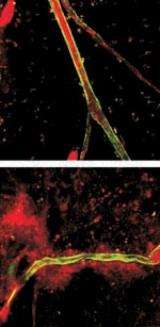
In the top image an inert red dye injected into the circulation of normal mice remains confined within blood vessels (green) of the brain. Whereas in the bottom image the same red dye injected into the circulation of mice with a 50 percent reduction in the level of Protein S leaks out of brain vessels (green), and leaches into the surrounding brain tissue. Credit: Image: Courtesy of Tal Burstyn-Cohen
Protein S, a well-known anticoagulant protein, keeps the blood flowing in more than one way, discovered researchers at the Salk Institute for Biological Studies. The protein contributes to the formation and function of healthy blood vessels.
The researchers found that mice lacking protein S suffered massive blood clots, but also had defective blood vessels that allow blood cells to leak into the surrounding tissue.
"We had anticipated finding clotting problems, but the prominent role of protein S in the development and maintenance of blood vessels was completely unexpected," says first author Tal Burstyn-Cohen, Ph.D., a former post-doc in the Molecular Neurobiology Laboratory and now at the Department of Ophthalmology, Hadassah Medical Center, Jerusalem, Israel.
There are more than 200 known human mutations and polymorphisms in the gene coding for protein S, which was arbitrarily named after Seattle, the city of its discovery. The resulting deficiencies predispose carriers to deep venous thrombosis, strokes at an early age, recurrent miscarriages, and pre-eclampsia, and are associated with several autoimmune diseases, most prominently systemic lupus erythematosus.
"Protein S is a really interesting molecule," says Greg Lemke, Ph.D., a professor in the Salk's Molecular Neurobiology Laboratory, who led the study, which appears in the Sept. 1, 2009, issue of the Journal of Clinical Investigation. "During the course of evolution, it was co-opted from the coagulation cascade for the regulation of inflammation in the immune system."
The moment a blood vessel is breached, the coagulation cascade activates a series of enzymes in domino-like fashion, which allows the rapid formation of a plug at the site of injury. As part of a carefully calibrated system of checks and balances, Protein S aids with the inactivation of clotting factors Va and VIIIa, preventing excessive clotting.
In patients who are born with two abnormal copies of the protein S gene, a severe form of thrombosis called purpura fulminans can result. This life-threatening condition involves severe clotting throughout much of the body, ultimately causing death to the tissues.
But Protein S also binds to and activates a trio of receptors, Tyro3, Axl, and Mer, which are collectively known as TAMs. Apart from being involved in a host of cellular processes, the TAMs most famously act as a molecular "trip switch" that prevents the immune system from spiraling out of control and turning against one's own body.
Though protein S's dual role in coagulation and inflammation is one that scientists have known about for years, its exact function has remained a mystery. Lemke and Burstyn-Cohen, wanting to understand the molecular details, created knockout mice missing the ProS1 gene, which encodes protein S.
"It was the last gene encoding a critical component of the blood coagulation cascade to be inactivated in mice," says Burstyn-Cohen, "and the resulting phenotype is probably the most severe of them all." Mice without functional protein S die in utero with massive consumptive blood clots, which soak up all available clotting factors, causing severe hemorrhaging elsewhere.
In addition to blood clots, these mice also had problems with vascular integrity and the functioning of these blood vessels. "TAM receptors are important for maintaining the physiological integrity of the smooth muscles that line blood vessels," explains Burstyn-Cohen. "Without protein S the muscle layer is disordered, and the vessels become leaky."
Like other components of the clotting cascade, most of the circulating protein S is produced by hepatocytes in the liver, or so it was thought. When Burstyn-Cohen shut down the production of protein S in hepatocytes, however, levels of protein S only dropped by half. A closer look revealed that the endothelial cells lining blood vessels themselves provided most of the remaining protein.
"Blood clotting disorders are a good target for gene therapy since the absence of a single factor can sabotage the body's ability to stanch bleeding or stop the coagulation process," says Lemke. "Our findings suggest that in addition to hepatocytes, endothelial cells, which are easily accessible via the circulatory system, may be a particularly good target for gene therapy to correct genetic or acquired defects in ProS or other regulators of blood coagulation."
-
Blood clotting protein may inhibit spinal cord regeneration
Jul 03, 2007 |
not rated yet |
0
-
Gene therapy technique thwarts cancer by cutting off tumor blood supply
Jun 12, 2009 |
not rated yet |
0
-
Protein identified that plays role in blood flow
Sep 18, 2008 |
not rated yet |
0
-
Researchers find master gene behind blood vessel development
Feb 04, 2009 |
not rated yet |
0
-
Protein Important in Blood Clotting May Also Play a Role in Fertility
Oct 19, 2006 |
not rated yet |
0
-
Engineers build first sub-10-nm carbon nanotube transistor
Feb 01, 2012 |
4.9 / 5 (33) |
30
-
Something old, something new: Evolution and the structural divergence of duplicate genes
Jan 31, 2012 |
4.6 / 5 (7) |
1
-
The hidden nanoworld of ice crystals: Revealing the dynamic behavior of quasi-liquid layers
Jan 30, 2012 |
5 / 5 (4) |
1
-
Stock market network reveals investor clustering
Jan 27, 2012 |
3.9 / 5 (23) |
8
-
Of microchemistry and molecules: Electronic microfluidic device synthesizes biocompatible probes
Jan 26, 2012 |
5 / 5 (2) |
0
-
Is Everyday Technology Killing Us?
Feb 08, 2012
-
Exercise and weight loss
Feb 08, 2012
-
Why do we have head aches? Our brains can't feel anything.
Feb 07, 2012
-
"The end of diseases" by David Agus, interview from Daily Show with Jon Stewart
Feb 04, 2012
-
Oncolytic adenovirus
Feb 04, 2012
-
Nutrition label stuffs and diets
Feb 02, 2012
- More from Physics Forums - Medical Sciences
More news stories
Overeating may double risk of memory loss
New research suggests that consuming between 2,100 and 6,000 calories per day may double the risk of memory loss, or mild cognitive impairment (MCI), among people age 70 and older. The study was released today and will be ...
Medicine & Health / Neuroscience
3 hours ago |
5 / 5 (2) |
0
|
Starve a virus, feed a cure? Findings show how some cells protect themselves against HIV
A protein that protects some of our immune cells from the most common and virulent form of HIV works by starving the virus of the molecular building blocks that it needs to replicate, according to research published online ...
7 hours ago |
5 / 5 (1) |
0
|
Declining health-care productivity in England: Who says so?
Reports that the National Health Service in England has been declining in productivity in the last decade appear to have been accepted as fact. However, a Viewpoint published Online First by The Lancet disputes this. The Vi ...
1 hour ago |
not rated yet |
0
Injured boomers beware: Know when to see doctor
(AP) -- It happened to nurse Jane Byron years after an in-line skating fall, business owner Haralee Weintraub while doing "men's" push-ups, and avid cyclist Gene Wilberg while lifting a heavy box.
8 hours ago |
5 / 5 (1) |
0
FDA-approved drug rapidly clears amyloid from the brain, reverses Alzheimer's symptoms in mice
Neuroscientists at Case Western Reserve University School of Medicine have made a dramatic breakthrough in their efforts to find a cure for Alzheimer's disease. The researchers' findings, published in the journal Science, show t ...
Medicine & Health / Neuroscience
Feb 09, 2012 |
4.9 / 5 (58) |
17
|
Scientists discover molecular secrets of 2,000-year-old Chinese herbal remedy
For roughly two thousand years, Chinese herbalists have treated Malaria using a root extract, commonly known as Chang Shan, from a type of hydrangea that grows in Tibet and Nepal. More recent studies suggest that halofuginone, ...
New method to examine batteries -- MRI from the inside
There is an ever-increasing need for advanced batteries for portable electronics, such as phones, cameras, and music players, but also to power electric vehicles and to facilitate the distribution and storage of energy derived ...
A mitosis mystery solved: How chromosomes align perfectly in a dividing cell
Although the process of mitotic cell division has been studied intensely for more than 50 years, Whitehead Institute researchers have only now solved the mystery of how cells correctly align their chromosomes during symmetric ...
Lab study raises questions over nano-particle impact
Tests involving chickens have raised questions about the impact on health from engineered nano-particles, the ultra-fine grains commonly used in drugs and processed foods, scientists said on Sunday.
Google might launch Drive for cloud storage soon
(PhysOrg.com) -- Google's next big move, according to the Wall Street Journal, is a cloud storage service called Drive. Hardly first to the plate, Google is simply catching up to introducing its cloud reposi ...
Researchers find extensive RNA editing in human transcriptome
In a new study published online in Nature Biotechnology, researchers from BGI, the world's largest genomics organization, reported the evidence of extensive RNA editing in a human cell line by analysis of RNA-seq data, demons ...