Great Barrier Reef under serious threat: report
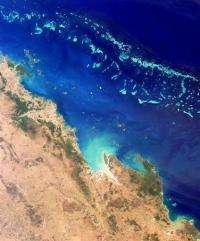
September 2, 2009 The reef is one of Australia's top tourist attractions

Enlarge

This file photo shows the 345,000-square-kilometre Great Barrier Reef which runs along the northeastern coast of Australia. Australia's Great Barrier Reef is in serious jeopardy as global warming and chemical runoff threaten to kill marine species and cause serious outbreaks of disease, a report warned.

Australia's Great Barrier Reef is in serious jeopardy as global warming and chemical runoff threaten to kill marine species and cause serious outbreaks of disease, a report warned Wednesday.

The World Heritage-listed reef was already showing the impacts of , with two episodes of mass coral bleaching in the past 10 years, the Marine Park Authority's inaugural reef outlook report said.

"While populations of almost all are intact and there are no records of extinctions, some ecologically important species, such as dugongs, marine turtles, seabirds, black teatfish and some sharks, have declined significantly," the authority wrote.

Coral disease, outbreaks of toxic blue-green algae and infestation by pestilent species such as the crown-of-thorns starfish appeared to be becoming more frequent and more serious, it added.

The 345,000-square-kilometre (133,000-square-mile) attraction had deteriorated significantly since European settlement in 1788 and was at a "crossroads", the report warned.

"Almost all the biodiversity of the will be affected by climate change, with coral reef habitats the most vulnerable," the report said.

"Coral bleaching resulting from increasing and lower rates of calcification in skeleton-building organisms such as corals because of , are the effects of most concern and are already evident."

The runoff of nitrogen-based pesticides from local farming areas was a particular concern, the report said, adding that their impact remained "largely unknown".

Environment Minister Peter Garrett said the report showed strong decisive action needed to be taken, and pledged to halve agricultural runoff by 2013 and to reduce sediment loads by 20 percent by 2020.

"Improving the quality of water flowing into the reef is one of the most important things we can do to help the reef withstand the impacts of climate change," Garrett said.

Australia's centre-left government has already pledged 52 million dollars (42 million US) to improve water quality on the reef.

It has also agreed to cut greenhouse gas emissions to 25 percent of 2000 levels by 2020 if world leaders sign up to an ambitious reduction goal in Copenhagen in December.

Without an agreement, Australia's target will remain unchanged at five percent.

(c) 2009 AFP


print this article email this article download pdf blog this article bookmark this article     Stumble it Digg this share on Facebook retweet share on Reddit add to delicious
Rate this story - 3.4 /5 (10 votes)

Rank Filter

Move the slider to adjust rank threshold, so that you can hide some of the comments.


Display comments: newest first

  • dachpyarvile - Sep 06, 2009
    • Rank: not rated yet
    They are on the right track as far as cutting agricultural chemical run-off. They are not on track for reducing CO2 emissions. Corals thrived in oceans when the CO2 levels were in the 1000s ppm. Why should we expect that they will bleach out and die with our pitifully low CO2 levels today?

    Besides, there is another problem looming on the horizon for mankind's descendants in somewhere between a million and a billion years. If our CO2 levels are not high enough (meaning twice as much as now in the atmosphere) by that time, the Sun will blast the oceans into space and all life as we know it will die and smolder under a Sun with a 30% higher radiative force!

    Increasing CO2 levels is the easiest way to prevent that fate and it does not add cost to what we already are doing.

September 2, 2009 all stories

Comments: 1

3.4 /5 (10 votes)
  • Stumble this up

  • Digg this

  • share this

  • hide
  • Related Stories

  • Scientists to unlock Great Barrier Reef genome
    created Jul 30, 2009 | popularity not rated yet | comments 0
  • Larry's cool change good for reef
    created Mar 22, 2006 | popularity not rated yet | comments 0
  • Scientists: Great Barrier Reef in danger
    created Jan 31, 2006 | popularity not rated yet | comments 0
  • Reef 'at risk in climate change'
    created Apr 06, 2007 | popularity not rated yet | comments 0
  • Fishing ban guards coral reefs against predatory starfish outbreaks
    created Jul 21, 2008 | popularity not rated yet | comments 0


  • hide
  • Relevant PhysicsForums posts

  • Which countries around the world cause the most destruction to the rain forest
    created 12 hours ago
  • HadleyCru data hacked
    created Nov 20, 2009
  • Younger Dryas Caused by Ice Dam Collapse?
    created Nov 17, 2009
  • Modeling rainfall and flooding
    created Nov 15, 2009
  • More from Physics Forums - Earth

Other News

Baby can wait as expectant dad finishes spacewalk (AP)

Baby can wait as expectant dad finishes spacewalk

Space & Earth / Space Exploration

created 11 hours ago | popularity 3 / 5 (2) | comments 0

(AP) -- A spacewalking astronaut put aside the impending birth of his daughter and blazed through his first-ever venture outside the International Space Station on Saturday.


Unseasonably hot and dry weather combined with strong winds to fan scores of blazes in the country's southeastern states

Australia issues 'catastrophic' alerts as fires rage

Space & Earth / Environment

created 17 hours ago | popularity 4 / 5 (3) | comments 0

Australia has issued "catastrophic" alerts after record-breaking temperatures and wild lightning storms sparked more than 100 fires across the country, officials said Saturday.


Commuters wait on the platform shrouded by fog in London

Climate change not man-made, say majority of Britons: poll

Space & Earth / Environment

created Nov 15, 2009 | popularity 3.3 / 5 (15) | comments 46

Less than half of Britons believes that human activity is to blame for global warming, according to a poll carried out for The Times newspaper and published on Saturday.


Mysteriously warm times in Antarctica

Mysteriously warm times in Antarctica

Space & Earth / Earth Sciences

created Nov 18, 2009 | popularity 4.2 / 5 (21) | comments 28

(PhysOrg.com) -- A new study of Antarctica's past climate reveals that temperatures during the warm periods between ice ages (interglacials) may have been higher than previously thought. The latest analysis ...


UN: Fight climate change with free condoms (AP)

UN: Fight climate change with free condoms

Space & Earth / Environment

created Nov 18, 2009 | popularity 3.1 / 5 (11) | comments 24

(AP) -- The battle against global warming could be helped if the world slowed population growth by making free condoms and family planning advice more widely available, the U.N. Population Fund said Wednesday.