Scientists to work on non-volatile 'universal memory' devices in new clean room facility
September 2, 2009 New Southampton clean room to push the boundaries of technology

Enlarge

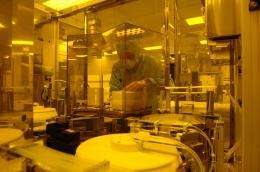
New Mountbatten Building clean room, University of Southampton

The University of Southampton’s Southampton Nanofabrication Centre, which opens next week (9 September), will make it possible to manufacture high-speed and non-volatile 'universal memory' devices for industry within 5 years. 

According to Dr Yoshishige Tsuchiya from the Nano Group at the University's School of Electronics & Computer Science, the Nano electromechanical systems (NEMS) available within the new clean room will make high-speed, non-volatile and low-power computer memory a reality. 'This high-speed, non-volatile and low-power NEMS memory will be suitable for pen drive devices for PCs and mobile applications and will mean that computers will warm up immediately when switched on and will have a ‘sleep’ switch to conserve energy,’ said Dr Tsuchiya. 

Working with Professor Hiroshi Mizuta in the Nano Group, Dr Tsuchiya will combine conventional silicon technology with the NEMS concept. ‘In the clean room, we will have both conventional equipment and new facilities such as Electron Beam Lithography and Focused Ion Beam, which we will use to fabricate the new ,’ Dr Tsuchiya added. 

The academics also plan to use the new equipment to do what they call “More than Moore” and “Beyond CMOS” (Complementary metal-oxide-semiconductor).  The former involves integrating nanoelectromechanical Systems (NEMS) into conventional electronic devices to create advanced switch, memory and sensor devices, while the latter involves working on quantum information devices based on single-electron and single-spin device technology which could realize massively-parallel information processing.

 ‘I believe that if we adopt unique properties of well-controlled silicon nanostructures and co-integration with other emerging technologies such as NEMS, nanophotonics and nanospintronics, we can develop extremely functional information processing devices, faster than anything we could ever have imagined with just conventional technologies,’ Professor Mizuta said.

Source: University of Southampton


print this article email this article download pdf blog this article bookmark this article     Stumble it Digg this share on Facebook retweet share on Reddit add to delicious
Rate this story - 2.5 /5 (2 votes)


September 2, 2009 all stories

Comments: 0

2.5 /5 (2 votes)
  • Stumble this up

  • Digg this

  • share this

  • hide
  • Related Stories

  • Researchers develop bistable nano switch
    created Oct 13, 2006 | popularity not rated yet | comments 0
  • Epson and Fujitsu Announce Joint Development of Next-Generation Technology for FRAM Non-Volatile Memory
    created Jun 15, 2005 | popularity not rated yet | comments 0
  • The clear future of electronics
    created Dec 09, 2008 | popularity not rated yet | comments 0
  • Silicon nanowires upgrade data-storage technology
    created Jun 09, 2007 | popularity not rated yet | comments 0
  • Freescale manufactures world's first 24-Mbit silicon nanocrystal memory
    created Nov 28, 2005 | popularity not rated yet | comments 0


  • hide
  • Relevant PhysicsForums posts

  • photoconductivity of polymers
    created 1hour ago
  • Heat pipe for high temperature
    created 13 hours ago
  • Robot built out of acrylic
    created 22 hours ago
  • Thickness or Ga. of Stainless steel water tank?
    created Nov 24, 2009
  • More from Physics Forums - Materials & Chemical Engineering

Other News

Fast, easy, and highly sensitive arsenic detection with gold nanoparticles

Nanotechnology / Nanomaterials

created 8 hours ago | popularity 5 / 5 (1) | comments 0

(PhysOrg.com) -- Mention of arsenic poisoning usually brings to mind underhanded murder. However, the danger of arsenic poisoning from contaminated drinking water is far greater. Low concentrations of arsenic are found in ...


Nanotech in Space: Experiment To Weather the Trials of Orbit

Nanotech in Space: Experiment To Weather the Trials of Orbit

Nanotechnology / Nanomaterials

created 20 hours ago | popularity 4 / 5 (2) | comments 0

Novel nanomaterials developed at Rensselaer were sent into orbit on Nov. 16 aboard Space Shuttle Atlantis.


Water droplets direct self-assembly process in thin-film materials

Nanotechnology / Nanomaterials

created Nov 23, 2009 | popularity 5 / 5 (4) | comments 2

You can think of it as origami - very high-tech origami. Researchers at the University of Illinois have developed a technique for fabricating three-dimensional, single-crystalline silicon structures from thin films by coupling ...


Nanotube defects equal better energy and storage systems

Nanotube defects equal better energy and storage systems

Nanotechnology / Nanomaterials

created Nov 19, 2009 | popularity 4.4 / 5 (10) | comments 2

(PhysOrg.com) -- Most people would like to be able to charge their cell phones and other personal electronics quickly and not too often. A recent discovery made by UC San Diego engineers could lead to carbon ...


Peptides control crystal growth with 'switches, throttles and brakes'

Peptides control crystal growth with 'switches, throttles and brakes'

Nanotechnology / Bio & Medicine

created Nov 23, 2009 | popularity 5 / 5 (3) | comments 0

(PhysOrg.com) -- By producing some of the highest resolution images of peptides attaching to mineral surfaces, scientists have a deeper understanding how biomolecules manipulate the growth crystals. This research ...